

Short Answer
Understanding the Universe’s Hidden Components
The cosmos, a vast and mysterious expanse, has fascinated human curiosity for thousands of years. A profound realization emerges from exploring its depths: the matter we can see constitutes only a tiny portion of the universe’s total mass-energy. This discrepancy has led to the pursuit of what is often called the “missing matter,” now identified in modern astrophysics as dark matter and dark energy. These unseen elements challenge our understanding and inspire ongoing scientific investigation into what lies beyond the observable universe.
Composition of the Universe According to Modern Cosmology
The prevailing cosmological framework, known as the Lambda Cold Dark Matter (ΛCDM) model, depicts a universe composed of various forms of matter and energy. Observations such as the cosmic microwave background radiation and baryon acoustic oscillations reveal that ordinary baryonic matter-comprising stars, planets, and cosmic dust-makes up only about 4% of the universe. In contrast, dark energy constitutes roughly 68%, while dark matter accounts for approximately 27%. Together, these invisible components form the essential structure of the cosmos, much like an intricate tapestry where only a few threads are visible, and the majority remain hidden.
Defining Dark Matter
Dark matter is a form of matter that does not emit, absorb, or reflect light, making it undetectable through electromagnetic means. Its presence is inferred solely through gravitational effects on visible matter, radiation, and the large-scale structure of the universe.
- Gravitational Influence:
Dark matter exerts gravitational forces that affect the motion of stars and galaxies, despite being invisible. - Galactic Rotation Curves:
Observations show that stars in galaxies orbit at nearly constant speeds regardless of their distance from the center, contradicting Newtonian predictions and implying the existence of unseen mass. - Role in Structure Formation:
Dark matter’s gravity is crucial for the formation and evolution of galaxies and galaxy clusters over billions of years.
Exploring Dark Energy
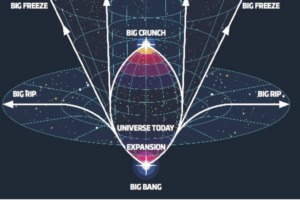
Dark energy is an enigmatic force responsible for the accelerated expansion of the universe. Unlike dark matter, it acts as a repulsive energy permeating space, pushing galaxies apart.
- Cosmic Acceleration:
Discovered in the late 1990s through observations of distant supernovae, dark energy causes the universe’s expansion rate to increase over time. - Possible Explanations:
Theories include the cosmological constant (a constant energy density filling space), dynamic scalar fields (quintessence), and modifications to gravity itself. - Philosophical Implications:
Dark energy challenges our understanding of space, time, and the fundamental forces governing the cosmos.
Mechanisms Behind Dark Matter and Dark Energy
While dark matter interacts primarily through gravity, its exact nature remains unknown. Candidates include weakly interacting massive particles (WIMPs), axions, and sterile neutrinos. Experimental efforts aim to detect these particles directly or indirectly using sophisticated detectors and particle accelerators.
Dark energy theories vary widely, from a simple cosmological constant to more complex models involving evolving fields or alterations to general relativity. Each approach offers a different perspective on the universe’s accelerated expansion and may lead to groundbreaking shifts in physics.
Mathematical Framework and Cosmological Parameters
The ΛCDM model mathematically describes the universe’s composition and evolution using parameters such as:
- Ωb (Baryon Density Parameter): Represents the fraction of the universe’s energy density made up of ordinary matter (~4%).
- Ωc (Cold Dark Matter Density Parameter): Denotes the proportion attributed to dark matter (~27%).
- ΩΛ (Dark Energy Density Parameter): Accounts for the dark energy component (~68%).
The Friedmann equations govern the expansion dynamics, incorporating these parameters to model cosmic evolution.
Practical Examples in Astronomy and Cosmology
Dark matter’s influence is evident in the behavior of galaxy clusters, gravitational lensing effects, and the cosmic web’s large-scale structure. Dark energy’s impact is observed in the accelerating recession of distant galaxies and the changing rate of cosmic expansion measured through supernovae and the cosmic microwave background.
Common Misunderstandings About Dark Matter and Dark Energy
- Misconception: Dark matter is just ordinary matter that is hidden.
Correction: Dark matter is fundamentally different from baryonic matter and does not interact electromagnetically, making it invisible to traditional detection methods. - Misconception: Dark energy is a form of matter.
Correction: Dark energy is not matter but a property of space causing accelerated expansion, acting as a repulsive force rather than a gravitational attractor.
Significance of Dark Matter and Dark Energy in Science and Daily Life
Understanding dark matter and dark energy is crucial for comprehending the universe’s origin, structure, and ultimate fate. These components influence galaxy formation, cosmic evolution, and the fundamental laws of physics. Their study bridges astrophysics, particle physics, and philosophy, enriching our grasp of existence and inspiring technological advancements in observational and experimental methods.
Conclusion: The Ongoing Journey to Unveil Cosmic Mysteries
The investigation into the universe’s missing matter epitomizes humanity’s relentless quest for knowledge. As observational techniques, computational models, and particle physics experiments advance, the veil over dark matter and dark energy gradually lifts. This pursuit not only deepens our scientific understanding but also connects us to the profound mysteries of the cosmos, fueling an enduring journey toward enlightenment amid the universe’s vast and shadowy expanse.
FAQ
What is dark matter?
Dark matter is a form of matter that does not emit or interact with electromagnetic radiation but exerts gravitational influence on visible matter.
How does dark energy affect the universe?
Dark energy causes the accelerated expansion of the universe by acting as a repulsive force on cosmic scales.
What evidence supports the existence of dark matter?
Observations such as galaxy rotation curves and gravitational lensing indicate mass that cannot be accounted for by visible matter alone.
Why is the missing matter important in cosmology?
It explains the formation and evolution of cosmic structures and the universe's expansion dynamics.
Are there ongoing experiments to detect dark matter?
Yes, experiments using particle detectors and colliders aim to directly or indirectly observe dark matter particles.
Leave a Reply