
Short Answer
Understanding Braid Theory
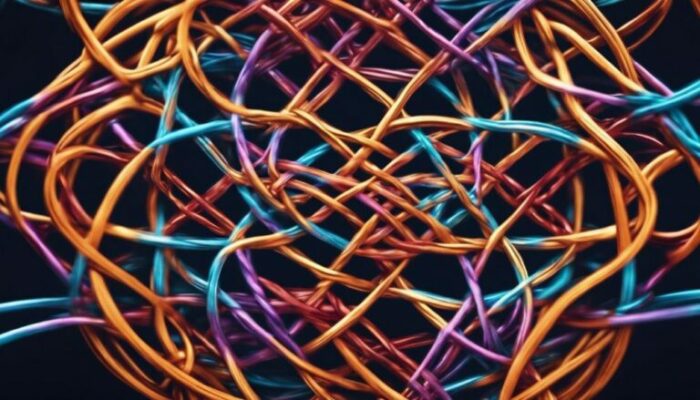
Braid theory is a branch of mathematics that investigates the properties and classifications of braids-intertwined strands that can be manipulated without severing. At its core, a braid consists of several strands twisted in specific patterns, which can be studied through combinatorial and topological methods. Despite the apparent simplicity of braids, their structural complexity gives rise to rich mathematical challenges and insights. This theory provides a concrete, visual framework to represent abstract mathematical ideas, making it a valuable tool in various scientific fields.
Quantum Computing: An Overview
Quantum computing represents a revolutionary paradigm in computation, leveraging the principles of quantum mechanics to process information. The fundamental unit of quantum information is the qubit, which, unlike a classical bit restricted to states 0 or 1, can exist in a superposition of both states simultaneously. This property enables quantum computers to perform certain calculations exponentially faster than classical machines. However, the mathematical description of qubit interactions, especially when entangled, is highly complex and requires sophisticated theoretical frameworks.
The Intersection of Braids and Quantum Computing
The convergence of braid theory and quantum computing arises from the need to model and manipulate entangled quantum states. When qubits become entangled, their states are interdependent, such that the state of one cannot be fully described without the other. This intricate relationship can be represented through braid diagrams in three-dimensional space, where each braid corresponds to a unique quantum state evolution during computation.
Topological Quantum Computing and Anyons
One of the most direct applications of braid theory in quantum computing is found in topological quantum computing. This model exploits anyons-quasi-particles that exist in two-dimensional systems with exotic statistical properties. The braiding of anyons encodes quantum information, with each braid representing a qubit state. A key advantage of this approach is its robustness against decoherence, a major challenge in quantum systems caused by environmental disturbances. The topological nature of braids provides intrinsic protection, preserving quantum coherence and enhancing computational stability.
Quantum Gates Through Braiding
Quantum gates, the fundamental operations in quantum circuits, can be implemented by manipulating braids. Each braid corresponds to a specific logical operation on qubits, enabling deterministic transformations of quantum states. Although braid structures may appear complex, their function is to execute precise quantum operations that drive the computational process forward. This method offers a novel way to design and control quantum algorithms through topological means.
Fault Tolerance and Error Correction in Braided Quantum Systems
As quantum computers scale up, error management becomes critical. Braiding operations exhibit non-local characteristics that inherently resist noise and errors. The interplay of different braids can encode error-correcting mechanisms, contributing to fault-tolerant quantum computation. This resilience not only improves performance but also deepens our understanding of quantum information, highlighting the abstract yet practical nature of braids in maintaining computational integrity.
Philosophical and Scientific Implications
Braid theory’s role in quantum computing extends beyond technical applications, inviting profound reflections on the relationship between mathematics and physical reality. The use of braids to model quantum phenomena challenges traditional conceptual boundaries, suggesting that physical processes and mathematical structures are deeply intertwined. This perspective encourages a reevaluation of how we define information and computation in the quantum realm, bridging abstract theory with tangible technological advancements.
Summary and Future Directions
The integration of braid theory into quantum computing opens promising pathways for both theoretical exploration and practical innovation. By linking braids with qubit behavior, researchers gain powerful tools to visualize entanglement, implement quantum gates, and enhance fault tolerance. As the field advances, ongoing research is expected to uncover further connections between mathematical topology and quantum mechanics, enriching our comprehension of the universe’s fundamental workings and propelling the development of next-generation quantum technologies.
FAQ
What is braid theory?
Braid theory is a branch of knot theory that studies the properties and manipulations of braided strands without cutting them.
How does braid theory apply to quantum computing?
In quantum computing, braid theory models the entanglement and manipulation of qubits, particularly in topological quantum computers where braiding anyons encodes quantum information.
What is topological quantum computing?
Topological quantum computing uses braiding of anyons in two-dimensional space to create qubits that are inherently protected from certain types of errors.
Why are braids important for fault tolerance?
Braids encode quantum operations in a topologically protected way, making the quantum information more resilient to noise and decoherence.
What challenges do braids address in quantum computing?
Braids help manage the complexity of quantum state interactions, enable robust quantum gate implementations, and provide error correction capabilities.






Leave a Reply