
Short Answer
Overview of Microsoft’s Quantum Computing Initiatives
Microsoft is a leading force in the rapidly evolving domain of quantum computing, driving innovations that promise to transform traditional computational frameworks. By merging principles of quantum mechanics with computational theory, Microsoft’s projects have far-reaching implications across diverse sectors such as cryptography, material science, and beyond. This article explores the breadth of Microsoft’s quantum chip developments, emphasizing their technical depth and the widespread excitement they generate within the scientific community.
Definition and Core Components of Microsoft’s Quantum Ecosystem
Microsoft’s quantum computing efforts revolve around several key components designed to facilitate the development and deployment of quantum technologies.
- Quantum Development Kit (QDK):
A comprehensive toolkit that supports the creation and simulation of quantum algorithms, enabling developers to design and test quantum programs efficiently. - Q# Programming Language:
A specialized language crafted specifically for quantum programming, allowing users to express quantum operations on qubits-quantum bits capable of existing in multiple states simultaneously, unlike classical bits. - Topological Qubits:
An advanced qubit design based on exotic particles called anyons, which exist in two-dimensional spaces and whose braiding properties help protect quantum information from errors. - Azure Quantum Platform:
A cloud-based service that democratizes access to quantum computing resources, enabling researchers and professionals to develop and optimize quantum algorithms without needing physical quantum hardware.
How Microsoft’s Quantum Technologies Function
At the core of Microsoft’s quantum strategy is the use of qubits, which differ fundamentally from classical bits by existing in superpositions of states. This property allows quantum computers to process complex computations more efficiently. The QDK and Q# language provide a framework for programming these qubits, abstracting the complexities of quantum mechanics into manageable code.
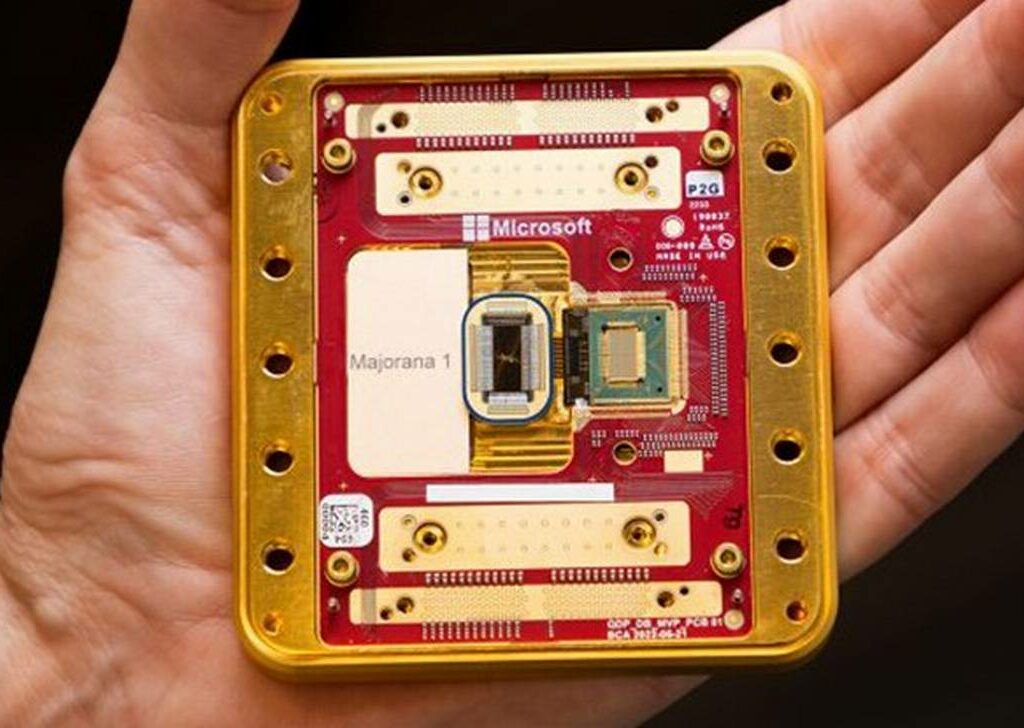
Topological qubits, a centerpiece of Microsoft’s hardware approach, leverage the unique properties of anyons. By braiding these particles in two-dimensional planes, quantum information becomes inherently protected from environmental noise and decoherence, a major obstacle in quantum computing. This fault-tolerant design aims to create stable quantum systems capable of practical computation.
Azure Quantum extends this capability by offering cloud access to quantum simulators and hardware from various providers, fostering collaboration and accelerating algorithm development without the need for costly quantum devices.
Mathematical and Theoretical Foundations
The operation of quantum computers can be described mathematically using quantum mechanics principles. Qubits are represented as vectors in a complex Hilbert space, and their states are manipulated using unitary transformations.
Quantum State Representation:
[
|psirangle = alpha|0rangle + beta|1rangle
]
Here, (|psirangle) denotes the state of a qubit, with (alpha) and (beta) as complex probability amplitudes satisfying (|alpha|^2 + |beta|^2 = 1).
Topological Qubits and Anyons:
The braiding of anyons corresponds to unitary operations on the quantum state, which can be mathematically modeled by representations of the braid group. This topological approach provides robustness against local perturbations, reducing error rates.
Collaborative Research and Specialized Projects
Microsoft actively partners with academic institutions to push the boundaries of quantum research. These collaborations focus on areas such as quantum algorithms, quantum machine learning, and quantum cryptography, each with transformative potential:
- Quantum Machine Learning:
Enhances data processing speeds and capabilities beyond classical limits, with applications in finance, healthcare, and more. - Quantum Cryptography:
Develops secure communication protocols leveraging quantum principles to safeguard data against future cyber threats.
Additionally, the Møller project investigates the interaction between quantum systems and classical environments, aiming to improve noise resilience and stability in quantum devices. This research is crucial for creating quantum technologies that can operate reliably in real-world conditions.
Emerging Quantum Technologies at Microsoft
Microsoft’s quantum research extends into several cutting-edge areas:
- Quantum Sensors:
Devices that exploit quantum phenomena to achieve ultra-precise measurements, potentially revolutionizing fields like gravitational wave detection and high-resolution imaging. - Quantum Internet:
A visionary communication network utilizing quantum entanglement and superposition to enable ultra-secure data transmission, promising to redefine cybersecurity and global communications.
Challenges in Quantum Chip Development
Despite significant progress, building functional quantum chips remains a formidable challenge. Qubits are inherently fragile and susceptible to decoherence, which disrupts quantum information. Overcoming these issues requires advanced materials science, innovative fabrication techniques, and sophisticated error correction methods. The complexity of maintaining stable quantum states not only tests engineering capabilities but also invites deeper philosophical questions about the nature of computation and reality.
Significance and Future Impact
Microsoft’s diverse quantum projects represent a fusion of theoretical insight and practical innovation, contributing substantially to the advancement of quantum computing. By developing scalable, fault-tolerant quantum systems and accessible platforms like Azure Quantum, Microsoft is helping to transition quantum computing from theoretical exploration to real-world application. These efforts have the potential to revolutionize industries, enhance scientific understanding, and reshape technological landscapes, underscoring the profound importance of quantum research in contemporary science and technology.
FAQ
What is Microsoft’s Quantum Development Kit (QDK)?
The Quantum Development Kit is a set of tools including the Q# programming language designed to help developers create quantum algorithms.
Why are topological qubits significant?
Topological qubits offer robustness against decoherence, making them promising for building fault-tolerant quantum computers.
What services does Azure Quantum provide?
Azure Quantum offers cloud-based access to quantum computing resources for experimentation and algorithm development.
What is the goal of the Møller project?
To explore quantum-classical system interactions and improve noise resilience in quantum devices.
How do quantum sensors impact scientific research?
They enable highly precise measurements that can advance fields like gravitational wave detection and imaging.






Leave a Reply