
Short Answer
Definition of Fundamental Nuclear Forces
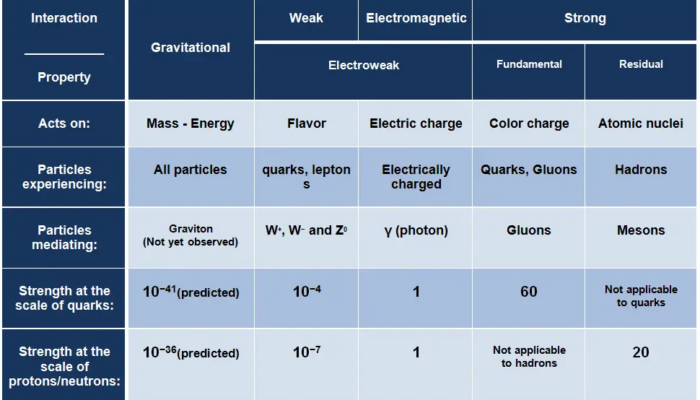
The universe operates under a handful of fundamental forces that govern interactions at all scales. Among these, the strong nuclear force and the weak nuclear force are essential in shaping the behavior of atomic and subatomic particles. Each force exhibits unique properties and effects, playing vital roles in phenomena ranging from the stability of atomic nuclei to radioactive decay and particle transformations.
The Strong Nuclear Force: Nature and Role
Recognized as the most powerful among the four fundamental forces, the strong nuclear force exerts an immense influence over extremely short distances, approximately one femtometer (10-15 meters), which corresponds to the size of atomic nuclei. This force is responsible for binding quarks together to form protons and neutrons, the fundamental constituents of atomic nuclei.
Quantum Chromodynamics and Color Charge
Quarks possess a unique property called “color charge,” which comes in three varieties: red, green, and blue. Unlike electric charge, color charge is the source of the strong interaction, described by the theory of quantum chromodynamics (QCD). In QCD, gluons act as the exchange particles that mediate the strong force by transferring color charge between quarks. This interaction confines quarks within composite particles such as protons and neutrons, a phenomenon known as confinement.
Binding Protons and Neutrons in the Nucleus
Within the nucleus, protons and neutrons are held together despite the electromagnetic repulsion between positively charged protons. The residual strong force overcomes this repulsion, ensuring nuclear cohesion and stability. The energy associated with this binding, called binding energy, is released during nuclear reactions like fission and fusion, powering stars and nuclear reactors alike.
The Weak Nuclear Force: Characteristics and Effects
In contrast to the strong force, the weak nuclear force operates over a slightly longer range and is responsible for processes that change the identity of particles. Mediated by the W and Z bosons, the weak force enables phenomena such as beta decay, where a neutron converts into a proton or vice versa, accompanied by the emission of a beta particle (electron or positron) and a neutrino.
Particle Transformation and Flavor Change
The weak interaction uniquely allows quarks to change their “flavor,” meaning one type of quark can transform into another. This capability underpins the transmutation of elements and plays a crucial role in the synthesis of elements in the universe. The weak force’s influence extends to cosmological scales by affecting elemental abundances and contributing to the evolution of matter in the cosmos.
Comparative Overview: Strong vs. Weak Nuclear Forces
Though both forces are fundamental to the structure and behavior of matter, they differ markedly in strength, range, and function. The strong force is immensely powerful but confined to subatomic distances, ensuring the cohesion of quarks and nucleons. Conversely, the weak force, while much weaker, facilitates particle transformations over a slightly larger scale, driving processes that alter the composition of matter.
- Range:
Strong force acts within approximately 1 femtometer; weak force extends slightly beyond this but remains short-ranged. - Strength:
The strong force is the most potent fundamental interaction; the weak force is significantly weaker. - Function:
Strong force binds quarks and nucleons; weak force enables particle decay and flavor changes.
Interplay in Astrophysical Phenomena
The interaction between these forces is fundamental to stellar processes. The strong force binds nuclei during nucleosynthesis, while the weak force governs the beta decay reactions that facilitate fusion in stars. This synergy is essential for the formation of elements and the energy production that sustains stars and, by extension, life.
Mathematical Framework and Theoretical Foundations
The strong force is mathematically described by quantum chromodynamics (QCD), which uses the SU(3) gauge symmetry to model color charge interactions. Gluons, the force carriers, are represented as gauge bosons mediating the exchange of color charge between quarks.
The weak force is formulated within the electroweak theory, unifying electromagnetic and weak interactions under the SU(2) × U(1) gauge group. The W± and Z0 bosons are massive gauge bosons responsible for mediating weak interactions, with their masses explaining the short range of the weak force.
Real-World Applications and Examples
- Nuclear Energy:
The strong force’s binding energy is harnessed in nuclear reactors and atomic bombs through fission and fusion reactions. - Radioactive Decay:
Beta decay, governed by the weak force, is used in medical imaging and radiometric dating techniques. - Stellar Processes:
Both forces are integral to the life cycle of stars, influencing element formation and energy generation.
Common Misunderstandings About Nuclear Forces
- Misconception: The strong force acts over large distances.
Correction: The strong force is extremely short-ranged, effective only within atomic nuclei. - Misconception: The weak force is unimportant due to its low strength.
Correction: Despite its relative weakness, the weak force is crucial for particle transformations and nuclear processes. - Misconception: The strong and weak forces are similar in function.
Correction: They serve fundamentally different roles-binding particles versus enabling decay and transformation.
Significance of Strong and Weak Forces in Science and Technology
Understanding the strong and weak nuclear forces is pivotal for advancements in particle physics, nuclear energy, and cosmology. These forces explain the stability of matter, the mechanisms behind radioactive decay, and the processes fueling stars. Moreover, ongoing research into their unification and relationship with gravity could unlock deeper insights into the fundamental laws governing the universe, influencing future technologies and theoretical physics.
FAQ
What is the strong nuclear force?
The strong nuclear force is the most powerful fundamental force, binding quarks and nucleons within atomic nuclei.
What role does the weak nuclear force play?
The weak nuclear force is responsible for particle decay and transformations, allowing particles to change identity.





Leave a Reply