
Short Answer
Definition of Quarks
Quarks are fundamental particles that constitute the basic building blocks of matter. They combine to form protons and neutrons, which in turn make up the nuclei of atoms. As elementary fermions, quarks are unique in their fractional electric charges and intrinsic properties, playing a pivotal role in the structure and behavior of the universe at the subatomic scale.
- Elementary Particles:
Quarks are not composed of smaller particles and belong to the fermion family, which obeys the Pauli Exclusion Principle. - Fractional Electric Charge:
Unlike electrons or protons, quarks carry fractional charges of either +2/3 or -1/3. - Flavors:
There are six distinct types of quarks: up, down, charm, strange, top, and bottom, each with unique masses and interaction characteristics.
Classification and Properties of Quarks
Quarks are categorized by their flavor, electric charge, mass, and color charge. The six flavors differ significantly in mass and stability, with the up and down quarks being the lightest and most abundant in ordinary matter.
- Up Quark:
Carries a charge of +2/3 and is one of the primary constituents of protons and neutrons. - Down Quark:
Has a charge of -1/3 and pairs with up quarks to form nucleons. - Heavy Quarks:
Charm, strange, top, and bottom quarks are heavier and less stable, typically appearing in high-energy environments.
Quark Combinations and Matter Formation
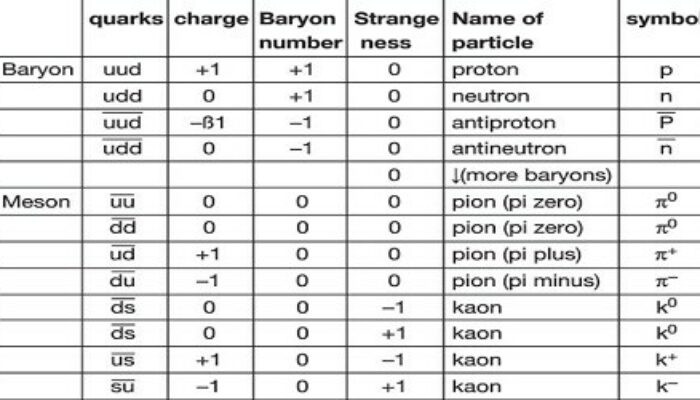
Protons and neutrons, collectively known as baryons, are formed by specific combinations of quarks. For example, a proton consists of two up quarks and one down quark (uud), while a neutron is made up of one up quark and two down quarks (udd). These combinations are fundamental to the existence of atomic nuclei and, consequently, all visible matter.
Mass Variations Among Quarks
The masses of quarks vary dramatically, influencing the properties of the particles they compose. Up and down quarks have relatively small masses-approximately 2.2 MeV/c² and 4.7 MeV/c² respectively-making them lightweight compared to their heavier counterparts. The top quark is the heaviest, with a mass near 173 GeV/c², highlighting the vast scale differences within the quark family. These mass differences are crucial for the stability and dynamics of matter.
Strong Interaction and Color Charge
Quarks are bound together by the strong nuclear force, mediated by gluons. This force is unique due to the concept of color charge, an abstract property analogous to electric charge but related to the strong interaction.
- Gluons:
Massless particles that act as carriers of the strong force, binding quarks within hadrons. - Color Charge:
Quarks possess one of three color charges-red, green, or blue-while gluons carry combinations of color and anti-color, ensuring quarks remain confined. - Color Confinement:
This principle prevents quarks from existing freely, forcing them to remain within composite particles such as protons and neutrons.
Quantum Chromodynamics (QCD)
Quantum Chromodynamics is the theoretical framework describing the interactions between quarks and gluons. It explains how the strong force operates, including the phenomenon of color confinement, where the force becomes stronger as quarks move closer together, preventing their isolation.
Flavor-Changing Interactions and the Weak Force
Quarks can change from one flavor to another through weak interactions, mediated by W and Z bosons. This process is essential in nuclear reactions such as beta decay, where a down quark transforms into an up quark, converting a neutron into a proton and emitting a W- boson.
Experimental Evidence and Particle Colliders
High-energy experiments, particularly those conducted at particle accelerators like the Large Hadron Collider (LHC), have been instrumental in confirming the existence and properties of quarks. These experiments have also led to the discovery of the Higgs boson, which provides insight into how particles, including quarks, acquire mass through their interaction with the Higgs field.
Significance of Quarks in Physics and the Universe
Quarks are more than mere constituents of matter; they embody the complexities of fundamental forces and symmetries that govern the universe. Understanding quarks deepens our knowledge of particle physics, informs the study of nuclear reactions, and opens pathways to exploring phenomena such as dark matter and the ultimate fate of the cosmos.
Common Misconceptions About Quarks
Quarks can exist freely outside of particles.
Due to color confinement, quarks are always bound within hadrons and cannot be isolated under normal conditions.
All quarks have the same mass.
Quark masses vary widely, from very light up and down quarks to the extremely heavy top quark.
Conclusion
Quarks are fundamental to the composition and behavior of matter, linking theoretical physics with experimental discoveries. Their diverse properties and interactions form the foundation of the visible universe, inspiring ongoing research and expanding our understanding of the natural world.
FAQ
Can quarks exist freely outside of particles?
No, due to color confinement, quarks are always bound within hadrons like protons and neutrons and cannot be isolated under normal conditions.
What are the different flavors of quarks?
There are six flavors of quarks: up, down, charm, strange, top, and bottom, each with distinct properties.
How do quarks acquire mass?
Quarks acquire mass through their interaction with the Higgs field, as explained by the discovery of the Higgs boson.
What role do quarks play in the structure of matter?
Quarks combine to form protons and neutrons, which make up atomic nuclei and thus all visible matter.
What is Quantum Chromodynamics?
Quantum Chromodynamics (QCD) is the theory describing the strong interaction between quarks and gluons, including phenomena like color confinement.






Leave a Reply