
Short Answer
Definition of Covalent Bonding
Covalent bonding is a core principle in chemistry where atoms achieve stability by sharing pairs of electrons. This type of bond primarily occurs between nonmetal atoms, which tend to have high electronegativity values, meaning they strongly attract shared electrons. Through this electron sharing, atoms fill their outermost electron shells, leading to the formation of stable molecules.
Atoms Involved in Covalent Bond Formation
The atoms that typically participate in covalent bonding are mainly nonmetals found in specific groups of the periodic table. These include elements from Groups 14 to 17, each exhibiting unique bonding capabilities based on their valence electron configurations.
- Group 14 Elements:
Carbon, silicon, germanium, and tin are notable for their ability to form stable covalent bonds. Carbon, in particular, is tetravalent, meaning it can form four covalent bonds, enabling the creation of a vast array of molecular structures ranging from simple hydrocarbons to complex biomolecules like proteins and nucleic acids. Silicon shares similar bonding traits, contributing to the formation of silicates and silicones, which are vital in both organic and inorganic chemistry. - Group 15 Elements:
Nitrogen and phosphorus are prominent covalent bond formers. Nitrogen can establish up to three covalent bonds and plays a crucial role in synthesizing amino acids and nucleotides, essential components of life. Phosphorus can form up to five covalent bonds in certain compounds and is a key element in DNA’s sugar-phosphate backbone. - Group 16 Elements:
Oxygen and sulfur exemplify covalent bonding with oxygen typically forming two bonds, essential for processes like combustion and cellular respiration. Molecules such as water (H₂O) and carbon dioxide (CO₂) are fundamental to life. Sulfur can form up to six covalent bonds in various allotropes and compounds, contributing to important biological molecules including amino acids and vitamins. - Group 17 Elements (Halogens):
Fluorine, chlorine, bromine, and iodine usually form one covalent bond, often resulting in diatomic molecules like F₂ and Cl₂. These halogens also combine with other nonmetals to create organic halides, which have significant roles in both synthetic chemistry and natural processes. - Metalloids:
Certain metalloids such as boron and arsenic also engage in covalent bonding. Boron, despite being electron-deficient, forms covalent bonds with nonmetals and is important in various chemical reactions, contributing to advanced materials in electronics and ceramics.
Mechanism of Covalent Bonding
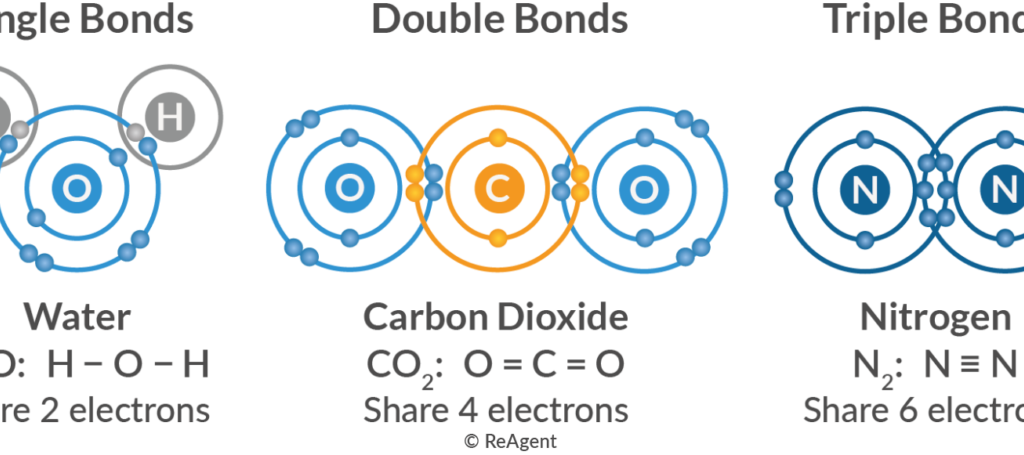
Covalent bonds form when two atoms share one or more pairs of electrons to fill their valence shells, achieving a more stable electronic configuration. The strength and type of covalent bond depend on the number of shared electron pairs:
- Single Bond: Sharing one pair of electrons.
- Double Bond: Sharing two pairs of electrons.
- Triple Bond: Sharing three pairs of electrons.
This sharing leads to the creation of molecules with diverse structures and properties, influencing their chemical behavior and physical characteristics.
Molecular Geometry and Bonding Theories
The spatial arrangement of atoms in a molecule, dictated by covalent bonding, is crucial for understanding molecular properties. The Valence Shell Electron Pair Repulsion (VSEPR) theory explains how electron pairs around a central atom repel each other, shaping the molecule’s geometry. This geometry affects reactivity, polarity, and intermolecular interactions.
Resonance and Electron Delocalization
In some molecules, a single Lewis structure cannot adequately represent the distribution of electrons. Resonance structures are used to depict the delocalization of electrons across multiple atoms, which enhances molecular stability. A classic example is benzene, where resonance leads to aromaticity, a unique property that influences both the chemical reactivity and physical characteristics of the molecule.
Mathematical Representation of Covalent Bonds
While covalent bonding is primarily described qualitatively, molecular orbital theory provides a quantitative framework. The bond order, which indicates bond strength and stability, can be calculated as:
Bond Order = (Number of bonding electrons – Number of antibonding electrons) / 2
A higher bond order corresponds to stronger bonds, such as triple bonds having a bond order of 3, double bonds 2, and single bonds 1.
Practical Applications and Examples
Covalent bonds are foundational to countless substances and processes:
- Biological Molecules: Proteins, DNA, and carbohydrates rely on covalent bonds for their structure and function.
- Industrial Materials: Silicones and polymers are formed through covalent bonding, enabling diverse applications from electronics to construction.
- Environmental Chemistry: Water and carbon dioxide, both covalently bonded molecules, are essential to life and ecological cycles.
Common Misunderstandings About Covalent Bonds
- Misconception: Covalent bonds only occur between identical atoms.
Correction: Covalent bonds commonly form between different nonmetal atoms, not just identical ones, allowing for a wide variety of compounds. - Misconception: All covalent bonds are equally strong.
Correction: Bond strength varies with bond type; triple bonds are generally stronger than double bonds, which are stronger than single bonds. - Misconception: Covalent bonding cannot involve metalloids.
Correction: Certain metalloids like boron and arsenic do form covalent bonds, contributing to unique chemical properties and materials.
Significance of Covalent Bonding
Covalent bonding is vital for understanding chemical interactions that govern the structure and function of molecules in both living organisms and synthetic materials. It underpins the complexity of organic chemistry, the stability of biological macromolecules, and the development of advanced materials in technology. Mastery of covalent bonding concepts is essential for advancements in fields ranging from medicine to materials science, highlighting its profound impact on science and everyday life.
FAQ
What types of atoms typically form covalent bonds?
Covalent bonds generally form between nonmetal atoms, especially those in Groups 14 to 17 of the periodic table, as well as some metalloids like boron and arsenic.
How do single, double, and triple covalent bonds differ?
They differ by the number of electron pairs shared: single bonds share one pair, double bonds share two pairs, and triple bonds share three pairs of electrons.
Can covalent bonds form between different types of atoms?
Yes, covalent bonds often form between different nonmetal atoms, allowing the creation of a wide variety of compounds.
What role does molecular geometry play in covalent bonding?
Molecular geometry, explained by theories like VSEPR, determines the spatial arrangement of atoms, which affects molecular properties such as polarity and reactivity.






Leave a Reply