
Short Answer
Definition of a Hydrogen Atom
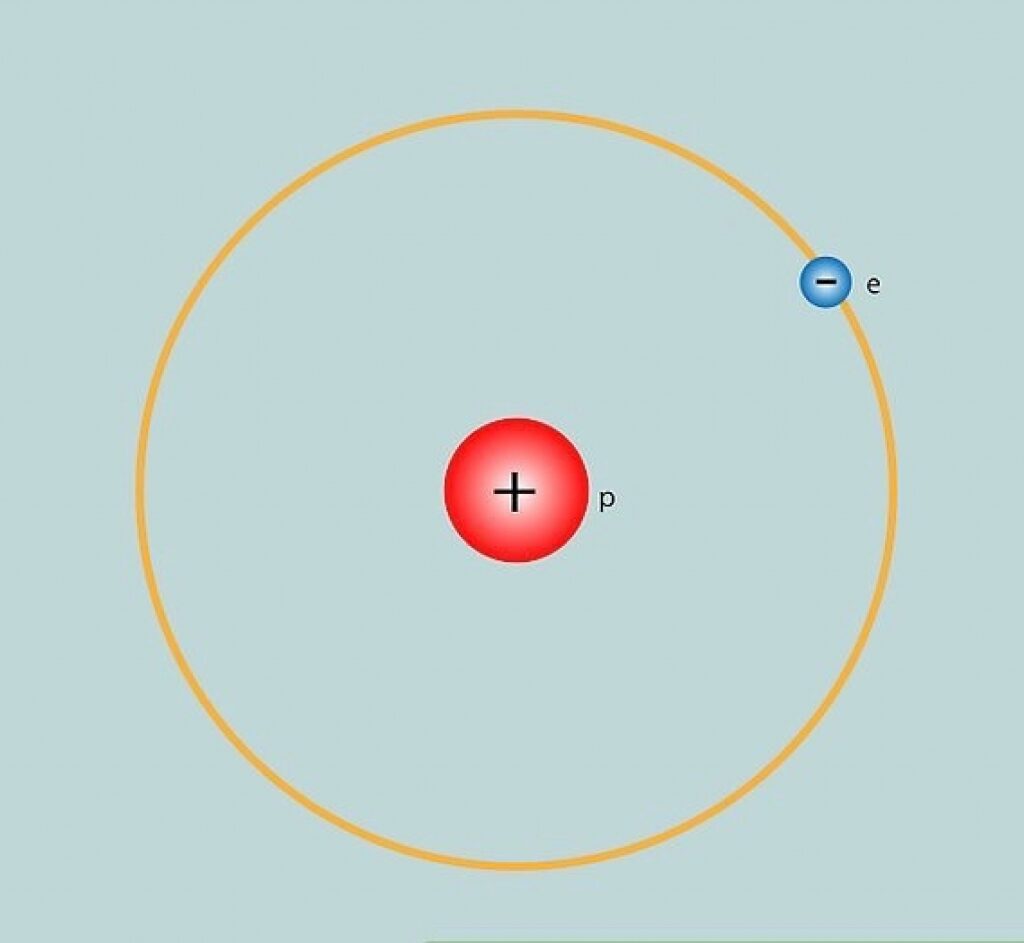
The hydrogen atom is the most basic and plentiful element found throughout the universe. It consists of a single proton at its core, orbited by one electron. This minimalistic atomic structure makes hydrogen a fundamental subject in physics and chemistry, serving as a model for understanding atomic behavior and interactions.
Atomic Composition and Structure
A hydrogen atom is composed of one positively charged proton located in the nucleus and one negatively charged electron occupying the surrounding electron cloud. The balance between these opposite charges results in a neutral atom. This simple configuration exemplifies the fundamental forces of electrostatic attraction and repulsion that dictate atomic stability and interactions.
Existence of Hydrogen Atoms in Isolation
While hydrogen atoms can theoretically exist on their own, they are most commonly found bonded as diatomic molecules (H2) in nature. The formation of H2 molecules is energetically favorable because it releases energy, leading to a more stable state. However, isolated hydrogen atoms do appear in specific high-energy environments, such as stellar atmospheres, where extreme temperatures and pressures prevent molecular bonding.
Quantum Mechanical Perspective on Stability
Quantum mechanics provides a framework for understanding the stability of solitary hydrogen atoms. Electrons occupy quantized energy levels, with the hydrogen electron residing in the lowest energy state known as the ground state. The electron’s position is described by a probability distribution rather than a fixed orbit, and the atom’s stability depends on the surrounding energy conditions and interactions.
Ionization and Its Effects
Hydrogen atoms can lose their electron through ionization, a process triggered by absorbing sufficient energy from heat or light. This results in a free proton and a detached electron, transforming the atom into charged particles. Ionized hydrogen plays a critical role in plasma formation and influences chemical and physical processes in various environments, especially in astrophysics.
Hydrogen in Cosmic Contexts
In the vastness of space, hydrogen atoms often exist independently, particularly in interstellar regions. These atomic hydrogen clouds are essential in the birth of stars and galaxies. Under gravitational forces, isolated hydrogen atoms cool and condense, eventually igniting nuclear fusion reactions that power stars.
Influence of Temperature and Pressure on Hydrogen’s State
The physical state of hydrogen-whether atomic or molecular-is heavily influenced by environmental temperature and pressure. Extremely high temperatures, such as those in stellar cores, favor the presence of individual hydrogen atoms and ionized particles. In contrast, at Earth-like conditions, hydrogen predominantly forms stable diatomic molecules due to intermolecular forces.
Laboratory Techniques for Isolating Hydrogen Atoms
Scientists have developed advanced experimental methods to isolate and study single hydrogen atoms under controlled conditions. Techniques like laser cooling and magnetic trapping enable detailed examination of atomic properties, including electron spin and quantum transitions, deepening our understanding of fundamental atomic physics.
Chemical Reactivity and Molecular Formation
Hydrogen’s chemical behavior is characterized by its high reactivity, which often leads to the formation of molecules. Although it can exist as a free atom, hydrogen readily bonds with electronegative elements, creating compounds such as water (H2O) and hydrocarbons. This dynamic ability to switch between atomic and molecular forms is central to many chemical processes.
Common Misconceptions About Hydrogen Atoms
Hydrogen atoms are always found as isolated atoms.
In natural conditions, hydrogen predominantly exists as diatomic molecules (H2), with isolated atoms appearing mainly in high-energy environments.
Ionized hydrogen is the same as a neutral hydrogen atom.
Ionized hydrogen consists of a proton and a free electron, differing fundamentally from a neutral hydrogen atom in charge and behavior.
Significance of Hydrogen’s Dual Existence
The ability of hydrogen to exist both as a solitary atom and as part of molecules is crucial across multiple scientific domains. In astrophysics, isolated hydrogen atoms are key to star formation and cosmic evolution. In chemistry, hydrogen’s reactivity underpins countless reactions essential to life and industry. Understanding this dual nature enhances our grasp of matter’s fundamental properties and the universe’s composition.
FAQ
Can a hydrogen atom exist by itself?
Yes, a hydrogen atom can exist independently in certain environments, especially those with high energy or low particle density, such as stars or interstellar space.
Why does hydrogen usually form molecules?
Hydrogen atoms form diatomic molecules because bonding releases energy and creates a more stable configuration than isolated atoms.
What is ionization in hydrogen atoms?
Ionization is the process where a hydrogen atom loses its electron, resulting in a proton and a free electron, often caused by high energy inputs.
How do temperature and pressure affect hydrogen's state?
High temperatures and low pressures favor isolated hydrogen atoms, while standard Earth conditions favor molecular hydrogen.
What experimental methods isolate hydrogen atoms?
Laboratory techniques like laser cooling and magnetic confinement allow physicists to isolate and study single hydrogen atoms.





Leave a Reply