
Short Answer
Understanding Dimensionality and Its Impact on Life
The dimensions that define our universe fundamentally shape the nature of existence and the forms life can take. Exploring the concept of life within a two-dimensional (2D) universe challenges our conventional understanding of biology and the essential traits that constitute living organisms. This investigation delves into how physics, chemistry, and biology might operate under the constraints of a flat, 2D plane, contrasting it with the familiar three-dimensional (3D) reality.
Definition of Dimensions
Dimensions describe the measurable extents of space in which objects and beings exist. They determine the complexity and structure of matter and life.
- One-Dimensional (1D) Universe:
Exists along a single axis, resembling a line without width or height, limiting movement and form. - Two-Dimensional (2D) Universe:
A flat plane with length and width but no depth, restricting entities to a surface without volume. - Three-Dimensional (3D) Universe:
Incorporates length, width, and height, allowing volumetric structures and complex biological forms.
Biological Constraints in a Two-Dimensional Universe
Life as we know it depends heavily on three-dimensional structures. Cells, the fundamental units of life, rely on volumetric organization to house organelles and facilitate metabolic functions. In a 2D universe, the absence of depth would challenge the very concept of a cell, requiring a radical redefinition of life’s building blocks.
Metabolic and biochemical processes depend on spatial arrangements of molecules. Enzymatic reactions, molecular binding, and complex chemical interactions are all influenced by three-dimensional orientation. In a flat universe, these interactions would be severely limited, potentially preventing the emergence of complex biochemical pathways essential for life.
Evolutionary Dynamics in Flat Space
Evolution thrives on diversity, adaptation, and complex interactions within ecosystems. These processes are deeply intertwined with the three-dimensional nature of environments, where organisms compete, cooperate, and evolve in volumetric space. A 2D environment would restrict these dynamics, likely confining life to simpler, less diverse forms due to limited ecological niches and interaction possibilities.
Hypothetical Life Forms in Two Dimensions
Despite these constraints, it is conceivable that simple life-like systems could arise in a 2D universe. Such entities might resemble flat fractal patterns-self-similar, repeating structures that mimic complexity without volumetric depth. These theoretical life forms would operate under physical and chemical laws distinct from those governing 3D life, potentially encoding information and sustaining processes in novel ways.
Information Encoding and Communication in 2D Life
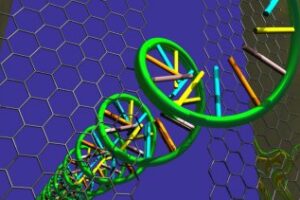
Genetic information in 3D life is stored in complex, three-dimensional molecules like DNA, whose double helix structure is crucial for replication and function. In a 2D universe, the lack of vertical space would necessitate alternative methods of information storage, possibly relying on linear sequences or planar molecular arrangements. This shift would profoundly affect how life encodes, transmits, and processes genetic data.
Consciousness and Cognitive Possibilities in Two Dimensions
The emergence of consciousness is linked to environmental complexity and the capacity for intricate interactions. A flat universe might support entities aware of their surroundings but lacking the dimensional depth required for advanced cognition, introspection, or existential thought. The relationship between spatial complexity and mental sophistication suggests that consciousness as we understand it may be limited or fundamentally different in 2D.
Connections to Theoretical Physics and Multidimensionality
Theoretical frameworks like string theory propose the existence of multiple compact dimensions beyond our perceptible three. These ideas expand our understanding of reality but also highlight the challenges of sustaining life without volumetric space. While higher or compact dimensions may exist, the absence of depth in a 2D universe poses significant obstacles to the development of life as we comprehend it.
Why Exploring Life in Two Dimensions Matters
Investigating the possibility of life in a two-dimensional universe deepens our grasp of what life fundamentally requires. It underscores the importance of spatial complexity in biological processes and evolution, while also inspiring imaginative perspectives on alternative forms of existence. This exploration enriches scientific discourse, encouraging us to question the boundaries of life and the universe itself.
Summary: The Essence of Life Across Dimensions
The inquiry into life within a 2D framework reveals the delicate balance between simplicity and complexity that defines living systems. While the constraints of a flat universe limit the potential for complex life, they also highlight the adaptability and diversity of life’s possible manifestations. This contemplation invites ongoing curiosity about the myriad ways life might arise, whether in familiar three-dimensional space or in the uncharted realms of lower or higher dimensions.
FAQ
Can life exist in a two-dimensional universe?
While conventional biology suggests that life relies on three-dimensional structures, theoretical models propose that simple life-like forms could arise in a 2D universe, albeit with significant limitations.
What are the main constraints for life in a 2D universe?
The absence of depth in a 2D universe would limit complex biochemical processes and evolutionary dynamics, potentially confining life to simpler forms.




Leave a Reply