
Short Answer
Definition of Quark-Gluon Plasma
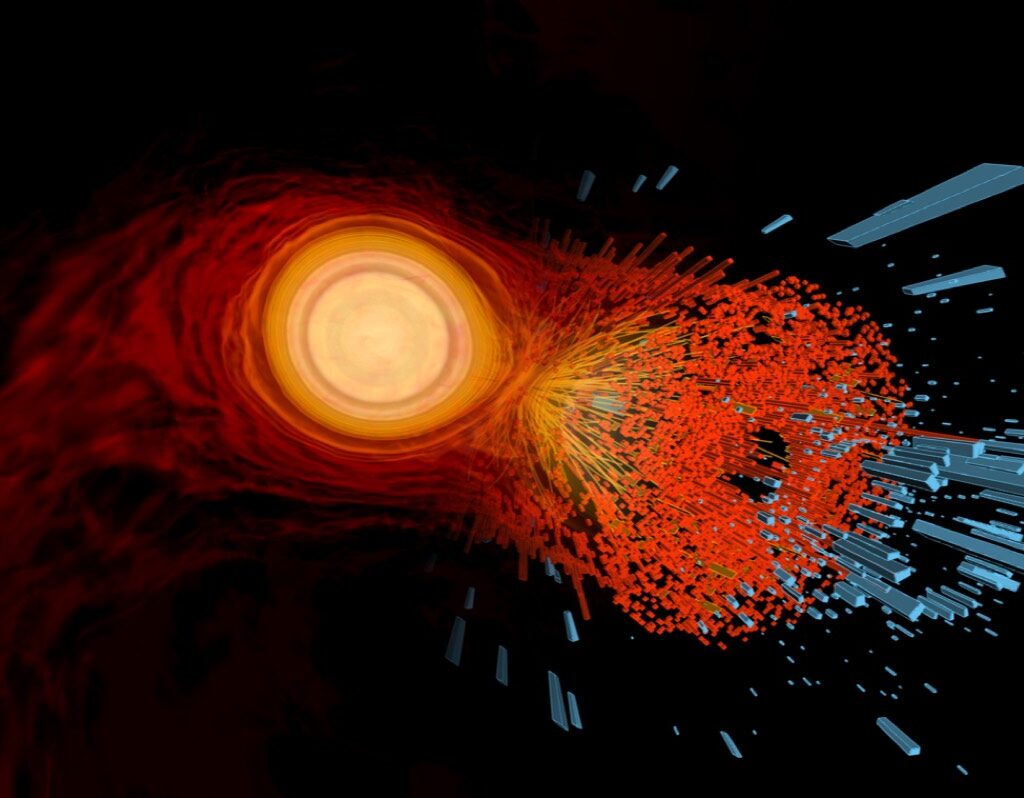
Quark-gluon plasma (QGP) is an extraordinary state of matter believed to have existed just microseconds after the Big Bang. Unlike ordinary matter composed of protons and neutrons, QGP consists of free quarks and gluons-fundamental particles that are usually confined within hadrons. This plasma forms under extreme temperatures and densities, where quarks and gluons are no longer bound but move freely in a hot, dense medium.
- Quarks:
Elementary particles that combine to form protons and neutrons. - Gluons:
Force carriers responsible for binding quarks together via the strong interaction. - Primordial State:
QGP represents the earliest phase of matter in the universe, preceding the formation of conventional atomic nuclei.
Historical Context and Discovery
The concept of quark-gluon plasma emerged from theoretical predictions in particle physics, suggesting that at temperatures exceeding trillions of degrees, quarks and gluons would exist in a deconfined state. Modern experimental efforts, particularly at CERN’s Large Hadron Collider (LHC), have sought to recreate these primordial conditions by colliding heavy ions at near-light speeds. These collisions generate the extreme energy densities necessary to produce QGP, allowing scientists to observe and analyze this fleeting state of matter.
Recent breakthroughs at CERN have transformed QGP from a theoretical construct into an experimentally accessible phenomenon, providing unprecedented insights into the universe’s infancy and the fundamental forces at play.
Mechanism of Quark-Gluon Plasma Formation
Under normal conditions, quarks are confined within hadrons by the strong force, mediated by gluons. However, when subjected to immense temperatures and energy densities, such as those created in heavy ion collisions, the strong force weakens enough to liberate quarks and gluons from their bound states. This liberation results in a fluid-like plasma where quarks and gluons move freely, exhibiting collective behavior distinct from ordinary matter.
This deconfined state is characterized by:
- High Temperature: Exceeding several trillion kelvin, surpassing conditions in the core of stars.
- Strong Interaction Dynamics: Gluons continuously interact with quarks, maintaining a dynamic, strongly coupled plasma.
- Fluid Properties: The QGP behaves like a nearly perfect liquid with very low viscosity.
Experimental Techniques and Measurements
Advancements in particle accelerator technology and detector sensitivity have enabled physicists to probe the properties of QGP with remarkable precision. Key experimental methods include:
- Relativistic Heavy Ion Collisions:
Accelerating and colliding heavy nuclei (such as lead or gold) at velocities close to the speed of light to generate the extreme conditions necessary for QGP formation. - Elliptic Flow Analysis:
Measuring the anisotropic expansion of the plasma, which reveals information about its shape, viscosity, and internal dynamics. - Particle Correlation Studies:
Examining the distribution and momentum of particles emitted from the plasma to infer temperature, density, and lifetime.
These techniques collectively allow researchers to transform transient, microscopic phenomena into quantifiable data, deepening our understanding of QGP’s characteristics.
Cosmological and Physical Significance
The study of quark-gluon plasma extends beyond particle physics, offering profound implications for cosmology and our comprehension of the universe’s evolution. By recreating and analyzing QGP, scientists gain insights into:
- Early Universe Conditions:
Understanding how matter transitioned from a quark-gluon soup to the formation of protons, neutrons, and eventually atoms. - Fundamental Forces Unification:
Exploring how the strong force relates to other fundamental interactions during the universe’s earliest moments. - Dark Matter and Gravitational Phenomena:
Investigating potential connections between QGP properties and elusive cosmic components like dark matter and gravitational waves.
Moreover, the exploration of QGP touches on philosophical questions about the origin and nature of matter, bridging scientific inquiry with metaphysical contemplation.
Common Misconceptions About Quark-Gluon Plasma
QGP is a stable form of matter.
QGP exists only under extreme conditions and for extremely brief periods before cooling and transitioning into ordinary matter.
Quarks and gluons can be isolated individually outside QGP.
Under normal conditions, quarks and gluons are confined within hadrons and cannot be observed independently.
QGP is identical to plasma found in stars.
While both are plasma states, QGP involves deconfined quarks and gluons, unlike the ionized gases in stellar plasmas.
Why Understanding Quark-Gluon Plasma Is Crucial
Investigating quark-gluon plasma is vital for multiple reasons. It provides a window into the universe’s earliest moments, helping to decode the processes that led to the formation of matter as we know it. The knowledge gained informs theoretical models in particle physics, cosmology, and nuclear physics, enhancing our grasp of fundamental forces and the behavior of matter under extreme conditions. Additionally, the technological innovations developed for QGP research drive progress in accelerator physics and detector design, with potential applications across scientific disciplines.
Conclusion: A New Era in Cosmic Exploration
The identification and study of quark-gluon plasma mark a pivotal advancement in our quest to understand the cosmos. CERN’s ongoing experiments at the LHC not only recreate the universe’s primordial state but also open pathways to unraveling the intricate connections between the microscopic world of particles and the vast expanse of cosmic phenomena. As research progresses, the quark-gluon plasma stands as a cornerstone in the narrative of existence, guiding humanity toward deeper knowledge of the universe’s origin and fundamental nature-one quark at a time.
FAQ
What is quark-gluon plasma?
Quark-gluon plasma is an extremely hot and dense state of matter composed of free quarks and gluons, believed to have existed microseconds after the Big Bang.
How does CERN study quark-gluon plasma?
By colliding heavy ions at nearly the speed of light in the Large Hadron Collider, CERN recreates the high-energy conditions necessary to produce quark-gluon plasma.
Why is quark-gluon plasma important for understanding the universe?
Studying QGP helps scientists understand the fundamental forces and the evolution of the early universe from a primordial particle soup to the matter structures we see today.






Leave a Reply