
Short Answer
Definition of the Gamma-Ray Sky
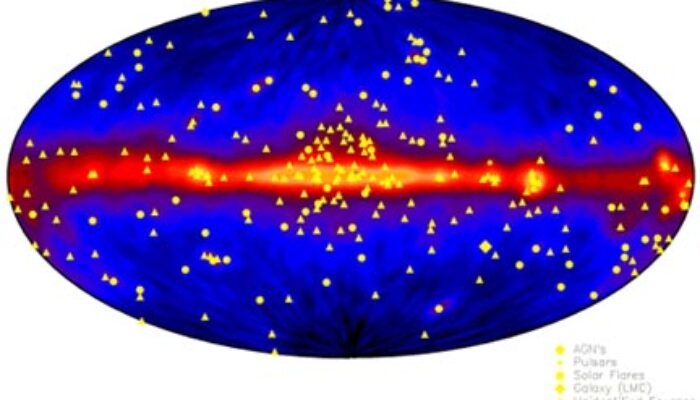
The gamma-ray sky refers to the celestial view observed through gamma rays, the highest-energy form of electromagnetic radiation. Unlike the familiar night sky visible to the naked eye, which is dominated by stars, planets, and the Milky Way’s soft glow, the gamma-ray sky reveals a universe energized by extreme astrophysical phenomena. This perspective exposes cosmic events and objects that emit radiation millions to billions of times more energetic than visible light, offering a radically different and dynamic portrayal of the cosmos.
Sources of Gamma Rays in the Universe
Gamma rays originate from some of the most violent and energetic processes in the universe. These include:
- Supernova Remnants:
The aftermath of massive stellar explosions, where shock waves accelerate particles to extreme energies, producing intense gamma-ray emission. - Pulsars:
Rapidly spinning neutron stars that emit beams of gamma radiation, detectable as rhythmic pulses due to their rotation. - Active Galactic Nuclei (AGN):
Supermassive black holes at galaxy centers that consume matter and generate powerful jets emitting gamma rays across vast intergalactic distances. - Gamma-Ray Bursts (GRBs):
Brief but extraordinarily luminous flashes of gamma rays caused by catastrophic events such as neutron star mergers or massive star collapses. - Dark Matter Annihilation or Decay:
Hypothetical processes where dark matter particles produce gamma rays, potentially creating faint halos around galaxies and clusters.
How Gamma Rays Illuminate the Cosmos
Gamma rays provide a unique window into the universe’s most energetic and extreme environments. They are produced when matter is accelerated to near-light speeds or when particles collide with immense force. Observing the sky in gamma rays reveals a vibrant and turbulent cosmos, where nebulae glow with hotspots of particle acceleration, and supernova remnants shine with the energy of their explosive origins. Pulsars act as cosmic lighthouses, their gamma-ray beams sweeping through space, while AGN jets blaze with radiation that shapes galaxy evolution. Gamma-ray bursts punctuate the sky with sudden, intense flares, highlighting the universe’s dynamic and often violent nature.
Mathematical and Physical Principles Behind Gamma-Ray Emission
Gamma-ray production involves high-energy processes governed by relativistic physics and particle interactions. Key mechanisms include:
- Synchrotron Radiation:
Charged particles spiraling at relativistic speeds in magnetic fields emit gamma rays. - Inverse Compton Scattering:
Low-energy photons gain energy by colliding with high-speed electrons, shifting into the gamma-ray regime. - Particle Annihilation:
Matter-antimatter interactions, such as electron-positron annihilation, release gamma photons.
These processes are described by equations from quantum electrodynamics and relativistic mechanics, linking particle energies, magnetic field strengths, and photon frequencies.
Real-World Observations and Instruments
Detecting gamma rays requires specialized telescopes and satellites, as Earth’s atmosphere absorbs these high-energy photons. Notable instruments include the Fermi Gamma-ray Space Telescope and the Cherenkov Telescope Array. These observatories have unveiled numerous gamma-ray sources, mapping the energetic universe and providing insights into phenomena invisible in other wavelengths. For example, Fermi has identified pulsars emitting gamma rays and captured the fleeting signals of gamma-ray bursts, enriching our understanding of cosmic evolution.
Common Misconceptions About Gamma Rays
Gamma rays are just a more intense form of visible light.
Gamma rays differ fundamentally from visible light in energy and origin, arising from processes involving extreme physics beyond ordinary electromagnetic radiation.
The night sky is static and unchanging.
The gamma-ray sky reveals a highly dynamic universe, with transient events like gamma-ray bursts and pulsar emissions constantly altering the cosmic landscape.
Gamma rays are harmful only on Earth.
While gamma rays can be dangerous due to their high energy, in space they serve as crucial messengers that help scientists decode the universe’s most energetic phenomena.
Significance of Gamma-Ray Astronomy
Studying the gamma-ray sky is vital for advancing our knowledge of fundamental physics, astrophysics, and cosmology. It allows scientists to probe environments where matter exists under extreme conditions, test theories of particle physics, and explore the nature of dark matter. Gamma-ray observations also inform models of galaxy formation and evolution, revealing how energetic feedback from black holes and stellar explosions shapes the cosmos. Beyond science, this field expands human perception, transforming our understanding of the universe from a serene starry dome to a vibrant, energetic arena.
Expanding Human Perception Through Gamma Rays
Our natural senses limit us to a narrow band of electromagnetic radiation, primarily visible light. By extending our vision into the gamma-ray spectrum, we uncover a hidden universe teeming with activity and complexity. Each gamma photon detected carries a narrative of cosmic creation, destruction, and transformation across vast distances and epochs. This expanded perspective challenges us to rethink our place in the cosmos and inspires ongoing technological innovation to capture and interpret these elusive signals.
Conclusion: The Gamma-Ray Universe as a Dynamic Frontier
Viewing the cosmos through gamma rays reveals a universe alive with energy and motion, far beyond the tranquil night sky familiar to human eyes. This high-energy panorama showcases the interplay of matter, radiation, and gravity under extraordinary conditions, offering profound insights into the workings of nature at its most extreme. The gamma-ray sky is both a scientific frontier and a source of wonder, inviting us to explore the universe’s deepest mysteries and appreciate the grandeur of its energetic phenomena.
FAQ
What are gamma rays?
Gamma rays are the highest-energy form of electromagnetic radiation, produced by extreme astrophysical processes.
Why are gamma rays important in astronomy?
They reveal energetic phenomena and cosmic events that are not visible in other wavelengths, enhancing our understanding of the universe.


Leave a Reply