
Short Answer
Definition of Nuclear Fission and Fission Fragments
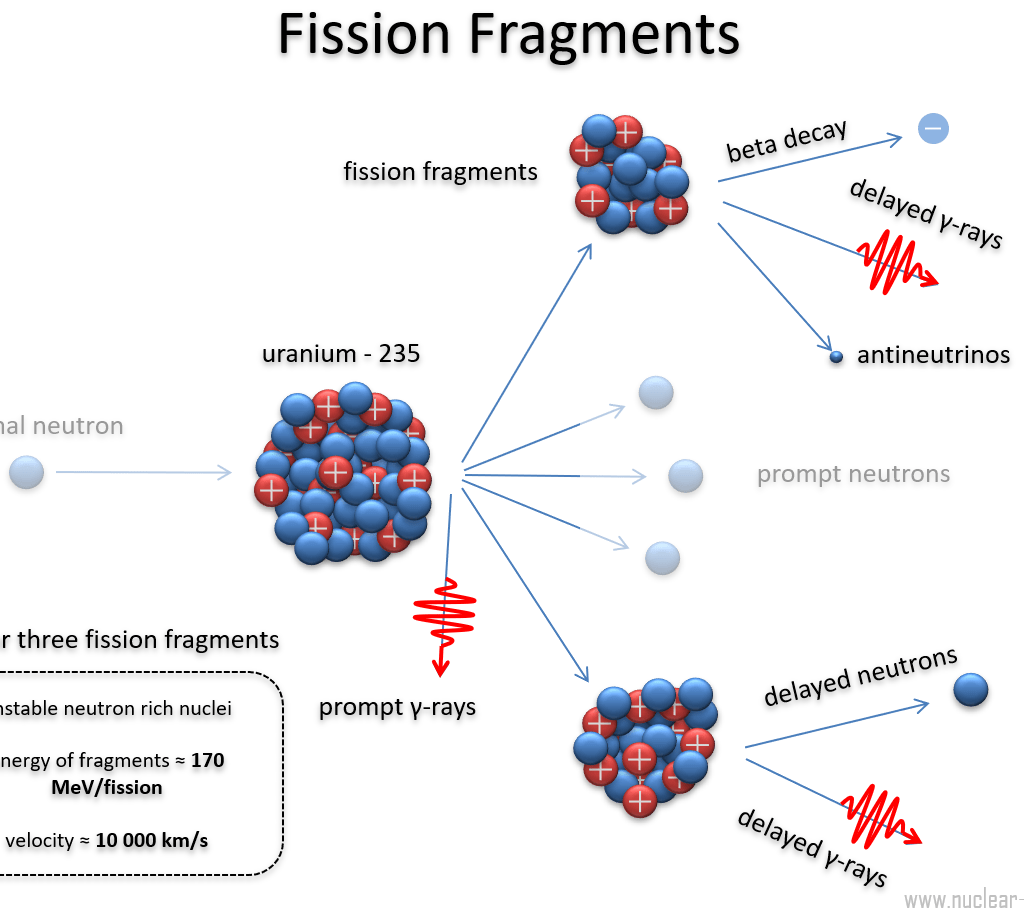
Nuclear fission is a fundamental process in nuclear physics where the nucleus of a heavy atom splits into two or more smaller nuclei, releasing a significant amount of energy. This phenomenon is central to both the operation of nuclear reactors and the destructive power of nuclear weapons. The smaller nuclei produced during this splitting are known as fission fragments, which exhibit a wide range of properties and behaviors. Understanding these fragments is essential for advancing nuclear science and managing practical applications such as energy generation and radioactive waste handling.
Types and Characteristics of Fission Fragments
Fission fragments can be broadly classified into two categories: primary and secondary products. Primary fission products are the immediate nuclei formed directly from the splitting of the original atom’s nucleus. Secondary products arise from the radioactive decay of these primary fragments over time. The energy released during fission is immense, often measured in millions of electron volts (MeV), underscoring the process’s potency.
- Primary Fission Products:
These are the initial nuclei created when a heavy atom such as Uranium-235 or Plutonium-239 absorbs a neutron and becomes unstable, causing it to split. - Secondary Fission Products:
These result from the decay of primary fragments, often involving beta decay and other radioactive transformations.
Mechanism of Nuclear Fission
When a heavy nucleus captures a neutron, it becomes unstable and may divide into two or three smaller nuclei, typically containing between 90 and 150 nucleons each. The distribution of these fragments tends to cluster around mass numbers ranging from 80 to 160, reflecting the typical sizes of the fission products. This splitting also releases additional neutrons, which can trigger further fission events, creating a self-sustaining chain reaction crucial for nuclear reactor operation.
Common Fission Fragments and Their Properties
Among the most frequently produced fission fragments are isotopes of elements such as Krypton, Barium, and Strontium. For example, Krypton-92 and Barium-141 are typical primary fission products:
- Krypton-92:
An inert noble gas that remains chemically non-reactive, allowing it to persist in various environments without readily forming compounds. - Barium-141:
An alkaline earth metal with higher chemical reactivity, often participating in subsequent chemical reactions after fission. - Strontium-90:
A beta-emitting isotope with a half-life of about 29 years, notable for its biological impact as it mimics calcium and accumulates in bones, posing health risks through internal radiation exposure.
Radioactivity and Decay of Fission Fragments
Many fission fragments are radioactive and undergo decay processes such as beta decay, emitting beta particles and transforming into new isotopes. Notable examples include:
- Iodine-131:
With a half-life of approximately 8 days, this isotope is environmentally significant due to its tendency to accumulate in the thyroid gland, increasing the risk of thyroid cancer following nuclear incidents. - Cesium-137:
Possessing a longer half-life of around 30 years, Cesium-137 remains a concern for long-term environmental contamination and necessitates ongoing monitoring and remediation efforts.
Classification of Fission Products by Mass
Fission products are often divided into “light” and “heavy” categories based on their atomic mass:
- Light Fission Products:
Typically have atomic masses below 100. - Heavy Fission Products:
Usually fall within the mass range of 100 to 160.
This classification aids in understanding the distribution and yield of fission fragments, which is vital for nuclear reactor safety and radioactive waste management.
Decay Chains and Their Complexity
The decay of fission fragments involves intricate chains of transformations, including alpha and beta decays, which produce a complex array of isotopes. These decay sequences generate additional radiation and result in diverse elemental compositions within spent nuclear fuel. Consequently, effective containment and long-term storage solutions are necessary to ensure safety until radioactivity diminishes to acceptable levels.
Role of Fission Fragments in Nuclear Reactor Environments
Fission fragments influence several phenomena within nuclear reactors, such as neutron activation and radiation shielding. Understanding the characteristics of neutron flux-comprising thermal, fast, and epithermal neutrons-is essential for optimizing reactor design and implementing effective shielding to protect against radiation hazards.
Significance of Fission Fragments in Science and Technology
The diverse nature of fission fragments provides critical insights into atomic behavior and nuclear reactions. Their dual role as both sources of energy and potential environmental hazards necessitates careful consideration in reactor engineering and nuclear safety protocols. Ongoing research continues to uncover new aspects of fission fragment behavior, deepening our comprehension of matter at the atomic level and enhancing the safe utilization of nuclear technology.
FAQ
What are fission fragments?
Fission fragments are the smaller nuclei produced when a heavy nucleus splits during nuclear fission, resulting in a range of isotopes with various properties.
How are fission fragments classified?
Fission fragments are classified into primary products, which are formed directly from the fission event, and secondary products, which arise from the radioactive decay of primary fragments.
What is the significance of fission fragments in nuclear reactors?
Fission fragments influence neutron activation and radiation shielding in nuclear reactors, making their study critical for safe reactor design and operation.




Leave a Reply