
Short Answer
Definition of Dispersion in Optics
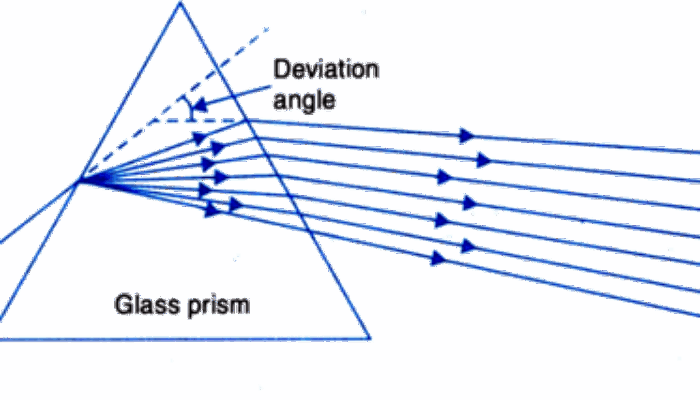
Dispersion is a fundamental optical phenomenon where white light separates into its individual spectral colors upon passing through a medium. This occurs because different wavelengths of light refract, or bend, by varying amounts depending on the material they traverse. In the context of lenses, dispersion describes the lens’s ability to split light into its constituent colors, a property known as the dispersive power of the lens.
- Dispersion:
The process by which light divides into a spectrum of colors due to wavelength-dependent refraction. - Dispersive Power:
A measure of how effectively a lens can separate light into its spectral components.
Fundamental Principles Behind Dispersion
Light exhibits a dual nature, behaving both as a wave and as a particle. This wave-particle duality is crucial in understanding how light interacts with materials. Wave optics explains that shorter wavelengths (such as blue light) refract more sharply than longer wavelengths (such as red light) when passing through a lens. This wavelength-dependent bending causes chromatic aberrations-optical distortions that degrade image quality by causing color fringing and blurring.
Mathematical Framework: Refraction and Lens Maker’s Equation
The behavior of light in lenses is quantitatively described by the lens maker’s formula, which connects the focal length of a lens to its curvature and the refractive index of the lens material. The refractive index, denoted as n, is a dimensionless value representing the ratio of the speed of light in a vacuum to that in the medium. Since n varies with wavelength, it directly influences the dispersive power of the lens.
Lens Maker’s Equation:
1/f = (n – 1) (1/R₁ – 1/R₂)
- f: Focal length of the lens
- n: Refractive index of the lens material
- R₁, R₂: Radii of curvature of the lens surfaces
Materials and Their Dispersive Characteristics
The dispersive power of a lens is heavily influenced by the optical properties of the materials used in its construction. Commonly employed materials include crown glass and flint glass, each with distinct refractive indices and dispersion profiles.
- Crown Glass:
Exhibits a relatively low refractive index and minimal dispersion, making it ideal for lenses where chromatic aberration must be minimized. - Flint Glass:
Possesses a higher refractive index and greater dispersive power, often used in combination with crown glass to create achromatic lenses that reduce color distortions.
Applications of Dispersive Power in Optical Devices
The dispersive power of lenses plays a vital role in the design and performance of various optical instruments such as cameras, telescopes, and microscopes. By combining multiple lenses with different dispersive properties-known as compound lenses-optical engineers can correct chromatic aberrations and enhance image sharpness across a range of wavelengths.
Dispersion in Spectroscopy and Scientific Analysis
Beyond imaging, dispersion is essential in spectroscopy, where precise separation of light into its spectral components allows scientists to analyze the composition of substances. This technique is indispensable in fields like chemistry, astronomy, and environmental science, enabling the study of molecular structures, stellar compositions, and atmospheric pollutants through their unique spectral signatures.
Role of Dispersive Power in Modern Technologies
Advancements in photonics and fiber optic communications underscore the importance of understanding dispersive power. In fiber optics, wavelength-dependent dispersion can cause signal distortion over long distances. By applying principles of dispersion, engineers optimize lens systems and materials to maintain signal clarity and integrity, revolutionizing global data transmission.
Common Misconceptions About Dispersion
Dispersion only occurs in prisms.
Dispersion happens in any medium where the refractive index varies with wavelength, including lenses and optical fibers.
All lenses have the same dispersive power.
Dispersive power varies significantly depending on the lens material and design.
Significance of Understanding Dispersive Power
Grasping the concept of dispersive power is crucial for both theoretical and practical optics. It deepens our comprehension of light-matter interactions and informs the design of sophisticated optical systems that demand high precision. From improving everyday devices like cameras to enabling cutting-edge scientific research and telecommunications, the study of dispersion continues to drive innovation and expand our understanding of the physical world.
FAQ
What does dispersive power mean in optics?
Dispersive power refers to how strongly a lens material separates light into different wavelengths, causing color spread.
How does dispersive power affect image quality?
Higher dispersive power can increase chromatic aberration, causing color fringing and reducing image sharpness.
Can dispersive power be controlled?
Yes, by combining different lens materials (achromatic lenses) or using compound lenses, optical engineers can reduce dispersion effects.
Why do different glasses have different dispersive powers?
Because their refractive index changes differently with wavelength, depending on their chemical composition.
Is dispersive power relevant to modern technology?
Absolutely, it is critical in designing fiber optic communication systems and advanced photonic devices.




Leave a Reply