
Short Answer
Definition of Massive Stars
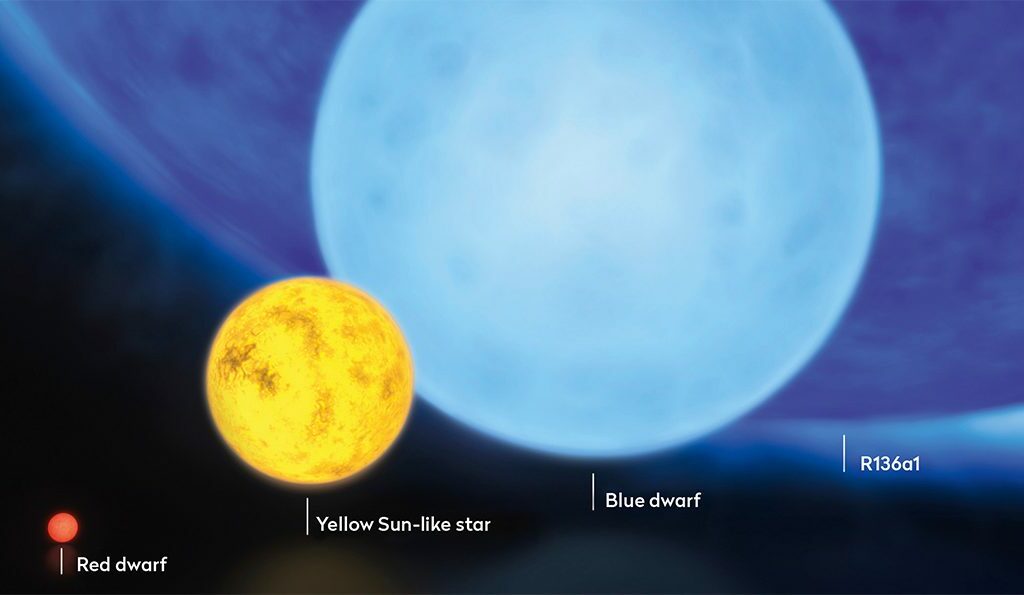
Massive stars are celestial bodies whose masses significantly exceed that of our Sun, typically surpassing 20 solar masses. These stars are characterized by their extraordinary brightness, rapid nuclear fusion processes, and relatively short lifespans. Unlike smaller stars, massive stars undergo complex evolutionary stages that culminate in dramatic and often violent endpoints, profoundly influencing the cosmic environment.
Internal Processes and Fusion Stages
At the heart of a massive star lies an intense nuclear furnace where fusion reactions occur at extreme temperatures and pressures, often reaching tens of millions of Kelvin. This environment enables the fusion of heavier elements beyond hydrogen and helium, including carbon, neon, oxygen, and silicon. Each fusion phase synthesizes progressively heavier nuclei, ultimately leading to the formation of an iron core. Since iron fusion does not release energy, this marks a critical turning point in the star’s lifecycle.
- Core Temperature and Pressure:
The core conditions in massive stars are sufficient to sustain fusion of heavy elements, unlike in smaller stars. - Fusion Sequence:
Hydrogen → Helium → Carbon → Neon → Oxygen → Silicon → Iron. - Iron Core Formation:
Iron accumulation signals the end of energy-producing fusion reactions.
Collapse and Supernova Explosion
When the iron core reaches a threshold mass, it can no longer support itself against gravitational forces. The core undergoes a rapid collapse, during which electrons and protons combine via inverse beta decay to form neutrons and neutrinos. This collapse compresses the core to densities comparable to atomic nuclei, halted only by neutron degeneracy pressure-a quantum mechanical effect preventing neutrons from occupying identical states.
The abrupt cessation of collapse generates a shockwave that expels the star’s outer layers in a supernova explosion. This event can outshine entire galaxies temporarily and disperses heavy elements such as iron, gold, and uranium into the interstellar medium, enriching it and enabling the formation of new stars and planetary systems.
Remnants: Neutron Stars and Black Holes
The aftermath of a supernova leaves behind compact remnants whose nature depends on the original core mass:
- Neutron Stars:
Extremely dense objects approximately 20 kilometers in diameter, containing more mass than the Sun, supported by neutron degeneracy pressure. - Black Holes:
Formed if the core mass exceeds the neutron star limit, resulting in a gravitational collapse to a singularity where gravity dominates all other forces.
Formation Environment and Lifespan
Massive stars typically originate in dense, turbulent molecular clouds rich in gas. Their formation conditions favor rapid accumulation of mass, but their lifespans are comparatively brief-on the order of a few million years-due to their accelerated fusion rates. Despite their short existence, these stars exert significant influence on their surroundings through intense radiation, stellar winds, and supernova feedback, shaping the evolution of their host galaxies.
Astrophysical Significance and Observational Impact
Massive stars play a pivotal role in astrophysics and cosmology. They dominate the ultraviolet emission of young stellar populations, making them essential for interpreting data from advanced telescopes. Their explosive deaths contribute to the cosmic abundance of heavy elements and may produce black holes that merge and emit gravitational waves, detectable by observatories such as LIGO and Virgo. These phenomena provide critical insights into fundamental physics and the dynamic processes governing the universe.
Common Misconceptions About Massive Stars
Massive stars live longer than smaller stars.
Due to their rapid fusion rates, massive stars have much shorter lifespans, often only a few million years compared to the Sun’s 10 billion years.
All massive stars end their lives as black holes.
Depending on the core mass after supernova, some massive stars leave behind neutron stars instead of black holes.
Why Massive Stars Are Crucial to Cosmic Evolution
Massive stars act as cosmic forges, synthesizing and dispersing heavy elements essential for the formation of planets and life. Their intense radiation and explosive deaths regulate star formation and galactic development. Studying these stars enhances our understanding of nuclear physics, quantum mechanics, and general relativity under extreme conditions, offering a window into the fundamental workings of the universe.
Summary: The Cosmic Role of Massive Stars
The lifecycle of massive stars-from their turbulent birth in molecular clouds to their spectacular demise as supernovae and the formation of exotic remnants-illustrates the interconnectedness of cosmic phenomena. These stars embody the cycle of creation and destruction, driving the chemical and structural evolution of galaxies and enriching the universe with the building blocks of complexity and life.
FAQ
What are massive stars?
Massive stars are stars with masses greater than 20 solar masses, known for their rapid fusion processes and significant cosmic impact.
What happens when a massive star collapses?
Upon reaching a critical mass, a massive star's core collapses, leading to a supernova explosion that ejects its outer layers and creates neutron stars or black holes.

Leave a Reply