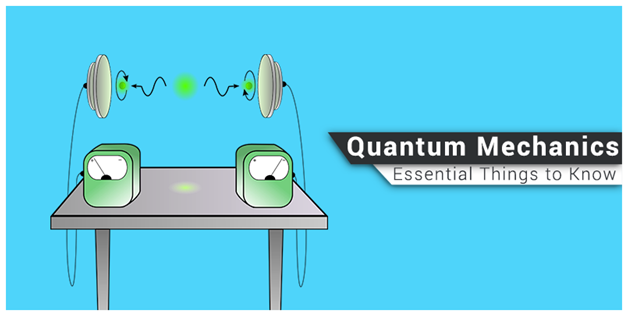
What has quantum physics done for us?

Definition of Quantum Physics Quantum physics, often regarded as the frontier of modern science, fundamentally reshapes our comprehension of the universe at its most elemental scale. This branch of physics explores the behavior and interactions of particles at atomic and subatomic levels, where classical physics no longer applies. Despite its abstract nature, quantum physics has […]

Read More →

How do magnets work at a quantum level?

Definition of Magnetism Magnetism is a fundamental physical phenomenon arising from the intrinsic properties of particles, primarily electrons, within materials. It manifests as the ability of certain substances to generate magnetic fields and exert forces on other magnetic objects. This property is deeply rooted in quantum mechanics and is observable in everyday items such as […]

Read More →

How is Schrödinger’s equation used in quantum computing?

Definition of Schrödinger’s Equation in Quantum Mechanics Schrödinger’s equation is a fundamental mathematical formulation that describes how quantum systems evolve over time. Unlike classical mechanics, which assigns definite positions and velocities to particles, this equation characterizes the state of a quantum system through a wave function. This wave function encodes the probabilities of finding a […]

Read More →

How interesting is quantum mechanics to learn?

Definition of Quantum Mechanics Quantum mechanics is a fundamental branch of physics that explores the behavior and interactions of matter and energy at the smallest scales-namely, atomic and subatomic levels. Unlike classical physics, which relies on deterministic laws, quantum mechanics introduces a probabilistic framework where particles do not possess definite properties until measured. This theory […]

Read More →

Can a molecule be described by one single wave function?

Understanding the Wave Function in Quantum Mechanics In quantum mechanics, the wave function is a fundamental concept that encapsulates the complete quantum state of a system. It provides a mathematical description that contains all the information necessary to predict the likelihood of various measurement outcomes for particles. Essentially, the wave function serves as a probabilistic […]

Read More →

Do you need physics for quantum computing?

Understanding Quantum Computing Quantum computing represents a revolutionary leap in computational technology, poised to surpass the capabilities of traditional computers. Unlike classical systems that rely on bits as the fundamental unit of information, quantum computers utilize qubits, which exploit the unique phenomena of quantum mechanics such as superposition and entanglement. These properties allow qubits to […]

Read More →

How quantum computing works and why it’s important?

Definition of Quantum Computing Quantum computing is an innovative computational paradigm that harnesses the principles of quantum mechanics to process information in ways fundamentally distinct from classical computing. Unlike traditional computers that use bits as the smallest unit of data, quantum computers utilize quantum bits, or qubits, which exploit unique quantum phenomena such as superposition […]

Read More →

Does consciousness explain quantum mechanics?

Understanding Consciousness and Quantum Mechanics Consciousness has fascinated thinkers from various disciplines for centuries, sparking questions about its origin, essence, and influence on intangible phenomena. Among these phenomena, quantum mechanics-a scientific framework that describes the behavior of matter and energy at the smallest scales-has inspired intriguing theories about the potential role of consciousness. Exploring the […]

Read More →

How will you describe quantum mechanics to a 10 year old?

Definition of Quantum Mechanics Quantum mechanics is a fundamental branch of physics that explores the behavior and properties of the smallest constituents of matter and energy. It reveals how particles at the atomic and subatomic levels operate in ways that defy classical intuition, often appearing strange or counterintuitive compared to everyday experiences. Quantum Particles: These […]

Read More →

What can quantum physics help me with?

Definition of Quantum Physics Quantum physics, also known as quantum mechanics, is a branch of science that investigates the behavior and properties of matter and energy at the smallest scales-typically at the level of atoms and subatomic particles. Unlike classical physics, which describes the macroscopic world, quantum physics reveals phenomena that often defy everyday intuition, […]

Read More →