
Short Answer
Definition of Dark Matter
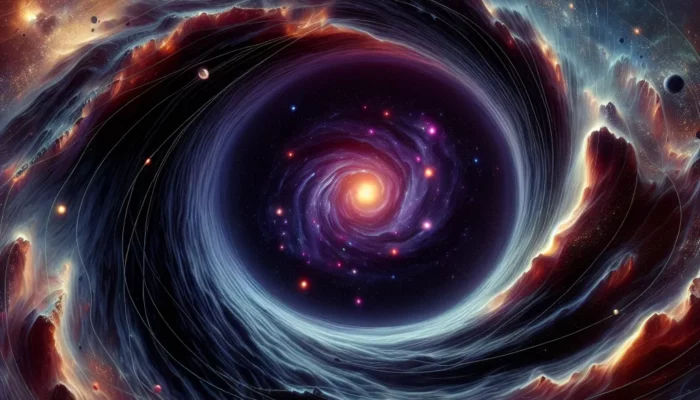
Dark matter is a form of matter that does not emit, absorb, or reflect light, making it invisible to current electromagnetic observational methods. Despite its elusive nature, it exerts a significant gravitational influence on visible matter, shaping the structure and evolution of the universe.
- Composition:
Dark matter is believed to consist of unknown particles that interact weakly with ordinary matter and electromagnetic radiation. - Cosmic Abundance:
It accounts for approximately 27% of the total mass-energy content of the universe, vastly exceeding the amount of ordinary baryonic matter. - Detection Challenges:
Its invisibility to direct detection methods necessitates indirect observation through gravitational effects and particle interaction experiments.
Dark Matter in the Cosmic Framework
Within the large-scale structure of the cosmos, dark matter plays a pivotal role. It forms extensive halos enveloping galaxies, influencing their rotational dynamics and the gravitational lensing of light from distant objects. These phenomena provide compelling evidence for dark matter’s existence and distribution on galactic and intergalactic scales.
Presence of Dark Matter in the Solar System
Exploring whether dark matter exists within the Solar System involves examining its local density and potential effects on planetary bodies. The Solar System resides within the Milky Way’s dark matter halo, where the estimated local dark matter density is about 0.3 GeV/cm³. Although this density is extremely low compared to the mass of the Sun or planets, it raises questions about subtle gravitational influences or interactions that might be detectable.

Theoretical Density Estimates
Models of the galactic dark matter halo suggest a relatively uniform distribution of dark matter particles around the Sun. This ambient presence implies that dark matter particles continuously pass through the Solar System, with only a tiny fraction potentially captured by the Sun’s gravitational field.
Types of Dark Matter Candidates
- Weakly Interacting Massive Particles (WIMPs):
Hypothetical particles that interact via gravity and the weak nuclear force, making them difficult to detect. - Axions:
Ultra-light particles proposed as dark matter candidates, characterized by extremely weak electromagnetic interactions.
Mechanisms of Dark Matter Detection in the Solar System
Detecting dark matter within the Solar System primarily relies on indirect methods, as direct observation remains unfeasible. These methods include:
- Particle Detection Experiments:
Underground detectors and space-based observatories aim to capture rare interactions between dark matter particles and atomic nuclei. - Gravitational Effects on Orbits:
Precise measurements of planetary and spacecraft trajectories may reveal anomalies caused by unseen mass concentrations, including dark matter clumps. - Astrophysical Signals:
Observations of gamma rays, neutrinos, or positrons that could result from dark matter annihilation or decay near the Sun or planets.
Mathematical Framework for Dark Matter Density
The local dark matter density, often denoted as ρDM, is a key parameter in modeling its influence:
ρDM ≈ 0.3 GeV/cm³
where:
- ρDM: Local dark matter density near the Sun
- GeV/cm³: Energy density units commonly used in particle physics
This density translates into a mass density that is minuscule compared to the mass of celestial bodies but sufficient to be considered in high-precision gravitational studies.
Impact on Planetary Motions and Spacecraft Trajectories
High-precision tracking of planetary orbits and spacecraft paths offers a potential window into detecting dark matter’s gravitational effects. Any unexplained deviations from predicted trajectories could indicate the presence of dark matter concentrations or “mini-halos” within the Solar System.
However, isolating such signals is complicated by numerous factors influencing orbital dynamics, including solar radiation pressure, gravitational perturbations from asteroids and comets, relativistic corrections, and measurement uncertainties.
Speculative Effects of Dark Matter on Solar and Planetary Phenomena
Some theoretical models propose that dark matter interactions might subtly influence internal processes of the Sun and planets:
- Solar Heat and Neutrino Flux:
Dark matter annihilation or decay near the Sun could contribute marginally to its energy output or neutrino emissions. - Planetary Core Heating:
Accumulated dark matter within planetary interiors might affect heat generation and magnetic field dynamics.
Currently, no conclusive observational evidence supports these hypotheses, but ongoing research continues to explore these possibilities.
Simulations and Modeling of Dark Matter Behavior in the Solar System
Computational studies simulate the trajectories and interactions of dark matter particles within the Solar System’s gravitational field. These models indicate that while most particles pass through without interaction, a small fraction may become gravitationally bound to the Sun, forming a sparse dark matter population.
Such simulations help predict potential signals for detection and refine estimates of dark matter’s local distribution.
Observational Searches for Secondary Dark Matter Signatures
Space-based gamma-ray telescopes and other observatories monitor the Solar System environment for anomalous emissions that could arise from dark matter particle interactions. Although occasional signals have sparked interest, the complexity of astrophysical backgrounds and limited resolution prevent definitive attribution to dark matter.
Dark Matter’s Role in Planetary System Formation
Beyond the Solar System, dark matter may influence the formation and stability of planetary systems. In regions with higher dark matter density, such as stellar nurseries or protoplanetary disks, its gravitational presence could subtly affect the accretion of material and the orbital configuration of emerging planets.
While these effects are likely negligible in our Solar System’s history, they provide valuable context for understanding dark matter’s broader astrophysical significance.
Common Misconceptions About Dark Matter in the Solar System
Dark matter is abundant and easily detectable within the Solar System.
The local density of dark matter is extremely low, making direct detection within the Solar System highly challenging.
Dark matter significantly alters planetary orbits.
Any gravitational effects of dark matter on planetary motions are subtle and currently indistinguishable from other perturbations.
Dark matter interacts strongly with ordinary matter.
Dark matter interacts primarily through gravity and possibly weak nuclear forces, with negligible electromagnetic interaction.
Significance of Studying Dark Matter in the Solar System
Understanding dark matter’s presence and influence within the Solar System is crucial for several reasons:
- Refining Astrophysical Models:
Accurate knowledge of local dark matter density informs models of galactic structure and evolution. - Enhancing Detection Techniques:
Investigations within the Solar System complement broader dark matter searches, guiding the design of sensitive detectors. - Advancing Fundamental Physics:
Insights into dark matter properties could reveal new physics beyond the Standard Model. - Improving Space Navigation:
Accounting for all gravitational influences, including dark matter, enhances the precision of spacecraft trajectory predictions.
Conclusion and Future Prospects
The question of whether dark matter permeates the Solar System remains an active area of scientific inquiry. While current evidence indicates that dark matter exists in the galactic environment surrounding the Sun, its local density is exceedingly low, resulting in minimal gravitational or interactive effects detectable with present technology.
Ongoing advancements in astrophysical instrumentation, particle detection experiments, and computational modeling continue to refine our understanding. As these efforts progress, the subtle presence of dark matter within our cosmic neighborhood may eventually be unveiled, deepening our comprehension of the universe’s hidden mass and the intricate dynamics of the Solar System.
FAQ
What is dark matter?
Dark matter is a type of matter that does not interact with electromagnetic forces, making it invisible, yet it has significant gravitational effects.
How does dark matter affect the Solar System?
While dark matter exists in the Solar System's vicinity, its low density leads to minimal detectable gravitational effects on planetary motions.



Leave a Reply