
Short Answer
Definition of the Cosmic Web and Dark Matter
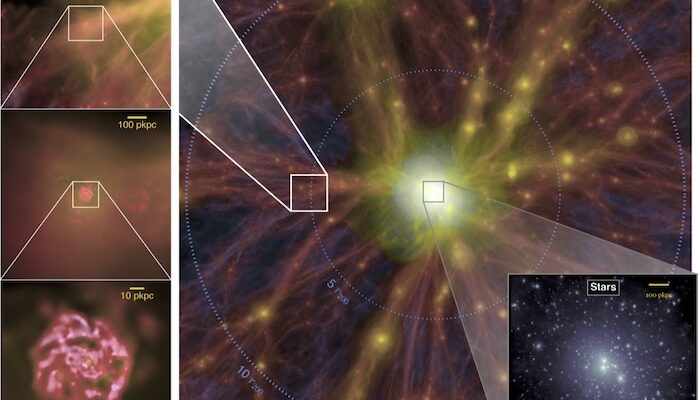
The cosmic web is an immense, intricate network that forms the large-scale structure of the universe. It consists of vast filaments, nodes, and voids made up of galaxies, galaxy clusters, and intergalactic gas. This sprawling framework extends across hundreds of millions of light-years, shaping the distribution of visible matter in the cosmos. Central to this grand design is dark matter, an invisible and enigmatic substance whose gravitational influence governs the formation and evolution of the cosmic web.
- Cosmic Web:
A colossal lattice of interconnected filaments and nodes that organizes galaxies and clusters on a universal scale. - Dark Matter:
A non-luminous form of matter that interacts primarily through gravity, acting as the scaffolding for cosmic structures.
Origins and Formation of the Cosmic Web
In the earliest moments following the Big Bang, the universe was a nearly homogeneous expanse of particles. Tiny fluctuations in density, seeded by quantum effects, initiated the gradual process of gravitational collapse. Dark matter, which does not emit or absorb light, played a pivotal role by exerting gravitational pull that gathered ordinary matter into dense regions. This process led to the emergence of the filamentary patterns characteristic of the cosmic web.
Unlike baryonic matter, which interacts electromagnetically and is visible through emitted light, dark matter remains undetectable by conventional telescopes. Its gravitational dominance, however, directs the assembly of galaxies and clusters along the web’s filaments and nodes.
Mechanics of Dark Matter in Structuring the Universe
Dark matter’s gravitational influence operates on scales that challenge human comprehension. It outweighs ordinary matter by a significant margin, dictating the pathways along which visible matter accumulates. Acting as the universe’s fundamental architect, dark matter forms a complex network of filaments and halos interspersed with vast voids. Advanced cosmological simulations have replicated this structure, closely matching the observed distribution of galaxies and reinforcing the theory that dark matter underpins the cosmic web.
Observational Evidence and Recent Discoveries
Recent astronomical observations have detected filaments of dark matter connecting distant galaxy clusters, providing direct evidence of the cosmic web’s invisible framework. These tenuous strands, spanning millions of light-years, function as conduits for the flow of matter and the formation of galaxies. They channel gas and dark matter from less dense regions into massive cluster hubs, facilitating galaxy growth and evolution over billions of years.
This interconnectedness challenges earlier views of galaxy formation as isolated events, revealing instead a dynamic, interwoven cosmic ecosystem driven by dark matter’s pervasive gravitational pull.
Structural Complexity and Cosmic Dynamics
The cosmic web’s architecture is both intricate and majestic. Dark matter filaments weave a sponge-like lattice that balances the universe’s expansion with gravitational collapse. At the densest intersections of this web lie galaxy clusters-massive conglomerations containing hundreds or thousands of galaxies. These nodes represent gravitational wells where dark matter’s influence is most intense, drawing in matter and triggering complex interactions such as galactic mergers.
This dynamic environment forms a vibrant cosmic ecosystem sustained by the unseen backbone of dark matter.
Scientific Significance and Broader Implications
The discovery and study of the cosmic web fundamentally alter our understanding of space. Rather than a vast emptiness punctuated by isolated celestial bodies, space emerges as a dynamic, pulsating network shaped by dark matter’s gravity. This realization raises profound questions about the nature of dark matter itself-its composition, interactions beyond gravity, and potential to reveal new physics beyond the current standard model.
Mapping the cosmic web also provides critical insights into cosmological parameters such as the universe’s expansion rate, the role of dark energy, and the balance of matter and antimatter. Each filament acts as a cosmic archive, preserving the history of universal growth and the forces shaping its evolution.
Implications for Dark Matter Research
The identification of dark matter filaments connecting galaxy clusters offers promising targets for detecting dark matter particles. Regions where dark matter density converges may enhance the likelihood of observing faint interactions predicted by advanced particle physics theories. Thus, understanding the cosmic web bridges cosmology and particle physics, fostering a unified approach to unraveling the universe’s deepest mysteries.
Expanding Our Cosmic Perspective
Embracing the concept of dark matter as the weaver of the cosmic web transforms our cosmic worldview. The universe is no longer seen as uniform but as a richly interconnected network evolving under gravity’s relentless influence. This perspective deepens our appreciation for the unseen forces shaping all cosmic structures and invigorates the quest to uncover dark matter’s true nature.
As research progresses, the cosmic web reveals itself as a grand masterpiece composed in the language of gravity, with dark matter as its invisible yet omnipresent architect.
Conclusion: The Cosmic Web as a Gateway to New Discoveries
The cosmic web, constructed by the invisible hands of dark matter, stands as a testament to the universe’s complexity and the mysteries that remain. This profound understanding marks a new era in astrophysics, inspiring deeper exploration and curiosity. By deciphering how dark matter builds and sustains the universe’s vast structure, humanity moves closer to unveiling the ultimate truths woven into the fabric of space and time.
FAQ
What is dark matter?
Dark matter is a non-luminous form of matter that interacts primarily through gravity, making it invisible to conventional telescopes.
Why is the cosmic web important?
The cosmic web reveals the interconnectedness of galaxies and clusters, fundamentally altering our understanding of the universe's structure.

Leave a Reply