
Short Answer
Understanding Quantum Computing
Quantum computing represents a groundbreaking paradigm in information processing, leveraging the principles of quantum mechanics to perform calculations far beyond the reach of classical computers. Unlike traditional computing systems that rely on bits-binary units representing either 0 or 1-quantum computers utilize quantum bits, or qubits, which can exist in multiple states simultaneously. This unique characteristic, known as superposition, allows quantum computers to process vast amounts of information concurrently, dramatically enhancing computational power.
Fundamental Principles of Quantum Computing
- Superposition:
Qubits can occupy multiple states at once, enabling parallel computation and exponentially increasing processing capabilities compared to classical bits. - Entanglement:
A phenomenon where qubits become interconnected such that the state of one instantly influences the state of another, regardless of the distance between them, facilitating complex and efficient information processing. - Decoherence:
The loss of quantum coherence due to environmental interference, which disrupts qubit states and poses a significant challenge in maintaining stable quantum computations.
Current State of Quantum Computing Technology
Despite the robust theoretical foundation, the practical construction of fully functional quantum computers remains a formidable challenge. Leading technology companies and research institutions have made notable strides in developing quantum processors, yet these devices are still in early stages and face significant limitations.
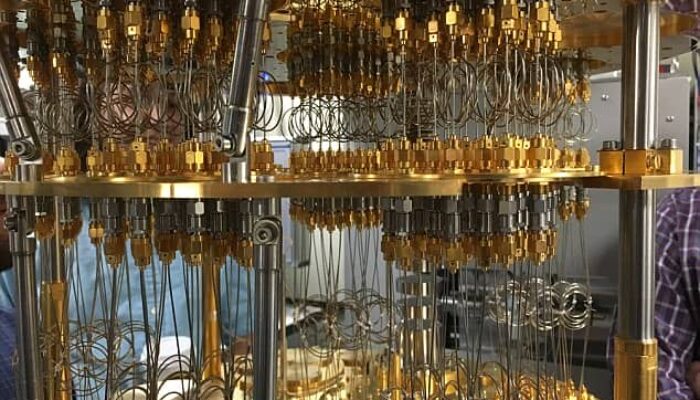
IBM’s introduction of the 127-qubit “Eagle” processor in 2021 marked a pivotal advancement, showcasing progress toward scalable and fault-tolerant quantum systems. Similarly, Google’s “Sycamore” processor gained widespread attention by demonstrating “quantum supremacy,” performing a specific task faster than the most powerful classical supercomputers. Other key players such as Rigetti Computing, IonQ, and D-Wave Systems continue to push the boundaries of quantum hardware development.
Challenges in Building Practical Quantum Computers
Several obstacles hinder the realization of reliable, large-scale quantum computers:
- Hardware Fragility:
Qubits are extremely sensitive to external disturbances, requiring sophisticated cooling and isolation techniques to preserve their quantum states. - Algorithm Development:
The field of quantum algorithms is nascent, with only a handful of algorithms demonstrating clear advantages over classical methods. Designing algorithms that fully harness quantum capabilities remains a critical research area. - Error Correction:
Quantum error correction is essential to mitigate the effects of decoherence and operational errors, but implementing these protocols is complex and resource-intensive.
Philosophical and Societal Implications
Beyond technical challenges, quantum computing invites profound philosophical contemplation about the nature of reality. Quantum mechanics reveals a world that defies classical intuition, prompting questions about information, computation, and existence itself. This intersection of physics and philosophy enriches the discourse surrounding quantum technologies.
On a societal level, quantum computing promises transformative impacts:
- Drug Discovery:
Quantum simulations could accelerate the understanding of molecular interactions, drastically reducing the time and cost of developing new medications. - Cybersecurity:
The advent of quantum computers threatens to obsolete many current encryption methods, necessitating the development of quantum-resistant cryptographic techniques. - Artificial Intelligence:
Enhanced data processing capabilities may revolutionize AI, enabling more sophisticated analysis and decision-making processes.
Why Quantum Computing Is a Crucial Frontier
The pursuit of quantum computing is not merely a technological endeavor but a transformative journey with far-reaching implications. Its potential to solve complex problems, optimize systems, and unlock new scientific insights positions it at the forefront of innovation. As research continues to overcome existing barriers, quantum computing stands to redefine computing paradigms and influence diverse fields from medicine to national security.
Summary and Outlook
While fully operational quantum computers capable of addressing large-scale practical problems have yet to be realized, the progress achieved thus far underscores the immense promise of this technology. The intricate challenges of hardware stability, algorithmic innovation, and error correction continue to inspire a vibrant research community. Ultimately, the quest for quantum computing is as much about expanding human understanding of the universe as it is about advancing computational power, heralding a new era of scientific and technological exploration.
FAQ
What is a quantum computer?
A quantum computer uses quantum bits (qubits) that can exist in multiple states simultaneously, allowing it to perform complex calculations more efficiently than classical computers.
What are the main challenges in building quantum computers?
Key challenges include hardware fragility, the development of quantum algorithms, and the implementation of error correction techniques.
What is quantum supremacy?
Quantum supremacy is the point at which a quantum computer can perform a calculation that is practically impossible for classical computers to achieve within a reasonable timeframe.






Leave a Reply