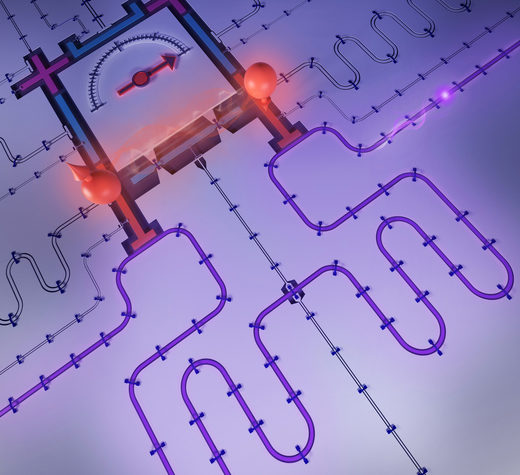
Why do Quantum Computers need to be cooled to?

Definition of Quantum Computer Cooling Quantum computers represent a revolutionary advancement in computational technology, leveraging the unique principles of quantum mechanics to perform calculations beyond the reach of classical machines. A critical prerequisite for their operation is maintaining the quantum processors at temperatures close to absolute zero. This extreme cooling is essential to protect the […]

Read More →

What is the use of chemistry for a computer engineer?

Definition The intersection of chemistry and computer engineering represents a dynamic fusion where chemical principles underpin the development and enhancement of computing technologies. This multidisciplinary approach leverages chemical knowledge to innovate materials, processes, and systems that drive advancements in computer hardware and software, ultimately improving performance, sustainability, and functionality. Materials Science: The Chemical Foundation of […]

Read More →

Is EECS the Ultimate Combo Degree for Quantum Careers?

Understanding the Intersection of EECS and Quantum Technology As quantum technology rapidly advances, a pivotal question arises for students and professionals alike: Is a combined degree in Electrical Engineering and Computer Science (EECS) the optimal educational path for those aiming to excel in quantum mechanics and its applications? This inquiry invites a comprehensive examination of […]

Read More →

Why do cryptographic algorithms only use prime numbers?

Definition of Prime Numbers in Cryptography Prime numbers are natural numbers greater than one that have no divisors other than 1 and themselves. In the realm of cryptography, these numbers serve as fundamental building blocks due to their unique mathematical properties. Cryptographic algorithms leverage primes to secure communication by exploiting the difficulty of certain mathematical […]

Read More →

Statistical Physics Meets Quantum: How Computation Turns Probabilistic

Definition The intersection of statistical physics and quantum mechanics represents a profound fusion of two fundamental branches of physics, offering insights into how deterministic phenomena emerge from inherently probabilistic systems. This interdisciplinary nexus explores the behavior of large ensembles of particles governed by statistical laws alongside the quantum principles that describe particles existing in superpositions […]

Read More →

Can a quantum computer calculate the value of Rayo(999)?

Understanding Rayo(999) Rayo(999) represents an extraordinarily large number defined by the Rayo function, a concept introduced by mathematician José Carlos Santos Rayo. This function is designed to generate numbers that surpass any value expressible through a finite sequence of symbols within set theory or computable functions. As the input number increases, the output of the […]

Read More →

What is a quantum computer? – Physics-Only?

Understanding Quantum Computing Quantum computing represents a revolutionary approach to processing information, captivating experts across physics, engineering, and mathematics. It challenges the boundaries of classical computing by proposing solutions to problems that traditional computers find impractical or impossible to solve. This raises a fundamental inquiry: is quantum computing simply an advanced iteration of classical computing, […]

Read More →

How close are we to a ‘real’ quantum computer?

Understanding Quantum Computing Quantum computing represents a revolutionary leap in computational technology, captivating researchers, engineers, and futurists worldwide. Unlike classical computers that operate using binary bits (0s and 1s), quantum computers harness quantum bits or qubits, which can exist simultaneously in multiple states due to the principle of superposition. This unique property allows quantum machines […]

Read More →

What is the current state of quantum computers?

Understanding Quantum Computing Quantum computing represents a rapidly evolving domain that challenges traditional computational frameworks. While its foundational principles hold immense promise, there remains an ongoing debate: Is quantum computing truly the dawn of a revolutionary technology, or is it an alluring concept fueled by the enthusiasm of digital pioneers? Central to this discourse is […]

Read More →

What’s so good about quantum computers?

Understanding Quantum Computing Quantum computing represents a revolutionary leap in computational technology, driven by the principles of quantum mechanics. Unlike classical computers that operate using bits as the smallest unit of data, quantum computers utilize quantum bits, or qubits, which possess unique properties enabling them to perform complex calculations far beyond the reach of traditional […]

Read More →