Does a 2D object actually exist?

Understanding Dimensions: An Overview Dimensions form the backbone of mathematical and physical sciences, providing a framework to describe the spatial properties of objects and spaces. Fundamentally, dimensions indicate the number of independent directions or parameters needed to specify a point within a given space. Zero Dimension (0D): A point with no length, width, or height. […]

Read More →

Which particle is not in nucleus?

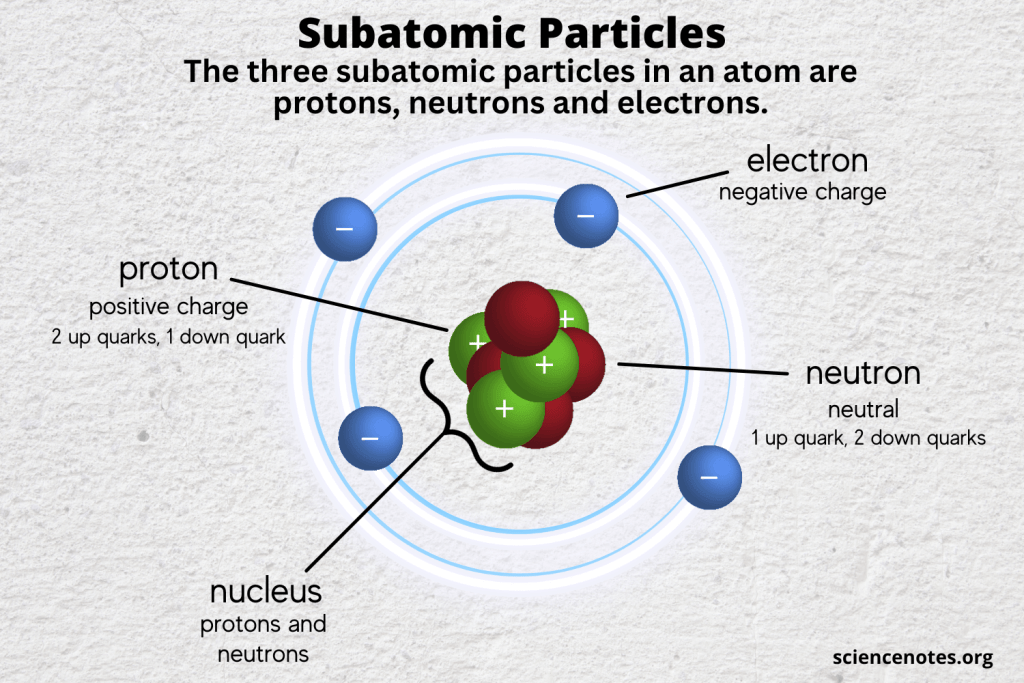
Definition of Atomic Particles and Their Locations An atom is composed of several fundamental particles, each with distinct properties and spatial arrangements. The nucleus, a dense central core, contains protons and neutrons-collectively known as nucleons-which account for most of the atom’s mass. In contrast, electrons are subatomic particles that do not inhabit the nucleus but […]

Read More →

What fascinating quantum mysteries is CERN exploring?

Understanding Quantum Mysteries at CERN The European Organization for Nuclear Research, widely known as CERN, stands at the cutting edge of physics research, delving into the profound enigmas of quantum mechanics. This institution serves as a hub where theoretical concepts and experimental breakthroughs converge to deepen our comprehension of the universe’s intricate structure. The pursuit […]

Read More →

Why is condensed matter physics interesting?

Definition of Condensed Matter Physics Condensed matter physics is a dynamic and multifaceted branch of physics that investigates the properties and behaviors of matter in its solid and liquid states. It focuses on how atoms and molecules aggregate to form complex structures, revealing a wide spectrum of physical phenomena. This field integrates principles from quantum […]

Read More →

Why do people think the Sun is a nuclear reaction?

Definition of Solar Energy Generation The Sun’s energy production is fundamentally driven by nuclear fusion, a process where atomic nuclei combine to form heavier elements, releasing vast amounts of energy. This phenomenon is central to astrophysics and explains how stars, including our Sun, sustain their luminosity and heat over billions of years. Stellar Nucleosynthesis: The […]

Read More →

What will be a career after a PhD in high energy physics?

Definition of Career Paths After a PhD in High-Energy Physics High-energy physics, a branch of science focused on investigating the fundamental particles of matter and the forces that govern their interactions, offers a wide spectrum of career opportunities for those who have earned a PhD. Graduates can pursue diverse professional avenues that leverage their specialized […]

Read More →

What are the different branches of physics?

Definition of Physics and Its Branches Physics stands as a foundational natural science dedicated to uncovering the essential laws that govern the universe. It encompasses a wide array of specialized fields, each concentrating on particular facets of matter, energy, and their interactions. Studying these diverse branches not only deepens our understanding of the physical environment […]

Read More →

Do colliders do fission or fusion?

Understanding Particle Colliders Particle colliders are monumental scientific instruments designed to accelerate subatomic particles to near-light speeds and induce collisions. These collisions allow physicists to investigate the fundamental components of matter and the forces governing their interactions. Iconic examples include the Large Hadron Collider (LHC), which operates deep underground and facilitates groundbreaking discoveries in particle […]

Read More →

Do elementary particles have shape?

Definition of Particle Shape in Physics The question of whether elementary particles possess a shape is a profound inquiry at the intersection of physics and philosophy. Unlike everyday objects that have clear, tangible forms such as spheres or cubes, elementary particles challenge these conventional ideas. In particle physics, entities like electrons, quarks, and neutrinos are […]

Read More →