
Short Answer
Understanding Black Holes and Dark Energy
Black holes and dark energy represent two of the most profound mysteries in contemporary cosmology. Black holes are regions in space where gravity is so intense that nothing, including light, can escape their pull. Dark energy, on the other hand, is an enigmatic force responsible for the accelerated expansion of the universe. Exploring the potential connections between these cosmic phenomena could unlock new insights into the fundamental workings of the universe.
Definition and Characteristics of Black Holes
Black holes form primarily from the gravitational collapse of massive stars or possibly from primordial density fluctuations in the early universe. They are characterized by an event horizon, a boundary beyond which the known laws of physics cease to apply in conventional ways. Inside this boundary lies a singularity, a point where density becomes infinite and spacetime curvature reaches extreme levels.
- Event Horizon:
The invisible boundary around a black hole beyond which nothing can return. - Singularity:
The core of a black hole where matter is compressed to infinite density. - Formation:
Resulting from stellar collapse or early universe fluctuations.
What is Dark Energy?
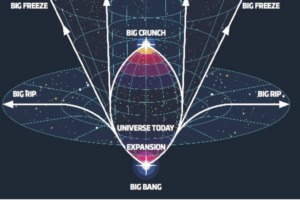
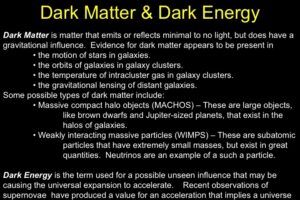
Dark energy constitutes about 68% of the universe’s total energy content. It is a pervasive form of energy that fills all space and exerts a repulsive gravitational effect, causing the universe’s expansion to accelerate. First observed through distant supernovae in the late 1990s, dark energy remains poorly understood. It is often modeled as the cosmological constant in Einstein’s equations or as a dynamic field known as quintessence, which evolves over time.
- Cosmological Constant:
A fixed energy density filling space uniformly. - Quintessence:
A time-varying field that could explain changes in dark energy’s strength. - Role in Expansion:
Drives the accelerated expansion of the universe.
Hypotheses Linking Black Holes and Dark Energy
One intriguing hypothesis suggests that black holes might act as reservoirs or transformers of dark energy. Given their ability to compress matter and energy into extremely small volumes, some theoretical models propose that the energy within black holes could influence or contribute to the dark energy driving cosmic acceleration. This raises the possibility that a fraction of dark energy is concealed within the event horizons of numerous black holes scattered throughout the cosmos.
Quantum Effects and Black Hole Evaporation
Traditional views consider black holes as one-way sinks absorbing matter and energy. However, quantum mechanics introduces complexity through phenomena like Hawking radiation, which predicts that black holes emit thermal radiation and gradually evaporate over vast timescales. This process implies that black holes might release energy back into the universe, potentially affecting the overall cosmic energy balance and hinting at a subtle interaction with dark energy.
Black Hole Entropy and the Holographic Principle
Black holes possess entropy, quantified by the Bekenstein-Hawking formula, linking their surface area to informational content. The holographic principle extends this idea, proposing that all information within a volume of space can be encoded on its boundary. This concept has led theorists to speculate that black holes could serve as models for understanding the universe’s boundary conditions and, by extension, the nature of dark energy. It is conceivable that the vacuum energy associated with dark energy might be holographically represented at black hole event horizons, connecting two of cosmology’s deepest enigmas.
Primordial Black Holes and Their Cosmological Significance
Primordial black holes, hypothesized to have formed shortly after the Big Bang, might be abundant enough to influence cosmic evolution. If these ancient black holes interact with dark energy differently than those formed by stellar collapse, they could leave observable imprints in cosmic background radiation, gravitational waves, or the large-scale structure of the universe. Studying their distribution, mass range, and evaporation rates could provide valuable clues about their relationship with dark energy.
Challenges in Observing Black Hole and Dark Energy Interactions
Detecting direct evidence of interactions between black holes and dark energy is extremely challenging. Black holes emit no light, and dark energy’s nature is inherently elusive. Researchers rely on indirect methods such as analyzing gravitational waves, gravitational lensing, and subtle variations in cosmic expansion. Advanced simulations and theoretical frameworks, including string theory and loop quantum gravity, are employed to explore possible mathematical connections between black hole physics and dark energy dynamics.
Implications for Cosmology and Fundamental Physics
If black holes are not merely endpoints of matter but active participants in the universe’s energy accounting, this could revolutionize our understanding of cosmic evolution and the ultimate fate of the cosmos. Such a perspective might bridge gaps between quantum mechanics and general relativity, advancing the quest for a unified quantum theory of gravity. Additionally, the interplay between black holes, dark energy, dark matter, and cosmic inflation suggests a dynamic and interconnected cosmic framework.
Conclusion: The Quest to Unveil Cosmic Mysteries
The proposition that black holes may conceal vital information about dark energy is both captivating and complex. It challenges scientists to delve deeper into the enigmatic realms shaped by gravity and quantum effects, reconsidering the intricate relationships between matter, energy, and spacetime. Whether or not black holes ultimately reveal the secrets of dark energy, ongoing research continues to expand the horizons of human knowledge, inspiring new theories and fueling the cosmic quest to illuminate the universe’s darkest mysteries.
FAQ
What are black holes?
Black holes are regions in space where gravity is so intense that nothing, including light, can escape their pull.
What is dark energy?
Dark energy is an enigmatic force responsible for the accelerated expansion of the universe, constituting about 68% of its total energy content.
How might black holes relate to dark energy?
Some hypotheses suggest that black holes could act as reservoirs of dark energy, potentially influencing cosmic acceleration.

Leave a Reply