
Short Answer
Definition of a Light-Year
A light-year is a unit of measurement used in astronomy to express vast distances in space. Contrary to what its name might imply, a light-year does not measure time but rather the distance that light travels in the span of one Earth year. This unit helps scientists quantify the immense expanses between celestial objects such as stars, galaxies, and nebulae.
- Light speed:
Light travels at an extraordinary velocity of approximately 186,282 miles per second (299,792 kilometers per second). - Distance covered:
Over the course of a year, light covers nearly 5.88 trillion miles (9.46 trillion kilometers).
Understanding the Concept
To grasp the idea of a light-year, imagine light as a cosmic messenger racing through the universe at a constant speed. In just one second, light can circle the Earth’s equator about 7.5 times. When this rapid traveler moves continuously for an entire year, the distance it covers becomes a useful yardstick for measuring the vastness of space.
The term “year” in light-year refers to the time interval during which light travels this immense distance, not to a duration of time itself. This distinction often causes confusion because “year” is commonly associated with time rather than distance.
Why Use Light-Years?
Distances within our solar system are typically measured in astronomical units (AU), where one AU equals the average distance between Earth and the Sun-about 93 million miles. However, when dealing with objects far beyond our solar neighborhood, these units become impractical due to the enormous scales involved. The light-year provides a more manageable and meaningful way to express these colossal distances.
By using the distance light travels in a year, astronomers can communicate spatial measurements that are both vast and comprehensible, bridging the gap between human experience and cosmic scale.
Light-Year as a Cosmic Odometer
Think of a light-year as a cosmic odometer, similar to the mileage counter in a car. Just as an odometer records the distance a vehicle travels on roads, a light-year measures how far light journeys through the universe. This analogy helps illustrate how astronomers use light-years to map the positions of stars and galaxies across the cosmic landscape.
Light-Year and the Passage of Time
When astronomers say a star is 10 light-years away, they mean that the light we see from that star today actually left it 10 years ago. This means observing distant objects in space is akin to looking back in time, as the light carries information from the past to our telescopes. Thus, the light-year intertwines distance with a temporal dimension, making astronomy a form of historical study through celestial light.
Scientific and Philosophical Significance
Beyond its practical use, the light-year holds a symbolic and philosophical allure. It represents humanity’s effort to comprehend the universe on its own terms, transcending everyday measurements and inviting us to imagine journeys across the stars. The concept challenges our intuitive understanding of space and time, reflecting the complex relationship between these dimensions as revealed by modern physics.
Relation to Modern Physics
The light-year embodies the interconnectedness of space and time, a principle central to Einstein’s theory of relativity. Observations of distance and time can vary depending on the observer’s frame of reference, highlighting the relativistic nature of the universe. This makes the light-year not only a practical tool but also a gateway to deeper scientific insights.
Common Misconceptions About Light-Years
A light-year measures time.
It is a unit of distance, specifically how far light travels in one year.
The “year” in light-year refers to a general time period.
It specifically denotes the Earth’s orbital year, used as a standard temporal frame to define the distance light covers.
Practical Examples of Light-Years
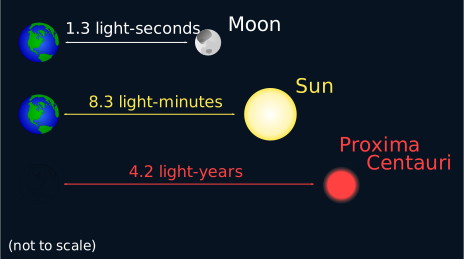
To put the scale into perspective, the nearest star system to Earth, Alpha Centauri, is about 4.37 light-years away. This means the light we see from Alpha Centauri today began its journey over four years ago. Similarly, distant galaxies can be millions or even billions of light-years away, illustrating the staggering scale of the cosmos.
Importance of the Light-Year in Astronomy and Beyond
The light-year is an indispensable measurement in astronomy, enabling scientists to map the universe and understand the structure and evolution of celestial bodies. It connects human perception with the vastness of space, reminding us of our place in the cosmos and the immense scales that govern it. This unit also enriches our cultural imagination, inspiring curiosity and exploration beyond our terrestrial confines.





Leave a Reply