
Short Answer
Definition of Gravity
Gravity is a fundamental interaction that governs the attraction between masses. Unlike the classical Newtonian view of gravity as a force acting at a distance, modern physics describes gravity as the warping or curvature of spacetime caused by mass and energy. This concept was revolutionized by Albert Einstein’s General Theory of Relativity, which redefined gravity as a geometric property of the universe rather than a conventional force.
- Newtonian Gravity:
Gravity as a force proportional to mass and inversely proportional to the square of the distance between objects. - Einsteinian Gravity:
Gravity as the curvature of spacetime, where massive objects cause distortions that influence the motion of other bodies.
Historical Context and Einstein’s Contribution
At the dawn of the 20th century, Albert Einstein transformed the understanding of gravity by introducing the General Theory of Relativity. This theory replaced the Newtonian concept of gravity with a model where mass and energy curve the fabric of spacetime, and this curvature dictates the motion of objects. Einstein’s insight laid the groundwork for modern gravitational physics and opened new avenues for exploring cosmic phenomena.
Detection and Significance of Gravitational Waves
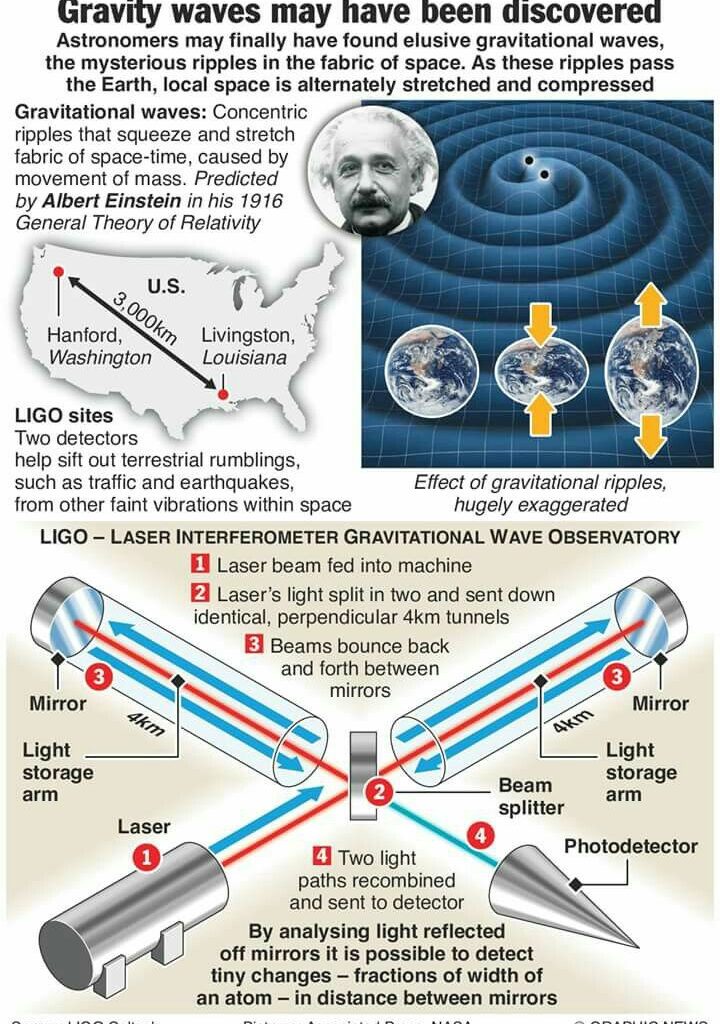
One of the most groundbreaking advancements since Einstein’s era has been the observation of gravitational waves-ripples in spacetime generated by massive accelerating bodies. Although predicted by Einstein, these waves remained undetected for nearly a century until 2015, when the Laser Interferometer Gravitational-Wave Observatory (LIGO) successfully recorded signals from merging black holes located billions of light-years away.
- Gravitational Waves:
Disturbances in spacetime caused by cataclysmic events such as black hole collisions and neutron star mergers. - Impact:
This discovery confirmed a key prediction of General Relativity and inaugurated gravitational wave astronomy, enabling the study of cosmic events previously inaccessible through electromagnetic observations.
Quantum Gravity: Bridging the Macro and Micro Worlds
While General Relativity excels at describing gravity on large scales, it does not reconcile with quantum mechanics, which governs the subatomic realm. The quest to unify gravity with quantum theory has led to the development of quantum gravity models, which attempt to describe gravitational interactions at the smallest scales.
- String Theory:
Proposes that fundamental particles are one-dimensional strings, with gravity emerging from vibrational modes, including hypothetical gravitons. - Loop Quantum Gravity:
Suggests that spacetime itself has a discrete structure, quantized at the Planck scale. - Gravitons:
Hypothetical quantum particles that mediate gravitational interactions, yet to be experimentally observed.
Gravity’s Role in Cosmology and the Universe’s Evolution
Gravity is central to understanding the large-scale structure and dynamics of the universe. Observations have revealed phenomena such as dark matter and dark energy, which challenge classical gravitational models and suggest new physics beyond General Relativity.
- Dark Matter:
An invisible form of matter detected through its gravitational influence on galaxies and cosmic structures. - Dark Energy:
A mysterious force driving the accelerated expansion of the universe, possibly linked to gravity in ways not yet fully understood. - Modified Gravity Theories:
Alternatives like Modified Newtonian Dynamics (MOND) and f(R) gravity attempt to explain cosmic observations without invoking dark matter, though these remain debated.
Experimental Tests and Observations of Gravity
Laboratory experiments and astrophysical observations continue to refine our understanding of gravity, testing its behavior under extreme conditions and at very small scales.
- Precision Measurements:
Experiments using torsion balances and atom interferometry probe gravitational interactions at sub-millimeter distances, searching for deviations from Newtonian predictions. - Event Horizon Telescope:
Imaging of the supermassive black hole in galaxy M87 provided direct visual evidence of intense gravitational fields and event horizon properties predicted by General Relativity. - Gravitational Time Dilation:
Confirmed through satellite-based systems like GPS, which require relativistic corrections to maintain precise timing and positioning.
Mathematical Framework of Gravity
The mathematical description of gravity in General Relativity is encapsulated by Einstein’s field equations, which relate the geometry of spacetime to the distribution of mass and energy:
Gμν + Λgμν = (8πG/c⁴) Tμν
- Gμν: Einstein tensor representing spacetime curvature.
- Λ: Cosmological constant associated with dark energy.
- gμν: Metric tensor describing spacetime geometry.
- Tμν: Stress-energy tensor representing matter and energy content.
- G: Gravitational constant.
- c: Speed of light.
Common Misconceptions About Gravity
Gravity is a force like electromagnetism.
Gravity is better understood as the curvature of spacetime, not a force transmitted through a field in the classical sense.
Gravity behaves the same at all scales.
Gravity’s behavior may differ at quantum scales or in extreme environments, necessitating new theories beyond General Relativity.
Dark matter is just a form of normal matter.
Dark matter does not interact electromagnetically and is detected only through gravitational effects, indicating it is fundamentally different from ordinary matter.
Why Understanding Gravity Is Crucial
Gravity is a cornerstone of physics, shaping the structure and evolution of the universe from the smallest particles to the largest cosmic formations. Its study informs technologies such as GPS, deepens our comprehension of black holes and cosmology, and drives the search for a unified theory of fundamental forces. Continued exploration of gravity promises to unlock profound insights into the nature of reality and the fundamental laws governing existence.
Real-World Applications and Implications
Gravity’s influence extends beyond theoretical physics into practical domains:
- Global Positioning Systems (GPS):
Require precise adjustments for gravitational time dilation to provide accurate location data. - Astrophysical Observations:
Enable the study of phenomena such as black hole mergers and neutron star collisions through gravitational wave detection. - Space Exploration:
Understanding gravitational fields is essential for spacecraft navigation and mission planning.
Leave a Reply