
Short Answer
Definition of Light Bending by Gravity
The phenomenon of light bending due to gravity refers to the alteration in the trajectory of light as it passes near massive objects. This effect occurs without any change in the intrinsic speed of light, which remains constant at approximately 299,792 kilometers per second. Instead, gravity influences the path that light follows by curving the fabric of spacetime itself.
- Light speed:
The speed of light in a vacuum is a universal constant, denoted as c, and remains unchanged even in the presence of gravitational fields. - Gravitational bending:
The deflection of light’s path is a result of spacetime curvature caused by massive bodies, not a change in light’s velocity.
Fundamental Principles Behind Light’s Interaction with Gravity
Einstein’s General Theory of Relativity revolutionized our understanding of gravity by describing it not as a force but as the warping of spacetime caused by mass and energy. Massive celestial bodies such as stars and black holes create indentations in this four-dimensional fabric, influencing the motion of objects and light traveling nearby.
Light, although massless, follows the straightest possible paths-called geodesics-within this curved spacetime. Consequently, its direction bends as it moves along these warped trajectories, while its speed remains locally constant.
Spacetime Curvature and Geodesics
Imagine spacetime as a flexible sheet stretched taut. When a heavy object rests on this sheet, it creates a depression. Light traveling across this sheet will follow the curved contours around the depression, resulting in a bent path. This bending is not due to a force acting on the light but because the geometry of spacetime itself is altered.
Gravitational Lensing: A Cosmic Optical Phenomenon
Gravitational lensing occurs when light from distant stars or galaxies is deflected by the gravitational field of an intervening massive object. This effect can produce multiple images, magnifications, or distortions of the background source, effectively turning gravity into a natural cosmic lens.
- Multiple images:
Light paths bent differently can create several visible images of the same astronomical object. - Magnification:
The bending can amplify the brightness of distant objects, allowing astronomers to observe otherwise hidden features. - Distortion:
Shapes of background galaxies may appear stretched or warped due to the lensing effect.
How Light’s Speed Remains Constant Despite Bending
Although the trajectory of light curves near massive bodies, its speed does not change. This can be understood by distinguishing between local and global frames of reference:
- Local frame:
In an infinitesimally small region of spacetime, light always travels at speed c. - Global frame:
Over large distances and curved regions, the path of light appears bent, but this is a geometric effect rather than a change in velocity.
An analogy is a ship navigating ocean currents: the ship’s engine speed remains constant, but the currents alter its course. Similarly, gravity shapes the path of light without accelerating or decelerating it.
Mathematical Description of Light Bending
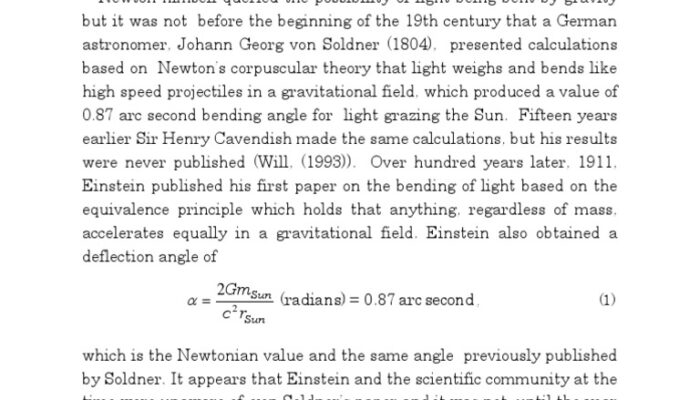
The deflection angle α of light passing near a massive object can be approximated by the formula derived from General Relativity:
α ≈ (frac{4GM}{c^2 b})
- G: Gravitational constant
- M: Mass of the deflecting object
- c: Speed of light in vacuum
- b: Impact parameter (closest approach distance of the light to the mass)
This formula quantifies how the mass and proximity of an object influence the bending angle of light passing nearby.
Historical and Experimental Evidence
The first empirical confirmation of light bending by gravity was achieved during the 1919 solar eclipse expedition led by Sir Arthur Eddington. Observations showed starlight deflected around the Sun’s gravitational field, matching Einstein’s predictions precisely. Since then, numerous observations of gravitational lensing around galaxies and black holes have consistently validated that light’s speed remains constant while its path is curved.
Distinguishing Light from Massive Particles in Gravitational Fields
Unlike photons, which are massless and always travel at speed c, massive particles experience changes in both speed and direction when influenced by gravity. Photons, however, undergo gravitational redshift or blueshift-changes in frequency and wavelength-without any alteration in their velocity.
Common Misconceptions About Light and Gravity
Gravity slows down or speeds up light.
Light’s speed remains constant locally; gravity only changes its direction by curving spacetime.
Light is pulled by gravity like a massive object.
Light follows geodesics in curved spacetime rather than being pulled by a force.
Significance of Light Bending in Science and Astronomy
The bending of light by gravity is a cornerstone of modern astrophysics and cosmology. It enables scientists to:
- Map invisible structures such as dark matter through gravitational lensing effects.
- Study the properties of black holes and galaxy clusters by observing how they distort light from background sources.
- Test the predictions of General Relativity and refine our understanding of gravity and spacetime.
This phenomenon also challenges classical intuitions about motion and forces, highlighting the elegant framework of relativistic physics that governs the universe.
Summary
In essence, gravity bends the path of light by curving the geometry of spacetime, but it does not alter the speed at which light travels. This interplay between light and gravity exemplifies the profound unity of the cosmos, where the speed of light remains an unbreakable constant, while its direction gracefully adapts to the invisible contours shaped by massive celestial bodies.



Leave a Reply