
Short Answer
Understanding Gravity: An Overview
Gravity has captivated the curiosity of scientists, philosophers, and thinkers throughout history. At its core lies a profound question: is gravity an inherent characteristic of matter, or does it arise from the structure of space-time itself? This inquiry transcends classical physics and delves into modern theoretical landscapes, revealing a complex interplay of ideas, theories, and empirical evidence that deepen our comprehension of gravity.
Classical Perspective: Gravity as a Force
Historically, gravity was interpreted through the lens of classical mechanics, particularly in Isaac Newton’s formulation. Newtonian gravity describes it as a force intrinsic to matter, where objects possessing mass exert an attractive pull on one another across distances. This relationship is mathematically expressed by Newton’s law of universal gravitation, which states that the gravitational force between two masses is directly proportional to the product of their masses and inversely proportional to the square of the distance separating them.
- Newton’s Law of Universal Gravitation:
F = G * (m₁ * m₂) / r², where F is the gravitational force, G is the gravitational constant, m₁ and m₂ are the masses, and r is the distance between their centers. - Implication:
Gravity acts as an instantaneous force pulling masses together, a concept that aligns well with everyday experiences but faces limitations at cosmic scales.
Limitations of Newtonian Gravity
Despite its success in explaining many phenomena, Newton’s theory could not fully account for certain observations. For example, the anomalous precession of Mercury’s orbit and the deflection of light by massive bodies posed challenges that hinted at the need for a more comprehensive framework. These discrepancies paved the way for a revolutionary shift in understanding gravity.
Einstein’s General Relativity: Gravity as Geometry
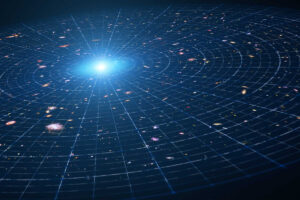
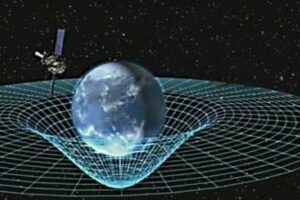
Albert Einstein’s general theory of relativity redefined gravity not as a force but as a geometric property of space-time. According to this theory, massive objects cause a curvature in the four-dimensional fabric of space-time, and this curvature directs the motion of objects, which we perceive as gravitational attraction.
- Space-Time Curvature:
Mass and energy warp space-time, creating “valleys” that influence the paths of moving objects. - Geodesics:
Objects follow the straightest possible paths (geodesics) in curved space-time, which appear as curved trajectories in three-dimensional space.
Key Phenomena Explained by General Relativity
This geometric interpretation accounts for phenomena unexplained by Newtonian gravity:
- Gravitational Lensing:
Light bends around massive objects due to space-time curvature, allowing astronomers to observe distant galaxies and black holes. - Time Dilation:
Clocks run slower in stronger gravitational fields, a prediction confirmed by experiments involving satellites and atomic clocks.
Gravitational Fields: Bridging Concepts
Gravitational fields serve as an intermediary concept linking matter and the curvature of space-time. They can be visualized as disturbances or gradients in space-time emanating from massive bodies, providing a framework that complements both Newtonian and relativistic views.
Quantum Gravity: The Frontier of Understanding
Modern physics seeks to unify gravity with quantum mechanics, leading to intriguing hypotheses about gravity’s fundamental nature. Theories such as quantum gravity, loop quantum gravity, and string theory propose that gravity might emerge from quantum phenomena:
- Gravitons:
Hypothetical quantum particles that mediate gravitational interactions, analogous to photons in electromagnetism. - Emergent Gravity:
The idea that gravity arises from the collective behavior of microscopic space-time structures, possibly linked to entropy and information theory.
Experimental Insights and Observations
Contemporary research employs advanced experiments to probe gravity’s essence:
- Gravitational Waves:
Detected ripples in space-time generated by massive cosmic events, confirming predictions of general relativity. - Precision Tests:
Measurements of gravitational effects in various environments test deviations from classical predictions, refining our understanding.
Visualizing Gravity: Analogies and Thought Experiments
To aid comprehension, analogies such as a heavy ball placed on a stretched rubber sheet illustrate how mass distorts space-time, guiding the motion of smaller objects. While simplified, these models help conceptualize complex gravitational dynamics.
Philosophical Reflections on Gravity
The nature of gravity also invites philosophical inquiry: does gravity exist independently of matter, or is it a relational property emerging from the interaction between matter and space-time? These questions challenge the boundaries of scientific knowledge and touch upon metaphysical considerations about reality.
Significance of Understanding Gravity
Grasping whether gravity is a property of matter or a manifestation of space-time curvature is crucial for multiple reasons. It shapes our comprehension of the universe’s structure, informs technologies such as GPS, and guides the search for a unified theory of fundamental forces. Gravity remains a central phenomenon that continues to inspire scientific exploration and philosophical debate.
FAQ
What is Newton's view on gravity?
Newton viewed gravity as a force intrinsic to matter, described by his law of universal gravitation.
How does Einstein's theory of general relativity redefine gravity?
Einstein proposed that gravity is not a force but a curvature of space-time caused by massive objects.
What are gravitational waves?
Gravitational waves are ripples in space-time caused by massive cosmic events, confirming predictions of general relativity.


Leave a Reply