
Short Answer
Understanding Gravity
Gravity is a fundamental force that governs the motion of celestial bodies and everyday objects alike. It shapes the structure of the universe, influencing the trajectories of planets, stars, and galaxies. From the simple act of an apple falling to the ground to the complex orbit of Earth around the Sun, gravity’s presence is undeniable. While Isaac Newton’s law of universal gravitation laid the groundwork for understanding this force, Albert Einstein’s theory of relativity offers a deeper and more comprehensive explanation, revealing the intricate relationship between gravity, space, and time.
Historical Perspective: Newton’s Law of Universal Gravitation
In the 17th century, Isaac Newton introduced a groundbreaking concept that described gravity as a force acting between two masses separated by a distance. His law states that the gravitational force is directly proportional to the product of the masses and inversely proportional to the square of the distance between them. This inverse-square law became a fundamental principle in classical mechanics, enabling precise predictions of planetary orbits, tidal movements, and projectile paths.
- Key Principle:
Gravity acts as an attractive force between masses. - Mathematical Relationship:
Force ∝ (Mass1 × Mass2) / Distance². - Limitations:
Assumes instantaneous action at a distance, conflicting with later findings about the finite speed of information transfer.
Unanswered Questions in Classical Gravity
Despite its success, Newton’s theory left several mysteries unresolved. Scientists pondered how gravity could act without any detectable delay and what medium, if any, transmitted this force across space. These questions hinted at a more complex underlying reality, which classical mechanics could not fully explain. The observable phenomena of falling objects and planetary orbits only scratched the surface of gravity’s true essence.
Einstein’s General Theory of Relativity: A New Paradigm
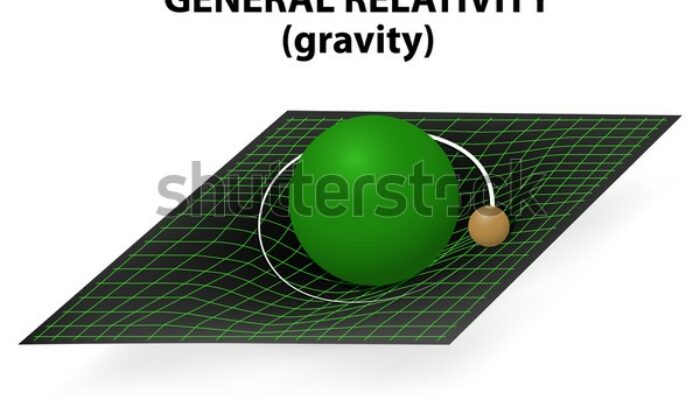
In the early 20th century, Albert Einstein revolutionized our understanding of gravity by proposing that it is not a force but a consequence of curved spacetime. Massive objects like planets and stars distort the fabric of spacetime around them, much like a heavy ball placed on a stretched rubber sheet creates a depression. Objects move along the curved paths, known as geodesics, shaped by this distortion.
- Gravity as Geometry:
Mass warps spacetime, guiding the motion of objects. - Geodesics:
The natural paths objects follow in curved spacetime. - Finite Propagation Speed:
Changes in gravitational fields travel at the speed of light, preserving causality.
Key Predictions and Confirmations of Relativity
Einstein’s theory made several groundbreaking predictions that classical gravity could not account for:
- Light Bending:
Light rays curve when passing near massive bodies due to spacetime curvature. This was spectacularly confirmed during the 1919 solar eclipse, providing strong evidence for general relativity. - Gravitational Time Dilation:
Time runs slower in stronger gravitational fields. Experiments with atomic clocks at varying altitudes on Earth have validated this effect, which becomes pronounced near black holes and neutron stars. - Black Holes:
Regions where spacetime curvature is so extreme that nothing, not even light, can escape. - Gravitational Waves:
Ripples in spacetime generated by violent cosmic events like merging black holes, detected by observatories in recent years, opening new avenues for astrophysical research.
Mathematical Framework of Gravity
Newton’s law of gravitation is expressed as:
F = G × (m₁ × m₂) / r²
- F: Gravitational force between two masses.
- G: Gravitational constant.
- m₁, m₂: Masses of the two objects.
- r: Distance between the centers of the two masses.
In contrast, Einstein’s general relativity uses the Einstein field equations, which relate the geometry of spacetime to the distribution of mass and energy. These complex tensor equations describe how matter and energy influence spacetime curvature, dictating gravitational phenomena.
Practical Implications and Everyday Relevance
While Newtonian gravity suffices for most everyday calculations and engineering applications, relativistic effects become crucial in high-precision technologies and astrophysical contexts. For example, the Global Positioning System (GPS) must account for gravitational time dilation to provide accurate location data. Moreover, understanding gravity’s true nature is essential for exploring extreme cosmic environments and advancing theoretical physics.
Common Misunderstandings About Gravity
- Misconception: Gravity is an instantaneous force.
Correction: According to relativity, gravitational changes propagate at the speed of light, not instantaneously. - Misconception: Gravity is a force like electromagnetism.
Correction: Gravity is better understood as the curvature of spacetime rather than a conventional force. - Misconception: Gravity only affects massive objects.
Correction: Gravity influences all objects with energy, including light, which follows curved paths in spacetime.
The Significance of Gravity in Science and Cosmology
Gravity is central to our comprehension of the universe’s structure and dynamics. It governs the formation of galaxies, the life cycles of stars, and the evolution of cosmic phenomena. The shift from Newtonian to relativistic gravity marks a profound advancement in physics, reflecting humanity’s quest to unravel the universe’s deepest mysteries. This evolving understanding continues to inspire scientific inquiry and technological innovation, highlighting gravity’s enduring importance in both theoretical and practical realms.
Leave a Reply