
Short Answer
Definition of Gravity’s Role in the Universe’s Origin
The inception of the universe remains one of the most profound mysteries in cosmology, intricately linked to the fundamental force of gravity. Gravity, an invisible yet powerful interaction, played a pivotal role in shaping the cosmos from its earliest moments. It influenced the formation of galaxies, stars, and the large-scale structure that defines the observable universe, making it a cornerstone in understanding cosmic evolution.
Early Universe Conditions and Quantum Fluctuations
At the very beginning, the universe was an extremely hot, dense, and nearly uniform expanse. This initial phase, commonly known as the Big Bang, involved a rapid expansion of spacetime itself. Matter and energy were almost evenly spread, leaving little room for gravity to create variations or structures. However, tiny irregularities known as quantum fluctuations introduced subtle differences in density. These minute variations, though imperceptible at first, became the essential seeds from which gravity would later foster complexity and structure.
Gravity and the Amplification of Density Variations
According to Einstein’s general relativity, gravity arises from the curvature of spacetime caused by mass and energy. This force began to magnify the initial density fluctuations, where regions with slightly higher density exerted stronger gravitational pull, attracting more matter and growing denser. Conversely, less dense areas lost matter, forming voids and breaking the initial uniformity. This gravitational instability was crucial for the clumping of matter, setting the stage for cosmic structure formation.

The Recombination Epoch and the Cosmic Microwave Background
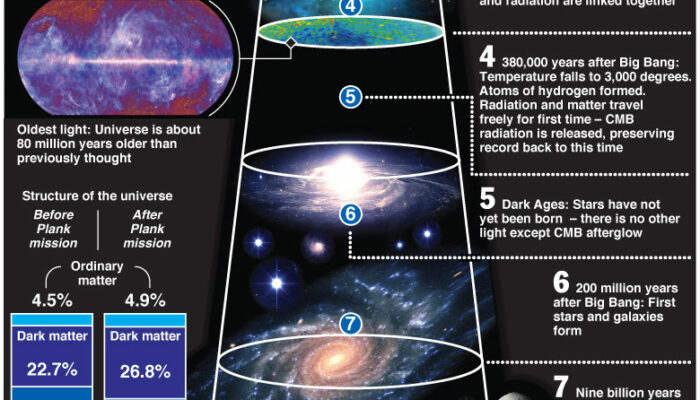
Approximately 380,000 years after the Big Bang, the universe underwent a significant transformation known as recombination. Prior to this, the cosmos was filled with a hot plasma of charged particles, which was opaque to radiation. As the universe cooled, protons and electrons combined to form neutral hydrogen atoms, allowing photons to travel freely. This event led to the release of the Cosmic Microwave Background (CMB), a relic radiation that carries the imprint of primordial density fluctuations. The slight temperature variations observed in the CMB provide direct evidence of gravity’s early influence in amplifying these density contrasts.
Formation of Cosmic Structures Post-Recombination
Following recombination, gravity’s influence intensified. The initially tiny density fluctuations began collapsing under their own gravitational pull, leading to the emergence of large-scale cosmic structures such as filaments, sheets, and clusters composed of dark matter and gas. These formations served as gravitational frameworks, guiding ordinary baryonic matter-composed of protons and neutrons-to gather and form the first stars and galaxies. Dark matter, which interacts primarily through gravity, played a vital role by creating gravitational wells that attracted baryonic matter, facilitating galaxy formation in a universe otherwise too diffuse to collapse rapidly.
Interplay Between Gravity and Other Fundamental Forces
In the universe’s earliest moments, gravity worked alongside other fundamental forces during a phase called cosmic inflation. This rapid exponential expansion, driven by a mysterious energy field, smoothed out the universe while stretching quantum fluctuations to macroscopic scales. Despite its relative weakness, gravity preserved these fluctuations, which later served as the blueprint for the formation of cosmic structures. This interaction between forces balanced the universe’s chaotic beginnings with emerging order.
Primordial Black Holes and Gravity’s Extreme Effects
Gravity’s influence during the universe’s infancy may have also led to the creation of primordial black holes. These hypothetical objects could form in regions where density contrasts were so extreme that gravitational collapse overwhelmed all opposing forces. While the existence and prevalence of primordial black holes remain subjects of ongoing research, their potential impact highlights the diverse and profound consequences of gravity’s omnipresence in cosmic evolution.
Hierarchical Clustering and the Cosmic Web
As matter continued to accumulate, gravity governed the hierarchical assembly of cosmic structures. Smaller entities merged to create larger ones in a process known as hierarchical clustering. This gravitationally driven assembly resulted in the cosmic web-a vast network of filaments connecting galaxies and clusters across billions of light-years. Gravity not only shaped this large-scale architecture but also influenced the internal dynamics of galaxies, star formation processes, and the life cycles of cosmic bodies.
Gravity’s Role in Primordial Nucleosynthesis
Beyond structuring matter, gravity indirectly influenced the formation of the universe’s first light elements through nucleosynthesis. In the minutes following the Big Bang, nuclear reactions synthesized hydrogen, helium, and trace amounts of other light elements. The rate of the universe’s expansion, governed by gravity’s interaction with mass-energy, regulated these nuclear processes. The resulting elemental abundances laid the foundation for the chemical composition of future stars and planets.
Gravitational Waves and Insights into the Early Universe
Gravity also manifests as gravitational waves-ripples in spacetime traveling at light speed, generated by violent cosmic events. Although primordial gravitational waves have yet to be detected, their discovery would offer unprecedented insights into the inflationary epoch and gravity’s earliest actions, deepening our understanding of the universe’s birth.
Gravity’s Influence on Cosmic Fate
Gravity acts as the architect of cosmic time and destiny, its persistent pull counterbalancing the universe’s expansion. This dynamic interplay determines possible futures, from eternal acceleration to eventual contraction in a cyclic model. Gravity’s dual role underscores its profound impact, extending from the universe’s origin to its ultimate fate.
Summary: Gravity as the Cosmic Architect
The story of the universe’s birth is fundamentally a narrative of gravity’s subtle yet transformative power. From imperceptible quantum fluctuations magnified by gravitational attraction to the sprawling cosmic web spanning billions of light-years, gravity has been the essential force sculpting cosmic architecture. Its enigmatic nature continues to inspire scientific exploration and philosophical reflection, standing as the invisible hand guiding the universe’s evolution from primordial chaos to magnificent order.



Leave a Reply