
Short Answer
Definition of Gravity and Its Propagation
Gravity is a fundamental force that governs the motion and interaction of celestial bodies such as planets, stars, and galaxies. It acts as an invisible link, drawing masses toward one another and shaping the structure of the universe. A critical question in physics has been how gravitational effects travel through the vast emptiness of space: do they occur instantaneously, or do they propagate at a finite speed? Modern scientific insights reveal that gravity transmits at the speed of light, intricately connecting this force to the fabric of spacetime itself.
Historical Perspectives on Gravity
Initially, gravity was understood through the lens of Newtonian mechanics, which described it as an instantaneous force acting across any distance without delay. This concept implied a mysterious “action-at-a-distance,” where one object could exert an immediate pull on another, regardless of the space between them. Such an idea posed a paradox, challenging the understanding of how information or influence could travel without any medium or time lag.
Einstein’s Revolution: Gravity as Curved Spacetime
Albert Einstein’s general theory of relativity transformed the classical view by redefining gravity not as a force transmitted through space, but as a manifestation of spacetime curvature. Massive objects cause distortions in the four-dimensional fabric of spacetime, creating gravitational wells that influence the motion of other bodies. A common analogy is a heavy ball placed on a stretched rubber sheet, causing it to deform and guiding smaller objects to move along the curved surface.
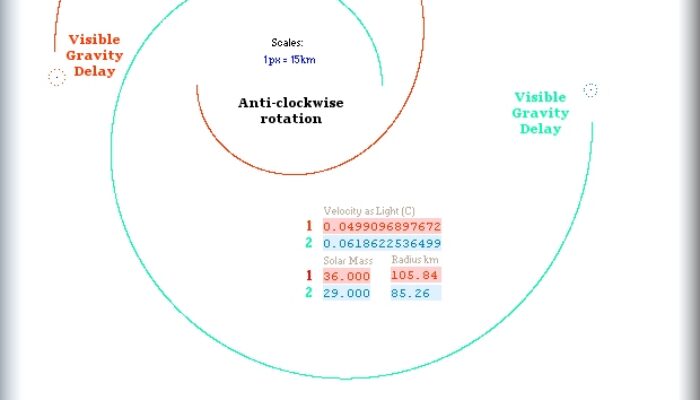
Importantly, changes in this curvature do not update instantaneously. When a massive object moves or changes, the alteration in its gravitational field propagates outward as ripples called gravitational waves.
Propagation Speed of Gravitational Effects
Contrary to Newtonian assumptions, gravitational changes travel at a finite speed-specifically, the speed of light, approximately 299,792 kilometers per second. This equivalence is not coincidental but arises from the geometric nature of spacetime and the equations governing gravity in Einstein’s framework. Consequently, any information about shifts in mass distribution cannot exceed this universal speed limit, embedding gravity firmly within relativistic physics.
Illustrative Thought Experiment: The Sun’s Sudden Disappearance
Consider a hypothetical scenario where the Sun abruptly vanishes. Would Earth immediately cease orbiting and move in a straight line? According to relativity, the answer is no. Earth would continue its orbit for about eight minutes-the time it takes sunlight to reach our planet-before feeling the absence of the Sun’s gravitational pull. This delay exemplifies how gravitational influence propagates at light speed, maintaining consistency with the cosmic speed limit.
Empirical Evidence: Gravitational Wave Observations
The direct detection of gravitational waves by the LIGO observatory in 2015 provided compelling experimental confirmation of gravity’s propagation speed. These waves, generated by cataclysmic events such as black hole or neutron star mergers, travel through spacetime at light speed. The simultaneous arrival of gravitational waves and electromagnetic signals from the same cosmic events verified with remarkable precision that gravity does not act instantaneously but respects the speed of light constraint. This milestone not only validated Einstein’s predictions but also inaugurated a new era in astrophysics.
Implications for Celestial Mechanics and Astrophysics
The finite speed at which gravity propagates introduces subtle but significant effects in the dynamics of astronomical systems. Gravitational interactions we observe are essentially delayed echoes from the recent past, akin to a cosmic telegraph transmitting information about the positions and motions of massive bodies. This time lag influences planetary orbits, pulsar timing, and the stability of galaxy clusters. Accurate modeling of these phenomena requires incorporating the finite propagation speed to refine predictions and test gravitational theories.
Philosophical and Scientific Significance
The realization that gravity’s influence travels at light speed challenges intuitive notions of immediacy and causality. It reveals gravity as a dynamic interplay between mass and spacetime, a continuous exchange that conveys information across cosmic distances. This perspective deepens our understanding of the universe’s interconnectedness and the fundamental principles that govern space and time.
Technological and Scientific Applications
Understanding the speed of gravity is crucial for advancing technologies and scientific fields such as satellite navigation, gravitational wave astronomy, and the investigation of dark matter and dark energy. Precise knowledge of gravitational behavior enhances the accuracy of space missions and informs the search for new physics beyond current models, opening pathways to uncovering the universe’s origins, evolution, and destiny.
Conclusion: The Cosmic Harmony of Gravity and Light
The discovery that gravity propagates at the speed of light revolutionizes our cosmic worldview, highlighting the elegant unity of physical laws. This profound connection between gravitational forces and electromagnetic signals underscores the intricate harmony underlying the universe’s operation. As research continues to unravel the complexities of gravitational transmission, our comprehension of the cosmos expands, revealing an ever more wondrous and interconnected reality.
FAQ
How does gravity propagate?
Gravity propagates at the speed of light, affecting how we observe gravitational interactions in space.
What is the significance of gravitational waves?
Gravitational waves provide evidence for the finite speed of gravity and confirm predictions made by Einstein's general theory of relativity.
What happens if the Sun were to disappear?
If the Sun were to disappear, Earth would continue in its orbit for about eight minutes before feeling the gravitational influence vanish.


Leave a Reply