
Short Answer
Definition of Gravitational Lensing
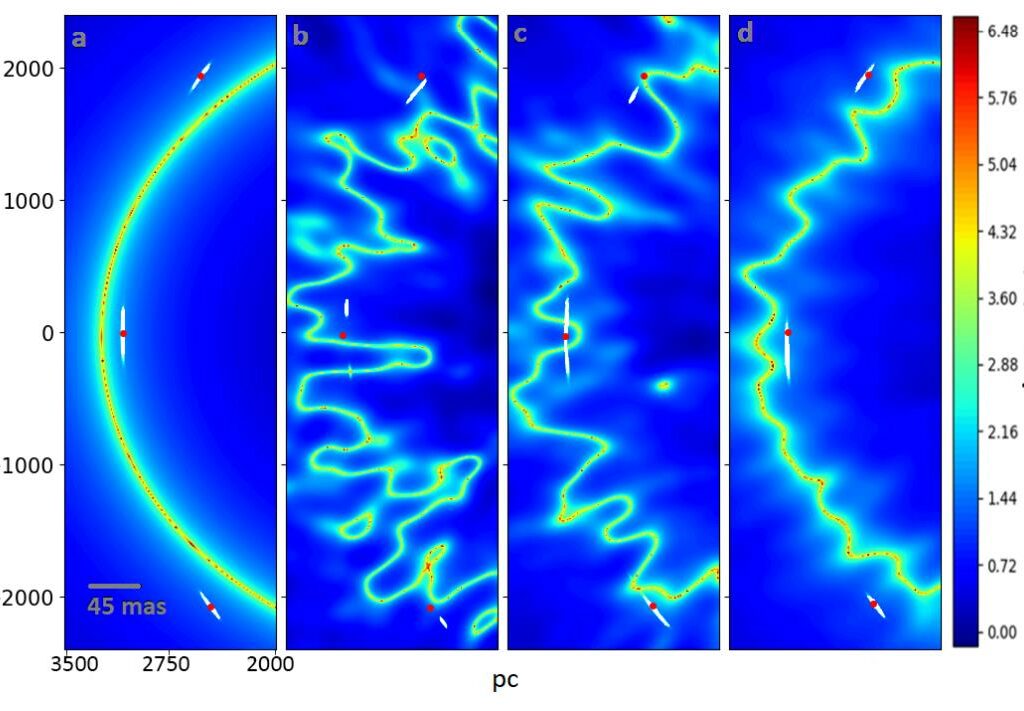
Gravitational lensing is a cosmic phenomenon where the gravitational field of a massive object bends and magnifies the light from a more distant source. This effect acts like a natural lens, distorting the appearance of galaxies, quasars, or other celestial bodies behind the massive object. It provides a unique observational window into the distribution of matter in the universe, including the elusive dark matter that cannot be detected through conventional electromagnetic observations.
- Gravitational bending of light:
Light rays passing near a massive object are deflected due to the curvature of spacetime caused by gravity. - Magnification and distortion:
The background source’s image can be stretched, split, or magnified, creating arcs, rings, or multiple images. - Revealing invisible matter:
The lensing effect exposes the presence of mass that does not emit or absorb light, primarily dark matter.
Fundamental Principles Behind Gravitational Lensing
The foundation of gravitational lensing lies in Einstein’s general theory of relativity, which describes gravity not as a force but as the warping of spacetime by mass and energy. When photons travel near a massive object, their paths curve along the distorted spacetime geometry. This bending alters the apparent position and shape of distant light sources as seen by an observer.
Unlike classical Newtonian gravity, which treats gravity as a force acting at a distance, general relativity predicts that mass changes the fabric of spacetime itself, guiding the trajectory of light. This principle transforms massive galaxy clusters and other dense cosmic structures into natural lenses that manipulate the light from objects behind them.
Types of Gravitational Lensing
- Strong Lensing:
Occurs when the alignment between the observer, lens, and background source is very close, producing dramatic visual effects such as Einstein rings, giant arcs, and multiple images of the same object. - Weak Lensing:
Produces subtle distortions in the shapes of many background galaxies, which can only be detected statistically. This effect helps map the large-scale distribution of dark matter across the universe. - Microlensing:
Involves smaller mass objects like stars or planets acting as lenses, causing temporary brightening of background sources without producing resolved multiple images.
Mathematical Framework of Gravitational Lensing
The deflection angle of light, α, caused by a lensing mass can be approximated by the formula:
α = (4GM) / (c²b)
- G: Gravitational constant
- M: Mass of the lensing object
- c: Speed of light
- b: Impact parameter (closest approach distance of the light to the mass)
More comprehensive lensing models use the lens equation, relating the angular positions of the source, lens, and image, incorporating the geometry of the observer-lens-source system and the mass distribution of the lens.
Gravitational Lensing as a Probe of Dark Matter
One of the most significant applications of gravitational lensing is its ability to detect and map dark matter, which neither emits nor absorbs light but exerts gravitational influence. Observations reveal that the visible matter in galaxy clusters accounts for only a fraction of the gravitational lensing effects observed. This discrepancy indicates the presence of substantial amounts of unseen mass.
By analyzing lensing patterns, astronomers have identified extensive halos of dark matter enveloping galaxies and clusters, shaping the gravitational landscape of the cosmos. These invisible structures form the scaffolding upon which visible matter accumulates, influencing galaxy formation and cosmic evolution.
Notable Case Study: The Bullet Cluster
The Bullet Cluster is a striking example where gravitational lensing has provided compelling evidence for dark matter. It consists of two colliding galaxy clusters. During the collision, the ordinary baryonic matter-composed of gas and stars-interacts and slows down, while the majority of the mass, inferred from lensing maps, passes through unaffected. This separation between visible matter and gravitational mass offers direct empirical proof that most of the cluster’s mass is non-baryonic dark matter.
Mapping the Cosmic Web Through Weak Lensing
Weak gravitational lensing enables cosmologists to chart the large-scale structure of the universe. By statistically analyzing the subtle distortions in the shapes of millions of distant galaxies, researchers reconstruct the filamentary network of dark matter that forms the cosmic web. This invisible framework governs the distribution of galaxies and the dynamics of cosmic expansion.
Gravitational Lensing and Dark Energy
Gravitational lensing also plays a crucial role in studying dark energy, the mysterious force driving the accelerated expansion of the universe. The lensing effect depends on the geometry of spacetime and the distribution of matter, both luminous and dark. Precise measurements of lensing distortions help refine cosmological models, improving our understanding of the balance between dark matter, dark energy, and ordinary matter.
Common Misconceptions About Gravitational Lensing
Gravitational lensing only magnifies distant objects.
While lensing can magnify, it also distorts and splits images, creating arcs and multiple images rather than simple magnification.
Dark matter can be seen directly through telescopes.
Dark matter does not emit or absorb light; it is detected indirectly through its gravitational effects, such as lensing.
Gravitational lensing violates the laws of optics.
Lensing is fully consistent with general relativity and classical optics, as it results from the curvature of spacetime affecting light paths.
Significance of Gravitational Lensing in Modern Astronomy
Gravitational lensing is a cornerstone technique in astrophysics and cosmology. It provides a powerful method to investigate the invisible components of the universe, such as dark matter and dark energy, which dominate cosmic mass-energy content. By revealing the hidden mass distribution, lensing informs theories of galaxy formation, cosmic structure, and the ultimate fate of the universe.
Moreover, gravitational lensing enhances observational capabilities by acting as a natural telescope, magnifying distant and faint objects that would otherwise be beyond detection. This has led to discoveries of early galaxies, quasars, and exoplanets, expanding our knowledge of the cosmos.
Philosophical and Scientific Implications
Beyond its scientific utility, gravitational lensing symbolizes the profound complexity and mystery of the universe. It challenges human perception by exposing the vast unseen forces shaping reality. The phenomenon invites a deeper appreciation of the cosmos, reminding us that much of existence lies beyond direct observation, yet leaves unmistakable imprints accessible through careful study.
In essence, gravitational lensing transforms abstract theoretical concepts into tangible cosmic maps, bridging the gap between the visible and invisible, and inspiring ongoing exploration into the fundamental nature of the universe.
FAQ
What is gravitational lensing?
Gravitational lensing is a cosmic phenomenon where the gravitational field of a massive object bends and magnifies the light from a more distant source.
How does gravitational lensing relate to dark matter?
Gravitational lensing helps detect and map dark matter by revealing mass that does not emit or absorb light, inferred through lensing effects.


Leave a Reply