

Short Answer
Understanding Distant Galaxies
Distant galaxies are vast assemblies of stars, gas, dust, and dark matter scattered across the universe. Far from being mere cosmic decorations, these galaxies serve as historical records and natural laboratories that reveal the fundamental laws governing the cosmos. By examining these remote celestial bodies, scientists gain invaluable insights into the origins, evolution, and structure of the universe.
Definition and Significance
Distant galaxies are galaxies located billions of light-years away from Earth, meaning the light we observe from them today began its journey long ago. This makes them crucial for studying the universe’s past and understanding the processes that shaped its current form.
- Galaxies:
Massive systems composed of stars, interstellar gas, dust, and dark matter bound together by gravity. - Dark Matter:
An invisible form of matter that does not emit light but exerts gravitational effects, making up about 85% of the universe’s matter. - Dark Energy:
A mysterious force driving the accelerated expansion of the universe.
How Observing Distant Galaxies Reveals Cosmic History
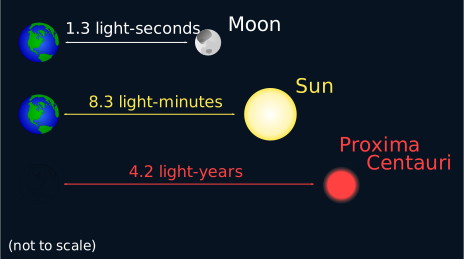
Because light travels at a finite speed, observing galaxies billions of light-years away allows astronomers to look back in time. This cosmic time travel enables the study of the universe’s infancy, its growth, and the dynamic processes that have shaped galaxies over billions of years.
- Time Machine Effect:
Light from distant galaxies shows them as they were in the past, providing snapshots of different cosmic epochs. - Evolutionary Insights:
Tracking changes in galaxy formation and behavior helps map the universe’s developmental timeline.
Galaxies as Probes of Dark Matter and Dark Energy
The formation, clustering, and interactions of galaxies offer critical clues about dark matter and dark energy, two of the most enigmatic components of the cosmos.
- Dark Matter’s Role:
Galaxies’ gravitational behavior reveals the presence and distribution of dark matter, which shapes large-scale cosmic structures. - Dark Energy’s Influence:
Studying the spatial distribution and redshift of galaxies helps scientists understand the accelerating expansion of the universe driven by dark energy.
Testing Fundamental Physics Through Galactic Observations
Observations of distant galaxies provide a unique testing ground for the core theories of physics, such as general relativity and quantum mechanics. These theories sometimes face challenges when applied to cosmological scales or the universe’s earliest moments.
- Validation and Challenges:
Galactic data can confirm or question existing models, prompting new theoretical developments. - Paradigm Shifts:
Discrepancies between predictions and observations may lead to revolutionary changes in our understanding of physics.
Technological and Methodological Challenges
Studying galaxies at extreme distances requires highly sensitive instruments capable of detecting faint signals across the electromagnetic spectrum. These observations are complicated by cosmic dust, gravitational lensing, and background radiation.
- Advanced Telescopes:
Instruments operating from radio waves to gamma rays are essential for capturing diverse galactic phenomena. - International Collaboration:
Global scientific partnerships are vital for developing, calibrating, and interpreting data from these sophisticated tools.
Philosophical Reflections on Cosmic Observation
The quest to understand reality through distant galaxies raises profound questions about the nature of observation and knowledge. It challenges us to consider whether the universe we perceive is an objective reality or influenced by our observational frameworks.
- Observer Effect:
The role of the observer in shaping scientific knowledge and cosmic interpretation. - Scale Reconciliation:
Bridging the gap between subatomic physics and the vast structures of the universe.
Citizen Science and Public Engagement
Public participation in galaxy research has grown through citizen science projects, enabling non-experts to contribute to data classification and discovery. This democratization accelerates scientific progress and fosters a collective curiosity about the cosmos.
- Galaxy Classification:
Volunteers help categorize galaxy shapes and features, aiding large-scale data analysis. - Cosmic Event Detection:
Citizen scientists assist in identifying subtle phenomena that might otherwise be overlooked.
Why Studying Distant Galaxies Is Crucial
The investigation of faraway galaxies transcends astrophysics; it is a profound exploration into the nature of existence itself. By expanding our understanding of the universe’s history, composition, and ultimate fate, this research enriches our knowledge and inspires a deeper appreciation of humanity’s place in the cosmos.
Summary
Distant galaxies serve as windows into the universe’s past, revealing the intricate interplay of matter, energy, and fundamental forces. Through advanced technology, collaborative efforts, and philosophical inquiry, the study of these remote cosmic structures continues to push the boundaries of science, offering ever more profound insights into the fabric of reality.
FAQ
What are distant galaxies?
Distant galaxies are galaxies that are billions of light-years away from Earth, allowing scientists to study the universe's history.
How do distant galaxies help in studying dark energy?
By analyzing the spatial distribution and redshift of distant galaxies, scientists can understand the accelerating expansion of the universe caused by dark energy.

Leave a Reply