
Short Answer
Definition and Purpose of the Large Hadron Collider
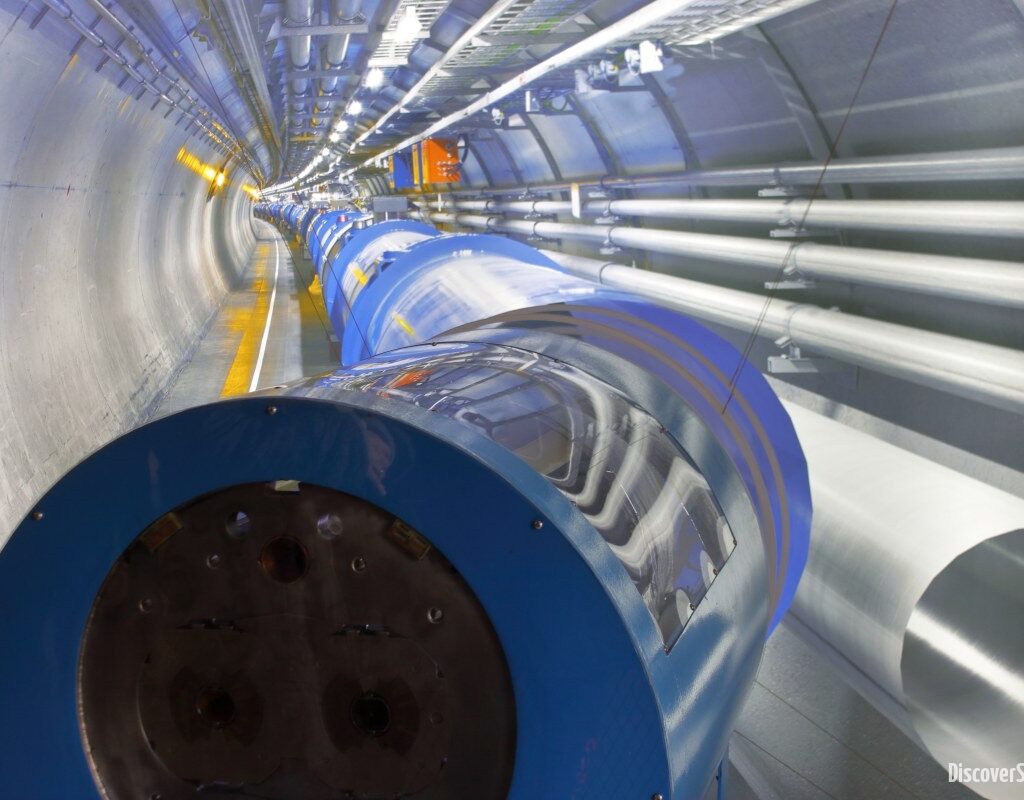
The Large Hadron Collider (LHC) is the world’s most powerful particle accelerator, spanning 27 kilometers beneath the border of France and Switzerland. This colossal underground facility is engineered to investigate the fundamental components of matter and the forces governing the universe. Far beyond a mere machine for smashing particles, the LHC serves as a sophisticated instrument designed to probe the deepest mysteries of existence, seeking answers to questions about the universe’s origin, structure, and underlying laws.
Simulating the Early Universe
At its core, the LHC accelerates protons to velocities approaching the speed of light before colliding them in high-energy impacts. These collisions recreate conditions similar to those that existed just moments after the Big Bang, providing scientists with a unique glimpse into the universe’s earliest moments. The challenge lies in analyzing the vast array of particles produced in these events, identifying rare phenomena, and detecting particles that have never been observed before.
The Standard Model and Its Limitations
The LHC’s investigations are grounded in the Standard Model of particle physics, a comprehensive framework describing the fundamental particles and forces that compose the universe. While the Standard Model has been remarkably successful in explaining known phenomena, it remains incomplete. It does not account for dark matter, which constitutes about 27% of the universe’s mass-energy, nor does it explain dark energy, the mysterious force driving the accelerated expansion of the cosmos. Additionally, the model cannot clarify why matter dominates over antimatter in the universe, leaving significant gaps in our understanding.
Key Discoveries and Ongoing Questions
One of the LHC’s landmark achievements was the discovery of the Higgs boson in 2012, the particle responsible for imparting mass to other particles. This breakthrough confirmed a crucial aspect of the Standard Model but also opened new avenues of inquiry. Scientists now explore whether the Higgs boson might connect to unknown physics realms through a so-called “Higgs portal,” and whether additional Higgs-like particles or forces exist that influence mass generation.
Exploring Supersymmetry and Beyond
Supersymmetry (SUSY) is a theoretical extension proposing that every known particle has a heavier superpartner. This concept could resolve several outstanding puzzles, such as providing a viable dark matter candidate and stabilizing the Higgs boson’s mass against quantum fluctuations. Despite extensive searches, the LHC has yet to find definitive evidence of these superpartners, raising questions about whether SUSY particles exist at energies beyond current experimental reach or if alternative theories are needed.
Probing Extra Dimensions and the Fabric of Space-Time
The LHC also investigates the possibility of extra spatial dimensions, a concept predicted by string theory and other advanced models attempting to unify gravity with quantum mechanics. If particles interact with or escape into these hidden dimensions during collisions, unique signatures could appear in the LHC’s detectors. Discovering such phenomena would revolutionize our understanding of reality and the fundamental structure of the cosmos.
Antimatter and the Matter-Antimatter Imbalance
The universe’s overwhelming dominance of matter over antimatter remains one of physics’ greatest mysteries. Theoretically, equal amounts of matter and antimatter should have emerged from the Big Bang. The LHC aims to shed light on this asymmetry by recreating early-universe conditions and searching for subtle differences or rare processes that could explain why matter prevailed.
Studying the Quark-Gluon Plasma
Another frontier explored by the LHC is the quark-gluon plasma, an exotic state of matter believed to have existed microseconds after the Big Bang. In this state, quarks and gluons-the fundamental constituents of protons and neutrons-are not confined within particles but move freely. By colliding heavy ions such as lead nuclei at extreme energies, the LHC temporarily recreates this primordial soup, enabling scientists to study the universe’s earliest phases before matter formed into stable particles.
Data Analysis and Computational Challenges
The LHC generates an enormous volume of data-measured in petabytes per second-posing significant challenges for analysis. To manage this, researchers employ advanced algorithms, machine learning techniques, and a global network of computational resources. This sophisticated data processing is essential for isolating meaningful signals from the overwhelming background noise, akin to finding a cosmic needle in a haystack.
Philosophical Implications and Scientific Limits
The LHC also raises profound philosophical questions about the limits of empirical science. Some aspects of physics may lie beyond current experimental capabilities, hidden behind energy scales too vast to reach. Additionally, certain phenomena might be so rare or subtle that even the LHC’s powerful collisions cannot detect them. These considerations highlight the interplay between human curiosity and the inherent boundaries of scientific exploration.
Significance and Future Prospects
The Large Hadron Collider embodies humanity’s bold quest to unravel the universe’s most fundamental secrets. By challenging our understanding of matter, energy, space, and time, it pushes the frontiers of knowledge and technology. As particle beams collide with extraordinary precision beneath the Earth’s surface, they reveal clues about the cosmos’s origin, composition, and destiny. Each discovery opens new questions, fueling the ongoing pursuit of the smallest truths that define our reality.




Leave a Reply