
Short Answer
Understanding the Universe: An Overview
The universe is an immense cosmic expanse that extends far beyond human perception, filled with mysteries encoded in the interplay of light and darkness. It can be envisioned as a vast, intricate tapestry woven from the threads of space and time, concealing profound truths that challenge our comprehension. Recent astronomical discoveries suggest that the cosmos contains elements far stranger than previously imagined-components so elusive that even our most advanced instruments struggle to detect them.
Cosmic Symphony: The Universe as a Grand Composition
Picture the universe as a magnificent symphony, where celestial bodies perform a cosmic melody across the vastness of space. For centuries, astronomers have endeavored to interpret this orchestration, analyzing the formation of stars, the movement of galaxies, and the subtle presence of dark matter. Yet, amid these familiar cosmic rhythms, scientists have identified anomalies-discordant notes that defy current understanding and demand further investigation.
Emerging Anomalies in Cosmology
Recent observations reveal phenomena that challenge the prevailing cosmological framework, which primarily relies on the concepts of dark matter and dark energy. Data from sophisticated telescopes and detailed measurements of the cosmic microwave background expose irregularities that hint at unknown physical processes. These discrepancies suggest that our existing models may be incomplete, pointing toward new physics beyond the current paradigm.
The Hubble Tension: A Cosmic Puzzle
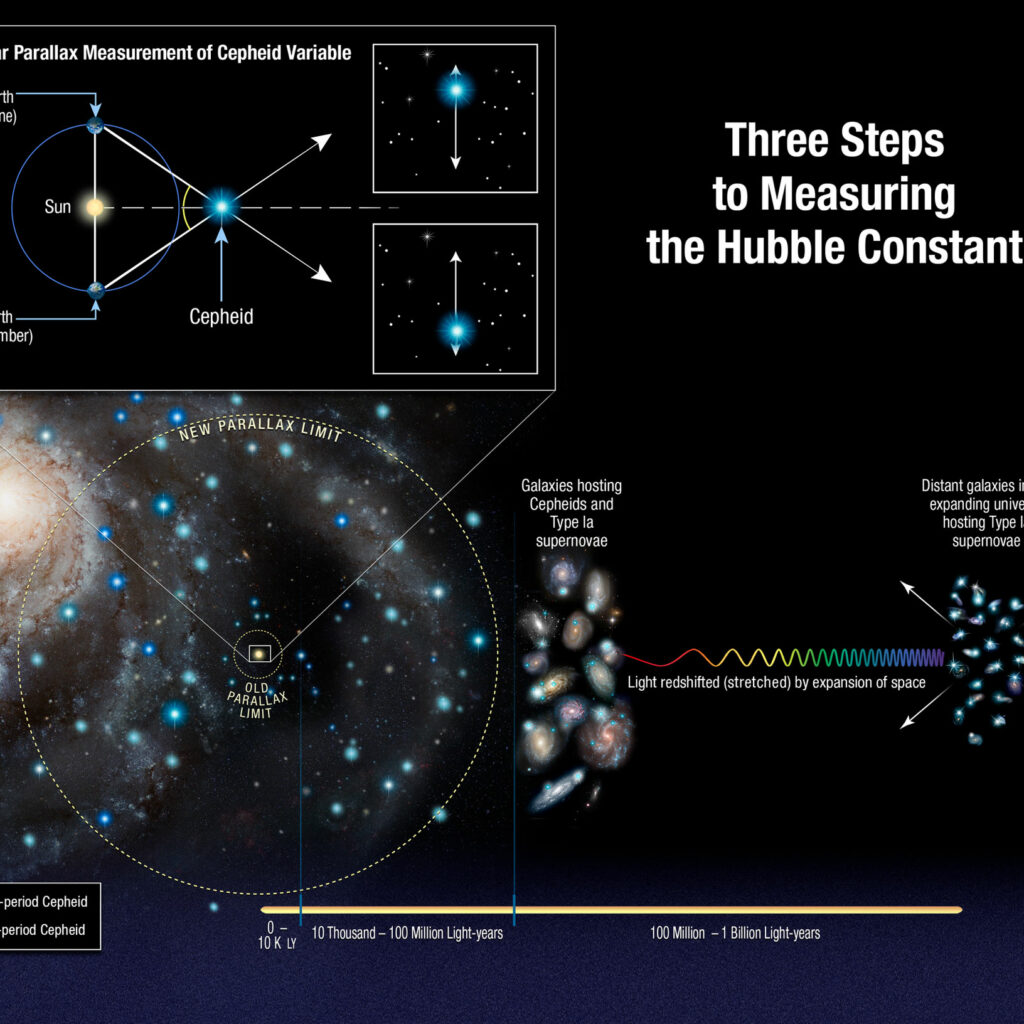
Central to these mysteries is the so-called Hubble tension-a persistent conflict between the predicted and observed rates of the universe’s expansion. While theoretical models forecast a specific expansion speed, empirical measurements consistently indicate a different value. This inconsistency implies the presence of an unseen influence driving cosmic acceleration, an invisible force shaping the movement of galaxies and clusters in ways not yet understood.
Hypotheses on Hidden Cosmic Forces
To explain these puzzling observations, scientists have proposed the existence of exotic forces or particles that remain undetected but exert significant effects on cosmic dynamics. One such idea is the “fifth force,” a hypothetical interaction beyond the four known fundamental forces: gravity, electromagnetism, and the strong and weak nuclear forces. This mysterious force could potentially resolve discrepancies in galactic behavior and gravitational lensing phenomena that current physics cannot fully explain.
Implications for Theoretical Physics
The possibility of undiscovered particles or fields challenges the foundations of the Standard Model of particle physics. These novel entities might interact subtly with ordinary matter or influence dark energy, the enigmatic driver behind the universe’s accelerating expansion. Understanding these hidden components could reshape our knowledge of space-time and the ultimate fate of the cosmos.
Irregularities in Cosmic Structure
Beyond expansion rates, anomalies also appear in the large-scale distribution of matter. Patterns observed in galaxy clusters and the cosmic web reveal inconsistencies with theoretical predictions, suggesting unknown interactions at play. These deviations serve as clues, guiding astronomers toward a more profound comprehension of the universe’s underlying architecture and complexity.
Visualizing the Hidden Universe
Imagine the universe as a vast ocean, its surface glittering with stars and galaxies. While we navigate this cosmic sea, mapping celestial bodies and measuring cosmic phenomena, a massive, unseen entity lies beneath the surface. This hidden presence influences cosmic currents and shapes the universe’s evolution, yet remains beyond direct detection-highlighting the scale and significance of the universe’s concealed components.
Technological Advances in Cosmic Exploration
Modern astronomy is propelled by cutting-edge technology aimed at uncovering these elusive cosmic elements. Instruments sensitive to gravitational waves, experiments detecting subtle distortions in space-time, and next-generation telescopes scanning the depths of space are at the forefront of this quest. Each new observation refines our theories and brings us closer to unveiling the universe’s hidden truths.
Philosophical Reflections on Cosmic Mysteries
The discovery of unknown forces or matter in the universe also prompts profound philosophical questions about the nature of reality, causality, and the origins of existence. It challenges the limits of human knowledge and invites humility, reminding us that even the vast scope of scientific inquiry encounters realms yet unexplored.
Significance of Unveiling the Universe’s Secrets
These emerging insights underscore the universe as a dynamic and enigmatic entity, layered with complexity beyond the visible starlight. The hidden components of the cosmos represent puzzles whose solutions could revolutionize science and deepen our appreciation of the infinite. This ongoing exploration is not only a scientific endeavor but a call to curiosity, encouraging humanity to venture further into the cosmic unknown where new discoveries await.
FAQ
What is the Hubble tension?
The Hubble tension refers to the discrepancy between the predicted and observed rates of the universe's expansion, indicating potential unknown influences.
What are the implications of hidden forces in the universe?
The existence of hidden forces could challenge current physics models and lead to a deeper understanding of cosmic dynamics.


Leave a Reply