

Short Answer
Definition of Dark Matter
Dark matter refers to a mysterious form of matter that does not emit, absorb, or reflect light, making it invisible to current astronomical instruments. Despite its invisibility, it is believed to constitute a significant portion of the universe’s total mass and energy, influencing the structure and behavior of cosmic bodies.
- Invisible Substance:
Dark matter cannot be detected through electromagnetic radiation, rendering it undetectable by conventional telescopes. - Dominant Cosmic Component:
It is thought to outweigh ordinary matter, shaping the gravitational landscape of galaxies and the universe at large.
Observational Evidence Supporting Dark Matter
Multiple astronomical observations suggest the presence of an unseen mass influencing cosmic phenomena. These include:
- Galaxy Rotation Curves:
Stars in galaxies rotate at speeds that cannot be explained solely by the visible matter, implying additional unseen mass. - Galaxy Cluster Dynamics:
Clusters of galaxies remain gravitationally bound despite insufficient visible mass, indicating extra gravitational influence. - Large-Scale Cosmic Structure:
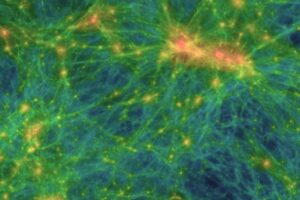
The filamentary web of galaxies across the universe suggests an invisible framework supporting visible matter. - Gravitational Lensing:
The bending of light from distant galaxies by massive objects reveals more mass than what is observable, pointing to dark matter’s presence. - Cosmic Microwave Background (CMB):
Patterns in the CMB radiation align with models that include dark matter, reflecting its role in the early universe’s evolution.
Theoretical Perspectives and Alternative Explanations
While dark matter is widely accepted, some scientists propose alternative theories to explain the observed gravitational anomalies without invoking unseen matter.
- Modified Newtonian Dynamics (MOND):
This theory suggests adjustments to Newton’s laws at galactic scales to account for rotation curves without dark matter. - Alternative Gravity Models:
Various hypotheses modify general relativity or propose new gravitational physics to explain cosmic phenomena.
However, these alternatives often face challenges in explaining the full spectrum of evidence, particularly the cosmic microwave background and large-scale structure formation.
Particle Physics and Dark Matter Candidates
Efforts to identify the fundamental nature of dark matter extend into particle physics, where several hypothetical particles have been proposed:
- Weakly Interacting Massive Particles (WIMPs):
Hypothetical particles that interact via gravity and weak nuclear force but rarely with ordinary matter. - Axions:
Extremely light particles theorized to solve certain quantum chromodynamics problems and potentially constitute dark matter. - Sterile Neutrinos:
Hypothetical neutrinos that do not interact via the standard weak force, making them difficult to detect.
Global experimental initiatives, including underground detectors and particle accelerators, are actively searching for these particles, though no direct detection has yet been confirmed.
Philosophical and Scientific Significance
Dark matter captivates not only because of its scientific implications but also due to its profound philosophical resonance. It challenges our understanding of reality and the limits of human perception, prompting reflection on the nature of existence and the unknown.
Moreover, the study of dark matter bridges multiple scientific disciplines-astrophysics, cosmology, particle physics-and drives technological innovation. It exemplifies the scientific spirit of inquiry, pushing the boundaries of knowledge and inspiring new theories and experiments.
Why Understanding Dark Matter Is Crucial
Recognizing dark matter’s role is essential for a comprehensive understanding of the universe’s composition and evolution. It influences galaxy formation, cosmic structure, and the dynamics of celestial bodies. Without accounting for dark matter, current models of the universe remain incomplete or inconsistent.
Common Misconceptions About Dark Matter
Dark matter is just ordinary matter that is hidden.
Dark matter is fundamentally different from ordinary matter; it does not interact with light and cannot be detected by conventional means.
Dark matter has been directly observed.
Dark matter has not been directly detected; its existence is inferred from gravitational effects and cosmological observations.
Alternative gravity theories have fully replaced the need for dark matter.
While alternative theories explain some phenomena, they do not comprehensively account for all evidence supporting dark matter.
Summary and Future Outlook
Although dark matter remains elusive to direct observation, a convergence of indirect evidence strongly supports its existence as a fundamental component of the cosmos. Whether it represents a new form of matter or signals the need for revised physics, dark matter continues to be a central focus of scientific research. The ongoing quest to unravel its mysteries embodies humanity’s enduring pursuit of knowledge and our desire to comprehend the universe’s deepest secrets.
FAQ
What is dark matter?
Dark matter is a mysterious form of matter that does not emit, absorb, or reflect light, making it invisible to current astronomical instruments.
Why is dark matter important?
Dark matter is crucial for understanding the universe’s composition, influencing galaxy formation and cosmic structure.
Have scientists observed dark matter directly?
No, dark matter has not been directly detected; its existence is inferred from its gravitational effects.



Leave a Reply