
Short Answer
Definition of the Optics Dilemma
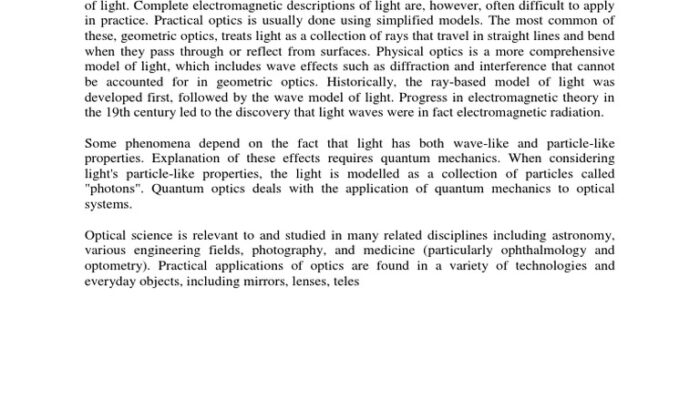
The optics dilemma refers to the longstanding scientific and philosophical challenge of understanding the true nature of light. Central to this issue is the dual characterization of light as both a wave and a particle, a paradox that has perplexed physicists for more than a century. This duality raises fundamental questions about how light behaves and how scientific models represent physical reality.
Historical Development of Light Theories
Wave Theory Origins
The wave theory of light traces back to the late 17th century with Christiaan Huygens, who introduced the wavefront concept, proposing that light travels as waves radiating outward in all directions. This perspective gained substantial support in the 19th century through James Clerk Maxwell’s formulation of electromagnetic theory, which unified electricity, magnetism, and optics by describing light as an electromagnetic wave.
Particle Theory Foundations
In contrast, Isaac Newton championed the particle theory, suggesting that light consists of tiny, discrete particles called corpuscles. Newton’s model effectively explained phenomena such as reflection and refraction. However, by the 19th century, experiments like Thomas Young’s double-slit experiment provided compelling evidence favoring the wave model, leading to its widespread acceptance.
Emergence of Quantum Perspectives
The early 20th century marked a paradigm shift with the advent of quantum theory. Max Planck’s concept of quantized energy levels and Albert Einstein’s explanation of the photoelectric effect revealed that light exhibits both wave-like and particle-like properties. Einstein demonstrated that light could eject electrons from materials only when its frequency exceeded a specific threshold, highlighting the particle aspect of light. This led to the introduction of photons, discrete packets of light energy, bridging the gap between wave and particle descriptions.
Wave-Particle Duality Explained
Wave-particle duality encapsulates the idea that light cannot be fully described solely as a wave or a particle; instead, it exhibits characteristics of both depending on the context. Wave models successfully explain interference and diffraction patterns, where light waves overlap constructively or destructively. Conversely, particle models account for phenomena such as the photoelectric effect and Compton scattering, where light behaves as discrete quanta.
Philosophical Implications of the Optics Dilemma
The optics dilemma extends beyond physics into the philosophy of science, questioning the nature and purpose of scientific theories. This debate aligns with the broader discourse between realism and anti-realism:
- Realism:
Scientific theories are considered accurate representations of the external world. - Anti-realism:
Theories are viewed as useful tools for prediction without necessarily reflecting an objective reality.
These perspectives influence how scientists interpret the dual nature of light and the validity of competing models.
Quantum Mechanics and Interpretations of Light
Quantum mechanics introduces further complexity to the optics dilemma through interpretations such as:
- Copenhagen Interpretation:
Proposes that light behaves as a wave until measured, emphasizing the observer’s role in determining physical outcomes. - Many-Worlds Interpretation:
Suggests that all possible outcomes occur simultaneously in separate, branching realities, challenging traditional notions of causality and determinism.
Modern Research and Experimental Insights
Contemporary studies in quantum optics have reinforced the importance of understanding light’s duality. Experiments involving quantum entanglement and Bell’s theorem reveal correlations between entangled particles that defy classical explanations, undermining local realism. These findings highlight the need for a unified theoretical framework that integrates both wave and particle aspects of light.
Educational and Scientific Significance
The optics dilemma remains a central topic in physics education and research. Modern curricula emphasize presenting wave and particle theories as complementary rather than contradictory, fostering a nuanced comprehension of light’s behavior. This approach equips emerging physicists to engage with unresolved questions and advances in the field.
Future Directions and Technological Impact
Looking ahead, the optics dilemma will continue to inspire scientific inquiry and technological innovation. Developments in quantum computing, photonics, and interdisciplinary research involving philosophy and cognitive science are expected to deepen our understanding of light’s complex nature. These efforts aim to develop coherent models that transcend traditional dichotomies.
Conclusion: The Enduring Challenge of Light’s Duality
The dual wave-particle nature of light represents a profound scientific puzzle that has shaped physics for over a century. This interplay enriches our grasp of the universe while provoking philosophical reflection on the essence of scientific knowledge. As research progresses, resolving the optics dilemma remains a pivotal endeavor, offering insights into the fundamental structure of reality and advancing both theoretical and applied physics.
FAQ
What is the optics dilemma?
The optics dilemma refers to the challenge of understanding light’s dual nature as both a wave and a particle, which has puzzled physicists for over a century.
How did historical theories of light evolve?
Theories of light evolved from wave theory, established by Huygens and Maxwell, to particle theory proposed by Newton, culminating in the quantum understanding of light.
What is wave-particle duality?
Wave-particle duality is the concept that light exhibits both wave-like and particle-like properties depending on the experiment being conducted.
How does quantum mechanics relate to the optics dilemma?
Quantum mechanics introduces interpretations of light that challenge traditional views, such as the Copenhagen and Many-Worlds interpretations.






Leave a Reply