
Short Answer
Definition of Dark Energy
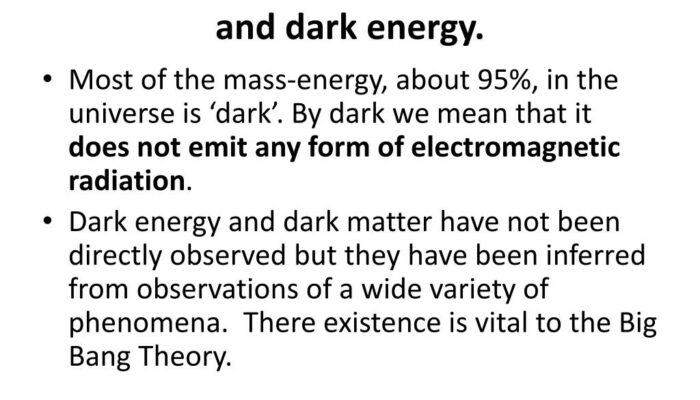
Dark energy is a mysterious and largely unknown component of the universe that is believed to be responsible for its accelerated expansion. Unlike ordinary matter or dark matter, dark energy exerts a repulsive effect on the cosmos, causing space itself to expand at an increasing rate. It is characterized by a negative pressure that counteracts gravitational attraction on cosmic scales, making it fundamentally different from mass-bearing substances.
Distinguishing Dark Energy from Mass
In physics, mass is an intrinsic property of matter that determines how objects resist acceleration and attract each other gravitationally. Objects with mass generate gravitational fields that pull other masses toward them. Dark energy, however, does not behave like traditional mass. Although it permeates all of space and influences the universe’s expansion, it does not cluster gravitationally or attract matter in the usual sense. This suggests that dark energy is not mass in the conventional understanding.
Theoretical Models of Dark Energy
The Cosmological Constant (Λ)
One of the primary explanations for dark energy is the cosmological constant, introduced by Albert Einstein in his field equations of General Relativity. This constant represents a uniform energy density filling space evenly, which remains unchanged as the universe expands. Unlike matter, whose density decreases as space grows, the cosmological constant maintains a steady energy density, preventing it from clumping under gravity and reinforcing its distinction from mass.

Quintessence and Dynamic Fields
Alternative theories propose that dark energy may be a dynamic scalar field known as quintessence. This field varies over time and space, possessing potential energy that evolves, unlike the static cosmological constant. Despite this variability, quintessence does not have rest mass like particles such as protons or electrons. Instead, it influences the geometry of spacetime and the rate of cosmic expansion through its field properties.
Equation of State and Observational Evidence
The behavior of dark energy is often described by its equation of state parameter, w, which relates its pressure to its energy density. Observations from supernovae, the cosmic microwave background, and large-scale structure surveys indicate that w is close to -1, consistent with the cosmological constant model. This negative pressure is a defining feature of dark energy, contrasting with the positive or negligible pressure exerted by matter, which leads to gravitational attraction rather than repulsion.
Dark Energy vs. Dark Matter
It is crucial to differentiate dark energy from dark matter, as they are distinct phenomena despite their similar names. Dark matter possesses mass and exerts gravitational influence, playing a key role in the formation and stability of galaxies and cosmic structures. Its presence is inferred through gravitational lensing and galaxy rotation curves. In contrast, dark energy does not have mass and is only observed through its effect on the universe’s accelerated expansion, not through localized gravitational interactions. This distinction highlights that dark energy is a property of spacetime rather than a form of matter.
Quantum Vacuum Energy and the Cosmological Constant Problem
From the perspective of quantum field theory, the vacuum of space is not empty but filled with fluctuating quantum fields and virtual particles, contributing a baseline energy known as zero-point energy. This vacuum energy is a candidate explanation for dark energy. However, theoretical predictions of vacuum energy density exceed observed values by many orders of magnitude, a discrepancy known as the cosmological constant problem. This challenge complicates attempts to interpret dark energy as a form of mass or particle-based energy, suggesting it may arise from fundamental properties of spacetime itself.
Modified Gravity Theories as Alternatives
Some scientific models propose modifications to Einstein’s General Relativity to explain cosmic acceleration without invoking dark energy as a separate entity. These theories adjust gravitational laws on large scales, effectively replicating the effects attributed to dark energy. If validated, such models imply that dark energy might not be a form of energy or mass but rather a manifestation of unknown gravitational dynamics operating at cosmic distances.
Cosmological Implications of Dark Energy’s Nature
The question of whether dark energy has mass carries significant consequences for our understanding of the universe. If dark energy possessed even a small amount of mass, it would influence the formation of cosmic structures in ways that conflict with observations. Instead, the uniform and persistent acceleration of the universe supports the idea that dark energy is an intrinsic feature of space itself. This understanding informs predictions about the universe’s ultimate fate, favoring scenarios like the “Big Freeze” or “Heat Death,” where expansion continues indefinitely, stars burn out, and entropy reaches a maximum.
Ongoing Research and Future Prospects
Current and upcoming observational projects aim to deepen our knowledge of dark energy’s properties. Advanced telescopes, cosmic microwave background experiments, and extensive galaxy surveys are refining measurements of the universe’s expansion rate and the equation of state parameter. These efforts may confirm existing theories or reveal new aspects of dark energy, potentially uncovering whether it has any hidden mass component or remains a fundamental attribute of the cosmos.
Summary: Dark Energy as a Unique Cosmic Phenomenon
In conclusion, evidence and theoretical insights consistently portray dark energy as fundamentally different from mass. It does not exhibit the characteristics of conventional matter or energy associated with rest mass. Instead, dark energy appears as an inherent property of spacetime or a dynamic field exerting negative pressure that drives the universe’s accelerated expansion. Its elusive nature challenges current physics paradigms, inviting expanded frameworks to comprehend phenomena beyond traditional concepts of mass and energy, and deepening our understanding of the universe’s profound mysteries.


Leave a Reply