
Short Answer
Definition of Dark Matter and Dark Energy
Dark matter and dark energy are two mysterious components that dominate the universe’s composition and influence its evolution. Together, they constitute about 95% of the total cosmic content, yet remain largely undetectable by conventional means.
- Dark Matter:
An invisible form of matter that does not emit, absorb, or reflect light, making it undetectable through electromagnetic observations. It acts as a gravitational scaffold, holding galaxies and larger cosmic structures together. - Dark Energy:
A pervasive energy field that fills all of space and exerts a repulsive force, causing the accelerated expansion of the universe. It counteracts the gravitational pull of matter and is often described as a form of anti-gravity.
Role in Cosmic Structure and Evolution
Dark matter and dark energy play contrasting yet complementary roles in shaping the universe’s large-scale structure and its dynamic behavior over time.
- Dark Matter’s Influence:
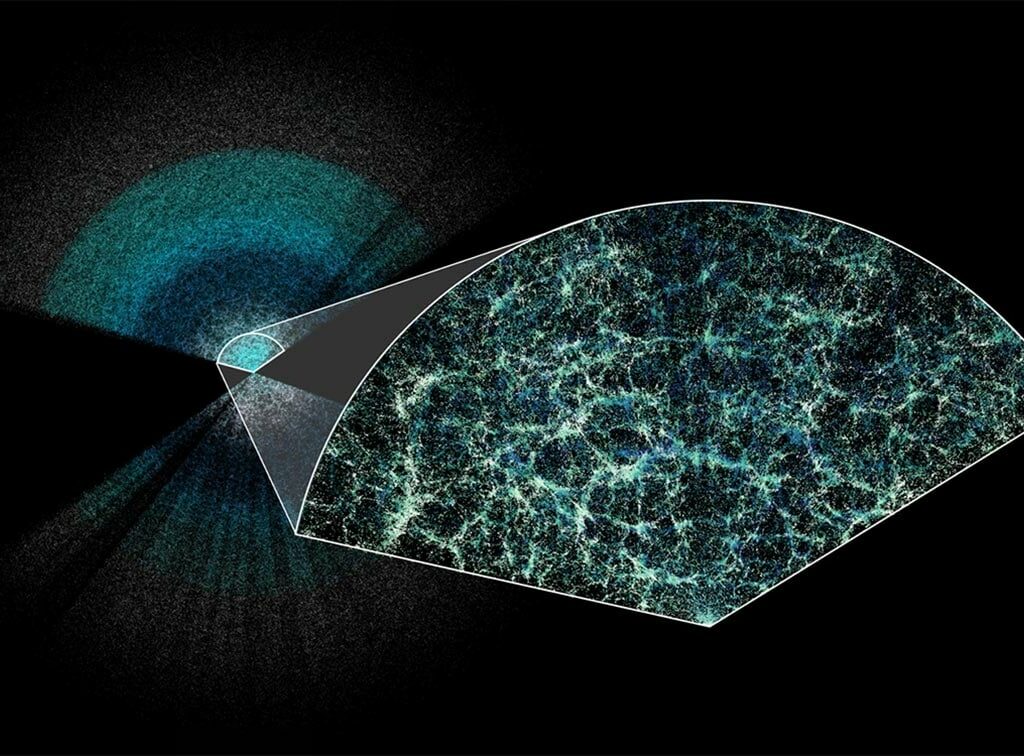
Acting as the universe’s invisible framework, dark matter forms a vast cosmic web that anchors galaxies and clusters. Its gravitational pull prevents galaxies from dispersing, maintaining their spiral shapes and enabling the formation of complex structures. - Dark Energy’s Effect:
In opposition to dark matter’s attractive force, dark energy drives the expansion of space itself, accelerating the universe’s growth and stretching the cosmic fabric at an ever-increasing rate.
Mechanism Behind Their Cosmic Impact
While dark matter exerts gravitational attraction, dark energy produces a repulsive pressure that influences the universe’s expansion dynamics. This interplay creates a cosmic tension that governs the fate of the cosmos.
- Gravitational Binding:
Dark matter’s gravity pulls matter together, enabling the formation of galaxies, clusters, and filaments. - Accelerated Expansion:
Dark energy acts as a form of negative pressure, pushing space apart and causing the universe’s expansion to speed up rather than slow down.
Mathematical Framework and Cosmological Parameters
The behavior of dark matter and dark energy is described within the framework of cosmology, particularly through the Friedmann equations derived from General Relativity.
- Density Parameters (Ω):
ΩDM ≈ 0.27 represents the fraction of the universe’s energy density attributed to dark matter, while ΩDE ≈ 0.68 corresponds to dark energy. - Equation of State for Dark Energy:
Often characterized by the parameter w, where w = pressure/density. For a cosmological constant, w = -1, indicating a constant energy density with negative pressure. - Friedmann Equation:
H² = (8πG/3)ρ – (k/a²) + Λ/3, where H is the Hubble parameter, ρ the total energy density, k the curvature, a the scale factor, and Λ the cosmological constant representing dark energy.
Historical Context and Discovery
Our understanding of dark matter and dark energy has evolved through astronomical observations and theoretical developments over the past century.
- Dark Matter:
First inferred from galaxy rotation curves in the 1970s, where stars in galaxies moved faster than visible matter alone could explain, suggesting the presence of unseen mass. - Dark Energy:
Discovered in the late 1990s through observations of distant Type Ia supernovae, which revealed that the universe’s expansion is accelerating rather than decelerating.
Real-World Examples and Observational Evidence
Several key observations support the existence and properties of dark matter and dark energy:
- Galaxy Rotation Curves:
Measurements show stars orbiting galaxies at speeds inconsistent with visible matter alone, implying a dark matter halo. - Cosmic Microwave Background (CMB):
Fluctuations in the CMB radiation provide a snapshot of the early universe, allowing precise measurements of dark matter and dark energy densities. - Large-Scale Structure:
The distribution of galaxies and galaxy clusters aligns with simulations that include dark matter’s gravitational effects. - Supernova Observations:
Distant supernovae appear dimmer than expected, indicating accelerated cosmic expansion driven by dark energy.
Common Misunderstandings
- Misconception: Dark matter is the same as ordinary matter but hidden.
Correction: Dark matter is fundamentally different from baryonic (ordinary) matter; it does not interact electromagnetically and is detected only via gravity. - Misconception: Dark energy is simply a repulsive force like anti-gravity.
Correction: Dark energy is more accurately described as a property of space itself, causing accelerated expansion through negative pressure rather than a conventional force.
Significance in Cosmology and Beyond
Understanding dark matter and dark energy is crucial for comprehending the universe’s origin, structure, and ultimate destiny. They challenge existing physics and inspire new theories in particle physics, quantum field theory, and cosmology.
- Cosmic Fate:
The balance between dark matter’s gravity and dark energy’s expansion determines whether the universe will continue expanding forever, collapse, or reach a steady state. - Technological Advances:
Investigations into these phenomena drive the development of advanced telescopes, detectors, and particle accelerators. - Philosophical Implications:
They provoke fundamental questions about the nature of reality, the limits of human knowledge, and our place in the cosmos.
Current Research and Future Prospects
Modern cosmology employs cutting-edge instruments and theoretical models to unravel the mysteries of dark matter and dark energy.
- Observational Projects:
Initiatives like the Dark Energy Survey, the Hubble Space Telescope, and the James Webb Space Telescope aim to refine measurements of cosmic expansion and structure. - Particle Physics Experiments:
Efforts to detect dark matter particles include underground detectors and collider experiments searching for weakly interacting massive particles (WIMPs) or axions. - Theoretical Models:
Researchers explore alternatives to the cosmological constant, such as dynamic scalar fields (quintessence) and modifications to General Relativity.
Conclusion: The Cosmic Dance of the Invisible
The interplay between dark matter and dark energy forms the backbone of the universe’s grand narrative. While dark matter provides the unseen framework that shapes galaxies and clusters, dark energy drives the relentless expansion of space. Together, they compose a cosmic paradox: the invisible forces that define the visible universe and challenge our understanding of reality. Their ongoing study not only deepens our knowledge of the cosmos but also illuminates the profound mysteries that lie beyond the reach of current science.


Leave a Reply