
Short Answer
Understanding Dark Matter and Dark Energy
The cosmos is an immense and intricate expanse, woven with mysteries that have intrigued scientists and philosophers for centuries. Among the most enigmatic components of the universe are dark matter and dark energy-two invisible phenomena that dominate the cosmic landscape yet elude direct detection. These elusive elements shape the universe’s structure and evolution, prompting profound questions about their nature and origin.
Definition and Composition of the Universe
Dark matter and dark energy together constitute approximately 95% of the universe’s total mass-energy content, overshadowing the ordinary matter that forms stars, planets, and living beings. Despite their invisibility, their effects are unmistakable:
- Dark Matter:
An unseen form of matter that exerts gravitational influence, dark matter stabilizes galaxies and clusters by preventing them from dispersing due to their rotational speeds. - Dark Energy:
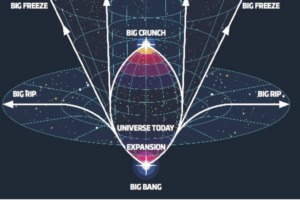
A mysterious force responsible for the accelerated expansion of the universe, dark energy counteracts gravitational attraction on cosmic scales, driving galaxies apart at an increasing rate.
Interrelation Between Dark Matter and Dark Energy
At first, dark matter and dark energy appear as distinct phenomena-one acting as a gravitational glue, the other as a repulsive force. However, their coexistence and complementary roles in cosmic dynamics suggest a deeper connection. The universe’s accelerated expansion alongside its large-scale structure hints at underlying principles that might unify these two components, challenging the traditional view of them as separate entities.
Hypothesis of a Unified Particle
One intriguing proposition is the existence of a single, yet-undiscovered particle or field that embodies the characteristics of both dark matter and dark energy. This hypothetical entity would exhibit dual behavior depending on the scale or environment:
- On galactic scales, it would manifest as mass, exerting gravitational pull akin to dark matter.
- On cosmological scales, it would generate a repulsive pressure, driving the accelerated expansion attributed to dark energy.
This duality presents a complex challenge, requiring a delicate balance between gravitational attraction and cosmic acceleration, with significant implications for particle physics and cosmology.
Role of Scalar Fields in Unification Theories
Scalar fields, characterized by a single value at every point in space and time, have been extensively studied as candidates for dark energy. Models such as quintessence describe dynamic scalar fields evolving over cosmic time. A compelling idea is that quantum excitations of these fields could produce particles responsible for dark matter phenomena. Such particles would interact weakly with electromagnetic and nuclear forces, making them difficult to detect, yet they would dominate gravitational effects.
Implications for Fundamental Physics
The search for a particle unifying dark matter and dark energy challenges existing frameworks in physics. It suggests the presence of a hidden sector populated by exotic particles and fields that interact feebly with known matter. Detecting these particles requires innovative methods, including:
- Gravitational lensing observations
- Analysis of cosmic microwave background fluctuations
- Studying anomalies in galactic rotation curves
These approaches highlight the sophistication needed to probe the universe’s most subtle phenomena.
Scientific Significance and Philosophical Impact
The prospect of a single particle explaining both dark matter and dark energy resonates with the scientific principle of parsimony-the preference for simpler, unified explanations of complex phenomena. This idea touches on profound questions about the quantum vacuum, the cosmological constant problem, and the hierarchy of fundamental forces, bridging particle physics and cosmology. It revitalizes age-old inquiries into the nature of space, time, and existence itself.
Observational Evidence and Ongoing Research
Discoveries such as the universe’s accelerated expansion and precise measurements of cosmic microwave background radiation have sharpened our understanding of dark energy and dark matter. Advanced instruments, both ground-based and spaceborne, continue to explore the cosmos for signs of exotic particles. Each new observation refines theoretical models, bringing us closer to unraveling these cosmic mysteries.
Challenges and Future Prospects
Although no definitive particle has yet been identified to unify dark matter and dark energy, the pursuit exemplifies human curiosity and scientific rigor. This endeavor encourages the development of new theories and experimental techniques, fostering a revolutionary perspective on the universe where dark matter and dark energy are manifestations of a deeper, unified physical reality.
Conclusion: The Quest for Cosmic Unity
The hypothesis that a single particle underpins both dark matter and dark energy encapsulates the essence of scientific exploration-combining wonder, complexity, and the drive for understanding. While the path to confirmation is fraught with challenges, the potential to achieve a coherent and elegant model of the cosmos promises profound insights into the fundamental workings of reality.

Leave a Reply