
Short Answer
Definition of the Graviton
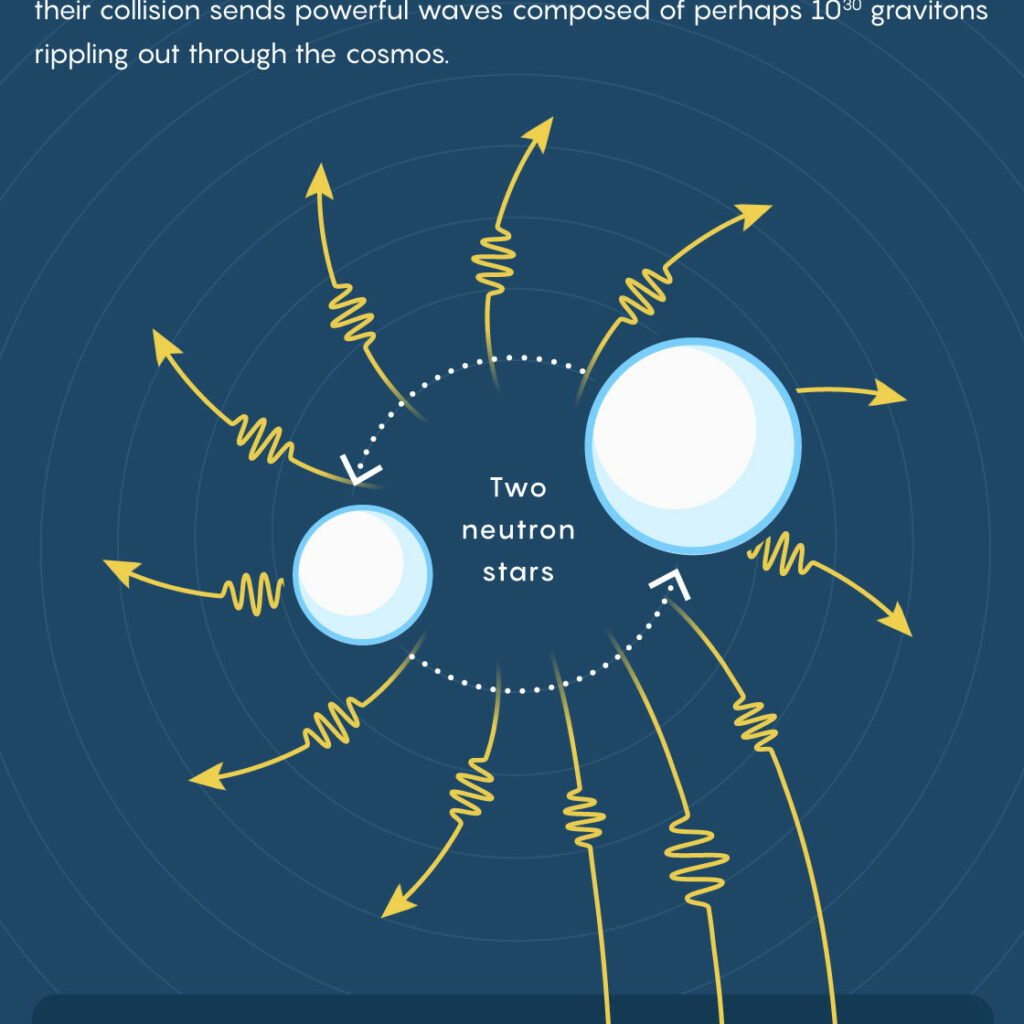
The graviton is a theoretical elementary particle proposed as the quantum carrier of the gravitational force. Unlike classical gravity, which is described by the curvature of spacetime in Einstein’s general relativity, the graviton represents gravity within the framework of quantum mechanics. It is hypothesized to be a massless boson with a spin of 2, mediating gravitational interactions much like photons mediate electromagnetic forces.
- Nature:
A massless, spin-2 boson that transmits the gravitational force at the quantum level. - Role:
Acts as the quantum messenger of gravity, analogous to how photons carry electromagnetic forces. - Origin:
Emerges from attempts to unify general relativity with quantum field theory.
Historical Background and Theoretical Foundations
The concept of the graviton arose from efforts to quantize gravity, particularly through linearized gravity models that treat weak gravitational fields as perturbations in flat spacetime. Early quantum field theory approaches revealed that the graviton would possess helicity ±2, consistent with the tensor nature of gravity. However, these initial attempts also exposed significant challenges, such as the nonrenormalizability of gravity, indicating that conventional quantum field methods cannot fully describe gravitational interactions.
General relativity, formulated by Einstein, describes gravity as the geometric deformation of spacetime caused by mass and energy. This geometric interpretation contrasts with the particle-exchange picture used for the electromagnetic, weak, and strong forces, which are mediated by photons, W and Z bosons, and gluons respectively. The graviton hypothesis bridges this conceptual gap by proposing a quantum particle that embodies gravity’s effects.
Quantum Gravity and the Graviton’s Role
Gravity’s integration into the quantum framework remains one of the most profound challenges in modern physics. The graviton is central to this quest, representing the quantum aspect of gravity that could unify the macroscopic and microscopic realms. The particle’s spin-2 nature ensures it respects the symmetries and gauge invariances of spacetime, interacting universally with energy and momentum.
Various advanced theoretical models, including string theory and loop quantum gravity, incorporate the graviton or graviton-like entities as fundamental components. These approaches aim to reconcile the standard model of particle physics, which excludes gravity, with general relativity, which governs large-scale cosmic phenomena.
Challenges in Detecting the Graviton
Despite its theoretical appeal, the graviton remains undetected due to the extreme weakness of gravitational interactions at quantum scales. Gravity is vastly weaker than electromagnetic and nuclear forces, making the graviton’s effects extraordinarily subtle and difficult to isolate experimentally.
- Technological Limitations:
Current instruments, including gravitational wave detectors like LIGO and Virgo, measure macroscopic spacetime ripples but cannot resolve individual gravitons. - Experimental Sensitivity:
Detecting a single graviton would require sensitivity many orders of magnitude beyond present capabilities, akin to capturing a single snowflake in a vast blizzard from miles away.
Potential Methods and Indirect Evidence
While direct detection remains elusive, researchers explore indirect strategies to infer graviton properties. These include:
- Quantum Behavior of Black Holes:
Studying black hole thermodynamics and quantum entanglement may reveal graviton signatures. - Gravitational Wave Analysis:
Precise measurements of gravitational waveforms could uncover subtle quantum deviations. - Quantum Optomechanics Experiments:
Tabletop setups exploiting quantum control of mechanical systems might detect faint quantum gravitational effects. - Cosmic Microwave Background Studies:
High-precision observations could identify primordial quantum gravitational imprints.
Conceptual Implications of the Graviton
The graviton’s existence would profoundly impact our understanding of spacetime and gravity. As a spin-2 boson, it embodies the quantum nature of gravity, suggesting that spacetime curvature arises from discrete quantum units rather than a continuous fabric. This perspective supports the idea that gravity is not merely a classical geometric phenomenon but a dynamic quantum interaction.
Moreover, the graviton could serve as a cornerstone for a unified theory of physics, linking quantum mechanics and general relativity. It also influences cosmological theories, including those addressing dark energy and the accelerated expansion of the universe, by constraining or allowing for a tiny graviton mass.
Real-World Significance and Future Prospects
Understanding the graviton is crucial for advancing fundamental physics and cosmology. Its discovery would revolutionize our comprehension of the universe, enabling a seamless integration of the large-scale structure governed by gravity with the quantum world of particles and forces.
Future technological advancements and theoretical breakthroughs may eventually enable the detection or indirect observation of gravitons. Such progress would open new avenues in quantum gravity research, potentially validating concepts like holographic principles and quantum spacetime foam, and deepening insights into the universe’s most profound mysteries.
Common Misconceptions About the Graviton
The graviton has been detected by gravitational wave observatories.
Current detectors measure classical gravitational waves, not individual gravitons, which remain beyond experimental reach.
Gravity is fully explained by quantum particles like the graviton.
Gravity is well described by general relativity at large scales, and the graviton remains a theoretical construct pending experimental confirmation.
The graviton must have mass.
The graviton is predicted to be massless to preserve gauge invariance and the long-range nature of gravity, though some theories explore tiny mass possibilities.
Why the Graviton Matters
The graviton represents a pivotal concept in the ongoing effort to unify the fundamental forces of nature. Its discovery would mark a monumental leap in physics, bridging the divide between quantum mechanics and general relativity. Beyond theoretical elegance, understanding the graviton could unlock new technologies, deepen our grasp of the cosmos, and reshape our perception of reality itself.


Leave a Reply