

Short Answer
Definition of Light and Matter Transformation
The phenomenon of light transforming into matter is a captivating concept that explores how energy, in the form of light, can convert into tangible particles that constitute the physical universe. Light, fundamentally an electromagnetic wave composed of photons, exhibits a dual nature-behaving both as waves and particles. Despite photons having no rest mass, they carry energy and momentum, raising the question of whether this energy can manifest as matter under specific conditions.
Fundamental Properties of Light
- Photon Characteristics:
Photons are massless particles that travel at the speed of light, carrying quantized energy and momentum. - Wave-Particle Duality:
Light exhibits properties of both waves and particles, a cornerstone of quantum mechanics. - Energy-Mass Equivalence:
According to Einstein’s equation, E=mc², energy and mass are interchangeable, suggesting that energy can be converted into matter.
Mechanism of Light-to-Matter Conversion
The conversion of light into matter is primarily demonstrated through the quantum mechanical process known as pair production. This occurs when a high-energy photon interacts with a strong electromagnetic field, typically near an atomic nucleus, resulting in the creation of an electron and its antimatter counterpart, the positron. This process exemplifies how pure energy can be transformed into particles possessing rest mass.
Conditions Required for Pair Production
- Energy Threshold:
The photon must have energy exceeding 1.022 million electron volts, the combined rest mass energy of an electron and positron. - Presence of an Electromagnetic Field:
Interaction with a nearby nucleus or electromagnetic field is essential to conserve momentum and energy, as pair production cannot occur in a vacuum alone.
Mathematical Explanation: Energy-Mass Relationship
The fundamental equation governing the conversion is Einstein’s mass-energy equivalence formula:
E = mc²
- E: Energy of the photon (joules or electron volts)
- m: Mass of the particle(s) created (kilograms)
- c: Speed of light in vacuum (~3 × 10⁸ m/s)
This equation implies that a photon with sufficient energy (E) can produce particles with mass (m), provided the energy is concentrated and conditions allow for conservation laws to be satisfied.
Natural and Experimental Occurrences
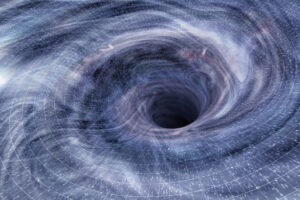
Pair production is not only observed in controlled laboratory environments such as particle accelerators but also occurs naturally in extreme astrophysical settings. Regions surrounding black holes and neutron stars, characterized by intense gravitational and electromagnetic fields, serve as natural arenas where high-energy photons can convert into matter. These cosmic processes contribute to the formation of exotic particles and influence radiation emissions observed by astrophysicists.
Common Misconceptions About Light and Matter
Visible light can spontaneously turn into matter.
Visible light lacks the necessary energy to initiate pair production or any matter creation process.
Photons can convert into matter in empty space without interaction.
Conservation of momentum and energy requires the presence of another particle or field for pair production to occur.
Significance of Light-to-Matter Conversion
The ability of light to transform into matter holds profound implications across multiple domains. Philosophically, it challenges our understanding of existence, substance, and the origins of the universe, particularly in the context of the Big Bang where energy condensed into the first particles. Scientifically, it deepens our grasp of quantum mechanics and relativistic physics, revealing the unity between energy and mass.
Technological and Scientific Implications
Research into light-to-matter conversion drives advancements in particle physics and quantum technologies. Efforts to replicate pair production using ultra-intense lasers and photon collisions aim to unlock new energy sources, develop advanced materials, and enhance quantum computing capabilities. However, these endeavors require overcoming significant challenges related to energy scales and precise environmental control.
Conclusion: The Intricate Dance of Energy and Matter
The question of whether light can become matter transcends a simple binary answer, instead opening a window into the complex interplay between energy and physical substance. While everyday experiences with light do not involve such transformations, the phenomenon of pair production exemplifies the universe’s remarkable capacity to convert energy into matter under stringent conditions. Ongoing scientific exploration continues to illuminate this profound relationship, expanding our understanding of the cosmos and the fundamental laws that govern it.
Leave a Reply