

Short Answer
Understanding Giant Spiral Galaxies
Giant spiral galaxies are among the most captivating structures in the universe, characterized by their expansive, winding arms filled with stars, gas, and dust. These colossal systems have long fascinated astrophysicists due to their complex morphology and dynamic processes. Central to their study is the question of how these galaxies influence the birth and development of new stars, often referred to as stellar youth. This inquiry delves into the intricate balance between star formation and the various internal and external forces acting within these massive cosmic entities.
Definition of Stellar Youth in Galactic Context
Stellar youth refers to the early stages of star formation and the presence of young, newly formed stars within a galaxy. This phase is critical for understanding galactic evolution and the ongoing cycle of matter and energy in the cosmos.
- Star Formation:
The process by which dense regions of molecular clouds collapse under gravity to form new stars. - Young Stars:
Stars that have recently formed and are typically characterized by high luminosity and specific spectral signatures. - Galactic Environment:
The conditions within a galaxy, including gas density, temperature, and turbulence, that influence star formation rates.
Mechanisms Influencing Star Formation in Giant Spirals
The formation of stars within giant spiral galaxies is governed by a complex interplay of physical factors. These include the density and temperature of interstellar gas, the presence of turbulence, and the gravitational forces exerted by the galaxy’s structure.
- Gas Density and Turbulence:
High concentrations of gas and dust in spiral arms provide the raw material for star formation, but turbulence can either trigger or inhibit the collapse of molecular clouds. - Gravitational Interactions:
Dense star clusters in central regions create strong gravitational fields that can stir turbulence and affect the stability of star-forming clouds. - Supernova Feedback:
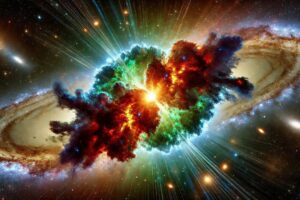
Explosions of massive stars generate shock waves that can disrupt nearby molecular clouds, potentially halting the formation of new stars.
Galactic Structures and Their Role in Star Formation
Features such as bars and spiral density waves play a significant role in redistributing gas within giant spiral galaxies, thereby influencing where and how stars form.
- Spiral Arms:
Act as channels funneling gas toward the galactic center, which can enhance star formation in inner regions but deplete material in the outskirts. - Galactic Bars:
These elongated structures can drive gas inflows, affecting the spatial distribution of star-forming regions.
Impact of Feedback and Galactic Winds
Massive stars and their end-of-life supernovae exert powerful feedback effects that shape the interstellar medium and regulate star formation.
- Ionizing Radiation:
Young, massive stars emit intense radiation that ionizes surrounding gas, potentially driving it out of star-forming regions. - Galactic Winds:
Outflows generated by supernovae can expel gas from the galaxy, reducing the fuel available for future star formation and accelerating galactic aging.
Environmental Influences on Star Formation
Giant spiral galaxies do not exist in isolation; their surroundings within galaxy clusters and groups significantly affect their star-forming capabilities.
- Tidal Interactions:
Gravitational forces from nearby galaxies can strip gas or trigger bursts of star formation. - Ram Pressure Stripping:
Movement through the intracluster medium can remove gas from a galaxy, suppressing star formation. - Gravitational Encounters:
Close passes with other galaxies can disturb gas distribution and star formation patterns.
Observational Evidence and Theoretical Insights
Empirical studies reveal a complex relationship between galaxy mass, morphology, and star formation rates in giant spirals. Contrary to expectations, the most massive spiral galaxies often show declining star formation activity, suggesting a potential stagnation in stellar youth.
Numerical simulations complement observations by modeling gas dynamics, star formation thresholds, and feedback processes. These models help identify conditions that either promote or inhibit the birth of new stars, offering a deeper understanding of galactic evolution.
Common Misconceptions About Star Formation in Giant Spirals
More massive spiral galaxies always have higher star formation rates.
Observations indicate that the largest spirals can experience reduced star formation, possibly due to gas depletion and feedback effects.
Supernovae only promote star formation by compressing gas.
While supernova shock waves can trigger star formation, they can also disperse molecular clouds, hindering the process.
Significance of Studying Stellar Youth in Giant Spiral Galaxies
Understanding how giant spiral galaxies influence the formation and evolution of young stars is vital for piecing together the broader narrative of cosmic evolution. These insights inform models of galaxy growth, the lifecycle of matter, and the conditions that lead to the diversity of galaxies observed today. Moreover, they shed light on the balance between creation and destruction that governs the universe’s ongoing transformation.
FAQ
What is stellar youth?
Stellar youth refers to the early stages of star formation and the presence of young, newly formed stars within a galaxy.
How do giant spiral galaxies influence star formation?
They influence star formation through mechanisms like gas density, turbulence, and gravitational interactions.


Leave a Reply