
Short Answer
Definition of Light Polarization
Polarization of light refers to the phenomenon where light waves oscillate predominantly in a particular direction or plane, rather than in multiple directions as seen in unpolarized light. This alignment of the electric field vectors of light waves can take several forms, including linear, circular, and elliptical polarization, each distinguished by the pattern of wave oscillation. Understanding polarization is fundamental to grasping how light interacts with various materials and environments.
- Linear Polarization:
Light waves vibrate in a single plane, producing a uniform orientation of the electric field. - Circular Polarization:
The electric field rotates in a circular motion as the wave propagates, creating a helical pattern. - Elliptical Polarization:
A general form where the electric field traces an ellipse, combining aspects of linear and circular polarization.
Mechanism of Polarization and Its Effect on Light Intensity
When light passes through a polarizing medium, such as a polarizing filter, certain orientations of the light wave are absorbed while others are transmitted. This selective filtering depends on the relative angle between the light’s polarization direction and the filter’s axis. At zero degrees alignment, the filter allows maximum light intensity to pass through, whereas at ninety degrees, the light is almost entirely blocked. This angular dependence of transmitted light intensity is a direct consequence of the polarization process.
Mathematical Description: Malus’s Law
The variation in light intensity after passing through a polarizer is quantitatively described by Malus’s Law, which states:
I = I₀ cos^2(theta)
- I₀: The initial intensity of the polarized incident light.
- I: The intensity of light transmitted through the polarizing filter.
- θ: The angle between the light’s polarization direction and the filter’s transmission axis.
This formula highlights the trigonometric relationship governing the intensity modulation of polarized light, providing a precise framework for predicting how much light will pass through a polarizing element based on orientation.
Practical Applications of Polarized Light
Polarization plays a crucial role in various technological and artistic fields, enhancing both functionality and aesthetics.
- Glare Reduction in Sunglasses:
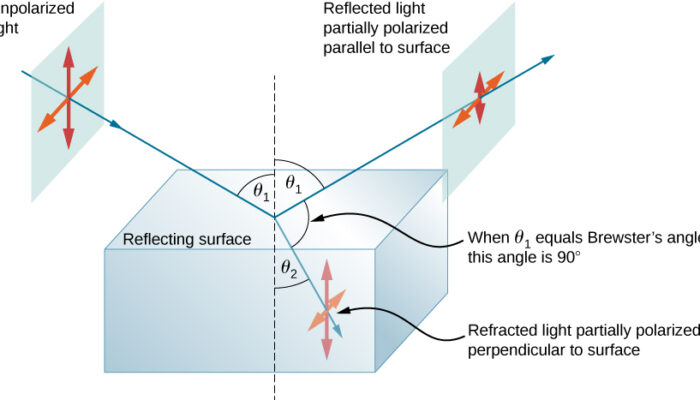
Polarized lenses filter out horizontally polarized light, which is commonly reflected off surfaces like water or roads, thereby reducing glare and improving visual comfort. - Photography and Cinematography:
Photographers use polarizing filters to increase contrast, deepen colors, and eliminate unwanted reflections. In film, polarization techniques enable the creation of immersive 3D effects by controlling light pathways.
Polarization in Scientific Research and Material Analysis
Beyond everyday uses, polarization is instrumental in scientific investigations, particularly in studying material properties and biological structures.
- Birefringence in Materials:
Certain substances exhibit different refractive indices depending on the polarization direction of incoming light, a property exploited in mineralogy and materials science to analyze crystal structures and orientations. - Polarized Light Microscopy:
This technique enhances visualization of cellular and tissue structures by exploiting differences in light polarization, offering detailed insights into biological samples.
Polarization and Quantum Mechanics
Polarization is not only a classical optical phenomenon but also a fundamental aspect of quantum physics. Photons, the quantum particles of light, possess polarization states that can exist in superposition, enabling complex quantum behaviors. Experiments involving polarized photons have been pivotal in demonstrating quantum entanglement and non-locality, deepening our understanding of the quantum realm and challenging classical notions of reality.
Emerging Innovations and Future Directions
Ongoing research continues to expand the applications of polarized light, from enhancing communication technologies to developing advanced imaging systems. These innovations promise to revolutionize fields such as telecommunications, medical diagnostics, and environmental sensing, illustrating the far-reaching impact of polarization studies.
Significance of Polarization in Science and Daily Life
The study of light polarization bridges theoretical physics and practical technology, enriching both scientific knowledge and everyday experiences. By enabling precise control over light intensity and direction, polarization enhances optical devices, improves visual clarity, and facilitates advanced research methodologies. Its influence permeates numerous aspects of modern life, underscoring its vital role in both natural phenomena and human innovation.
Summary
Exploring how light intensity changes upon polarization reveals a complex interplay of physical principles and practical applications. Malus’s Law provides a clear mathematical description of intensity variation, while real-world uses-from glare-reducing eyewear to sophisticated imaging techniques-demonstrate the phenomenon’s versatility. The study of polarized light not only advances scientific inquiry but also enriches technological development, inviting continued exploration into the fundamental nature of light and its myriad effects.
FAQ
What is light polarization?
Light polarization is the phenomenon where light waves oscillate predominantly in a particular direction or plane.
What is Malus's Law?
Malus’s Law describes how the intensity of polarized light changes as it passes through a polarizing filter, mathematically expressed as I = I₀ cos²(θ).
How does polarization affect light intensity?
When light passes through a polarizer, its intensity depends on the angle between the light’s polarization direction and the filter’s axis, allowing maximum intensity at zero degrees and minimal intensity at ninety degrees.






Leave a Reply