
Short Answer
Definition of Atomic Radius
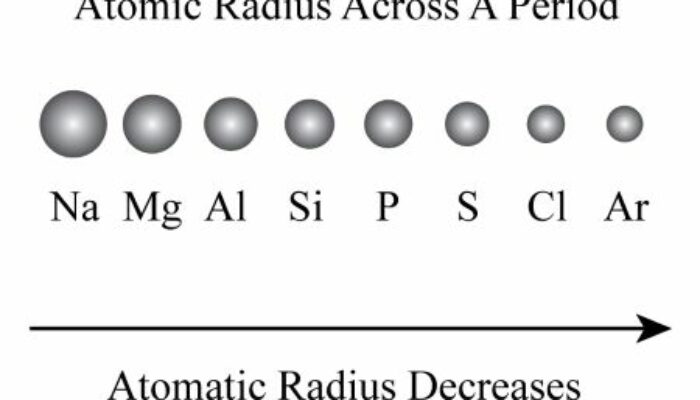
The atomic radius is a key concept in chemistry and physics that describes the size of an atom. It is typically defined as the distance from the nucleus to the outermost boundary of the electron cloud surrounding the atom. However, this boundary is not sharply defined, making the atomic radius a somewhat flexible and context-dependent measurement rather than a fixed value.
Quantum Mechanical Basis of Atomic Radius
At the heart of the complexity in determining atomic radius lies the quantum mechanical behavior of electrons. Unlike classical models where electrons orbit the nucleus in fixed paths, quantum mechanics describes electrons as existing within probabilistic clouds called orbitals. These orbitals represent regions where there is a certain likelihood of locating an electron, resulting in a diffuse and non-uniform electron distribution. Consequently, the atomic radius is better understood as an average distance derived from electron density rather than a precise boundary.
Types of Atomic Radii and Their Variations
The measurement of atomic radius varies depending on the chemical environment and the type of atomic interactions involved. Different definitions of atomic radius include:
- Covalent Radius:
The half-distance between nuclei of two atoms bonded covalently. This radius reflects how closely atoms approach each other in a chemical bond. - Metallic Radius:
The half-distance between nuclei of atoms in a metallic lattice, influenced by metallic bonding characteristics. - Van der Waals Radius:
The effective radius of an atom when it is not bonded but in close proximity to another atom, representing the size of the electron cloud in non-bonding interactions.
These variations highlight how atomic size is not absolute but depends on the atom’s bonding context and surrounding environment.
Influence of Electronegativity and Chemical Environment
Electronegativity, the tendency of an atom to attract electrons, significantly affects the distribution of electron density around an atom. Atoms with higher electronegativity pull bonding electrons closer, which can reduce the effective atomic radius in molecules. For example, chlorine’s atomic radius differs when it exists as a diatomic molecule (Cl2) compared to when it forms ionic compounds like sodium chloride (NaCl). This demonstrates that atomic radius must be interpreted within the framework of chemical bonding and molecular structure.
Measurement Techniques and Their Challenges
Determining atomic radius experimentally involves several sophisticated methods, each with inherent limitations:
- X-ray Diffraction:
Provides average atomic positions in crystalline solids but cannot precisely define electron cloud boundaries. - Nuclear Magnetic Resonance (NMR):
Offers insights into atomic environments but averages over many atoms, limiting spatial resolution. - Atomic Force Microscopy (AFM) and Scanning Tunneling Microscopy (STM):
Enable visualization of individual atoms on surfaces, allowing localized measurements. However, surface interactions can distort atomic structures, complicating size determination.
The interplay of these techniques reflects the ongoing challenge of accurately quantifying atomic dimensions.
Scientific Significance and Practical Implications
Understanding atomic radius is crucial beyond theoretical interest. It plays a vital role in fields such as materials science, nanotechnology, and pharmacology. For instance, the interaction between drug molecules and biological targets depends heavily on atomic-scale dimensions. Variations in atomic radius can influence binding affinity and efficacy, affecting therapeutic outcomes. Thus, precise knowledge of atomic sizes informs the design and development of new materials and medicines.
Common Misconceptions About Atomic Radius
Atomic radius is a fixed, unchanging property.
Atomic radius varies depending on bonding type, chemical environment, and measurement method.
Electrons orbit the nucleus in fixed paths defining atomic size.
Electrons exist in probabilistic clouds, making atomic boundaries diffuse and statistical rather than exact.
Summary and Future Perspectives
The challenge of precisely measuring atomic radius arises from the quantum nature of electrons, the diversity of bonding interactions, the influence of electronegativity, and the limitations of current measurement technologies. This complexity not only fuels scientific curiosity but also drives ongoing research to refine atomic models and measurement techniques. As our understanding deepens, it will continue to impact various scientific and technological domains, illustrating the dynamic and evolving nature of atomic theory.
FAQ
What makes atomic radius measurement challenging?
The quantum mechanical nature of electrons means there is no fixed boundary, and different bonding environments yield different radii.
How do different radii types vary?
Covalent radius measures bonded atoms, metallic radius applies to metal atoms, and van der Waals radius applies to non-bonded interactions.
Can modern microscopy techniques provide exact atomic radii?
While AFM and STM offer localized views, they can distort atomic positions due to surface interactions, limiting precision.
Why is understanding atomic radius important?
It impacts fields like materials science, nanotechnology, and pharmacology by influencing molecular interactions.






Leave a Reply