

Short Answer
Understanding Dark Matter
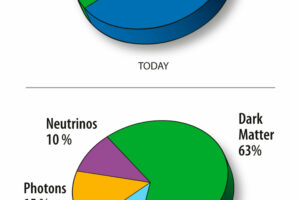
Dark matter is a mysterious and invisible form of matter that does not emit, absorb, or reflect light, making it undetectable by conventional telescopes. Despite its elusive nature, it is believed to constitute approximately 27% of the universe’s total mass-energy content. This unseen substance plays a crucial role in shaping the large-scale structure of the cosmos, acting as the gravitational framework that holds galaxies and galaxy clusters together.
- Invisible Mass:
Dark matter cannot be observed directly but is inferred through its gravitational effects on visible matter. - Cosmic Scaffold:
It provides the gravitational pull necessary for the formation and stability of galaxies and clusters. - Evidence:
Observations such as galaxy rotation curves, gravitational lensing, and the cosmic microwave background radiation support its existence.
Galaxy Cluster Collisions: The Cosmic Train Wreck
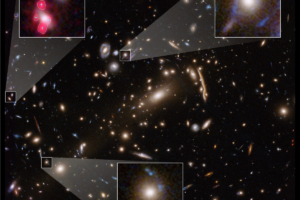
In astrophysics, the term “train wreck” describes a violent collision between massive cosmic structures, such as galaxy clusters. These rare and dramatic events offer unique insights into the behavior of both visible and dark matter under extreme conditions. A recent observation of such a collision has revealed unexpected phenomena that challenge the prevailing dark matter theories.
- Event Description:
Two colossal galaxy clusters collided, creating a chaotic environment where the interactions of different matter components could be studied. - Observational Surprise:
The hot gas (baryonic matter) slowed down and distributed differently than predicted, while the expected gravitational effects of dark matter were notably absent in certain regions.
Conventional Dark Matter Theory and Its Challenges
Traditional cosmological models posit that dark matter exerts gravitational forces that influence the motion of visible matter and light. This framework has successfully explained many cosmic phenomena, but the recent cluster collision has exposed inconsistencies.
- Gravitational Lensing:
The bending of light around massive objects, attributed to dark matter, showed discrepancies when compared to the new data. - Behavioral Mismatch:
The divergence between the movement of baryonic matter and the expected dark matter distribution suggests gaps in the current understanding.
Alternative Theories and New Questions
The unexpected findings from the cosmic collision have prompted scientists to explore alternative explanations and reconsider foundational assumptions.
- Modified Gravity Theories:
Concepts like Modified Newtonian Dynamics (MOND) propose adjustments to gravitational laws that might better explain observed phenomena without invoking dark matter. - Unknown Particles or Forces:
The possibility exists that undiscovered particles or interactions could account for the universe’s missing mass-energy. - Paradigm Shift:
These challenges may herald a transformative change in cosmology, integrating quantum theories with astrophysical observations.
Implications for Astronomy and Technology
The revelations from this cosmic event extend beyond theoretical physics, influencing observational strategies and technological development in astronomy.
- Enhanced Observational Tools:
The need for more sensitive and advanced telescopes and detectors is driving innovation to capture detailed data on cosmic collisions. - Expanded Research Focus:
Scientists are investigating a broader range of merging phenomena, testing new physics beyond traditional dark matter models. - Collaborative Approaches:
Interdisciplinary efforts combining astrophysics, particle physics, and cosmology are becoming essential to unravel these mysteries.
Philosophical Reflections on Cosmic Exploration
The pursuit of understanding the universe’s composition and behavior is not only a scientific endeavor but also a philosophical journey. The challenges posed by phenomena like the galaxy cluster collision invite reflection on the nature of knowledge and the evolution of scientific thought.
- Embracing Uncertainty:
Scientific progress often involves revising or overturning established theories in light of new evidence. - Interplay of Observation and Theory:
The dynamic relationship between empirical data and conceptual frameworks drives the advancement of cosmology. - Human Curiosity:
The quest to comprehend the cosmos reflects a fundamental aspect of human nature, inspiring continual exploration and discovery.
Summary and Future Directions
The recent observation of a dramatic galaxy cluster collision challenges the conventional dark matter paradigm, revealing discrepancies that compel a reexamination of cosmic mass-energy composition. This event serves as both a puzzle and an opportunity, encouraging the development of new theories and observational techniques. As astrophysics ventures into uncharted territory, the ongoing quest to decode the universe’s mysteries remains a testament to human curiosity and scientific resilience.
FAQ
What is dark matter?
Dark matter is a mysterious and invisible form of matter that makes up about 27% of the universe’s total mass-energy content, inferred through its gravitational effects.
What is the significance of the cosmic train wreck?
The cosmic train wreck refers to a violent collision between galaxy clusters that reveals unexpected behaviors of dark matter, challenging existing theories.
What alternative theories are being explored?
Scientists are considering modified gravity theories and the possibility of unknown particles to explain discrepancies in dark matter observations.


Leave a Reply