
Short Answer
Definition of Dark Energy and Cosmic Expansion
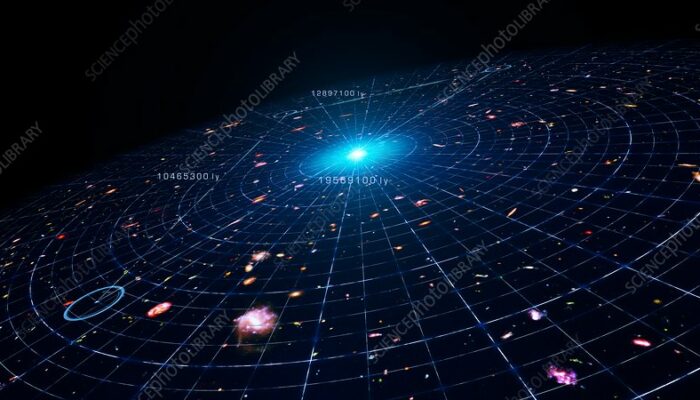
Dark energy is a mysterious form of energy that permeates all of space and is responsible for the accelerated expansion of the universe. Unlike ordinary matter or dark matter, dark energy exerts a repulsive force that drives galaxies apart at an increasing rate, fundamentally altering our understanding of cosmology and the fate of the cosmos.
- Dark Energy:
An unknown energy component constituting about 68% of the universe’s total energy, causing the acceleration of cosmic expansion. - Cosmic Expansion:
The phenomenon where the universe’s scale increases over time, causing galaxies to move away from each other.
Historical Context and Discovery
For centuries, scientists believed that the universe’s expansion, first observed by Edwin Hubble, would gradually slow down due to gravitational attraction between matter. However, in the late 1990s, observations of distant Type Ia supernovae revealed a startling truth: the expansion of the universe is not decelerating but accelerating. This discovery introduced the concept of dark energy as a dominant force shaping cosmic dynamics.
Conceptualizing the Universe’s Expansion
One way to visualize the expanding universe is to imagine it as the surface of a balloon being inflated. Galaxies are like dots on this balloon’s surface, moving away from each other as the balloon grows. Unlike a balloon that inflates due to external pressure, the universe’s expansion accelerates autonomously, driven by an intrinsic energy embedded in the vacuum of space. This intrinsic energy defies the behavior of known forces, making dark energy a unique and puzzling phenomenon.
Quantifying Dark Energy’s Influence
Dark energy accounts for roughly 68% of the universe’s total energy budget, overshadowing the combined contributions of ordinary matter and dark matter. Its presence is inferred from precise measurements of the redshift of light emitted by distant supernovae, which act as “standard candles.” These observations allow astronomers to track the universe’s expansion rate over billions of years, revealing the accelerating trend attributed to dark energy’s repulsive effect.
The Cosmological Constant and Alternative Theories
Originally introduced by Albert Einstein as the cosmological constant (Λ) to maintain a static universe, this term has been revived as a leading explanation for dark energy. It represents a constant vacuum energy density inherent to empty space, implying that even “nothingness” possesses energy. This concept challenges traditional physics and raises profound questions about the nature of reality.
Beyond the cosmological constant, several alternative models have been proposed:
- Quintessence:
A dynamic field that changes over time, potentially explaining variations in dark energy’s strength. - Modified Gravity Theories:
Proposals that alter the laws of gravity on cosmic scales to account for accelerated expansion without invoking dark energy. - Observational Artifacts:
Hypotheses suggesting that perceived acceleration might result from our unique position or perspective within the universe.
Implications for the Universe’s Fate
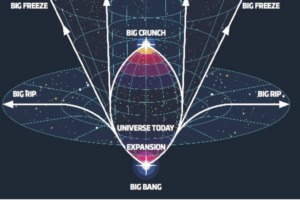
The nature of dark energy profoundly influences the ultimate destiny of the cosmos. If dark energy remains constant or grows stronger, the universe may face a “Big Freeze,” where galaxies recede beyond observable limits, leaving isolated pockets of matter in an ever-cooling void. Alternatively, if dark energy’s properties change dramatically, scenarios like the “Big Rip” could occur, tearing apart galaxies, stars, and even atomic structures as spacetime itself is disrupted.
Modern Research and Observational Efforts
Contemporary cosmology relies on advanced technology to probe dark energy’s mysteries. Space telescopes observe ancient light from the early universe, while ground-based observatories map the large-scale distribution of galaxies. These data sets refine our understanding of cosmic expansion and test theoretical models, driving progress in unraveling dark energy’s elusive nature.
Why Understanding Dark Energy Is Crucial
Dark energy is not just a theoretical curiosity; it is central to comprehending the universe’s structure, evolution, and ultimate fate. Its discovery has revolutionized physics, prompting new questions about the fundamental forces and the composition of reality. Studying dark energy enhances our grasp of cosmology, informs the development of new physics, and inspires philosophical reflection on humanity’s place in an ever-expanding cosmos.
Common Misconceptions About Dark Energy
Dark energy is the same as dark matter.
Dark energy and dark matter are distinct; dark matter exerts gravitational attraction, while dark energy causes repulsive acceleration.
The universe is expanding into empty space.
The expansion is of space itself, not into a pre-existing void; space stretches uniformly everywhere.
Dark energy is well understood.
Despite extensive study, dark energy’s fundamental nature remains one of the biggest mysteries in physics.
Summary
The accelerating expansion of the universe, driven by dark energy, represents one of the most profound discoveries in modern science. From its initial detection through supernova observations to ongoing theoretical and observational research, dark energy challenges our understanding of physics and cosmology. Its enigmatic presence shapes the universe’s past, present, and future, making it a central focus of scientific inquiry and a symbol of humanity’s quest to comprehend the cosmos.
FAQ
What is dark energy?
Dark energy is a form of energy that causes the acceleration of the universe's expansion, constituting about 68% of the universe's total energy.
How does dark energy differ from dark matter?
Dark energy causes a repulsive force leading to the expansion of the universe, while dark matter exerts gravitational attraction.
Why is dark energy important?
Understanding dark energy is crucial for comprehending the universe's structure, evolution, and ultimate fate.

Leave a Reply