
Short Answer
Definition of the Dark Universe
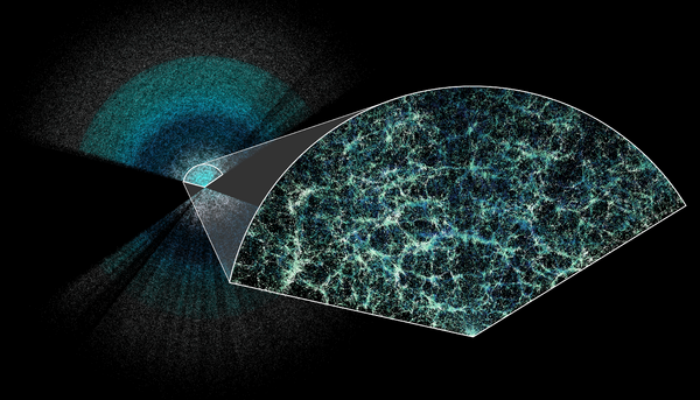
The universe, when observed through telescopes, reveals a dazzling array of stars, galaxies, and luminous matter. However, these visible components represent only a small fraction of the cosmos. The vast majority of the universe is composed of unseen substances collectively known as the dark sector, which includes dark matter and dark energy. These mysterious elements dominate the cosmic landscape, shaping the structure, behavior, and ultimate fate of everything that exists.
- Ordinary Matter:
Comprises about 5% of the universe, including all atoms that form stars, planets, and living organisms. - Dark Matter:
Makes up roughly 27% of the universe and exerts gravitational effects without emitting or absorbing light. - Dark Energy:
Constitutes approximately 68% of the universe, driving its accelerated expansion through a repulsive force.
Understanding Dark Matter
Dark matter is an invisible form of matter that does not interact with electromagnetic radiation, making it undetectable by conventional telescopes. Its existence is inferred primarily through gravitational effects on visible matter, radiation, and the large-scale structure of the universe. For example, the unexpectedly high rotational speeds of stars at the outskirts of galaxies suggest the presence of additional unseen mass providing the necessary gravitational pull to keep these stars bound.
Hypothesized Components of Dark Matter
Scientists propose several candidates for dark matter particles, including:
- Weakly Interacting Massive Particles (WIMPs): Hypothetical particles that interact via gravity and the weak nuclear force but not electromagnetically.
- Axions: Extremely light particles that interact very weakly with ordinary matter and radiation.
Despite extensive experimental efforts, direct detection of dark matter particles remains elusive, making it one of the most profound mysteries in modern cosmology.
Exploring Dark Energy
Dark energy is an enigmatic force responsible for the accelerated expansion of the universe. Unlike matter, dark energy is uniformly distributed throughout space and exerts a repulsive effect that counteracts gravitational attraction. Its discovery in the late 1990s, through observations of distant Type Ia supernovae appearing dimmer than expected, revolutionized our understanding of cosmic dynamics.
Theoretical Models of Dark Energy
- Cosmological Constant (Λ): Represents a constant energy density filling space uniformly, originally introduced by Einstein.
- Dynamic Fields: Propose that dark energy evolves over time, potentially changing its influence on cosmic expansion.
The true nature of dark energy remains one of the most significant open questions in physics, challenging existing theories of gravity and the fundamental forces.
The Role of Dark Matter and Dark Energy in Cosmic Evolution
Dark matter and dark energy are not merely passive components; they actively shape the universe’s past, present, and future. Dark matter acts as the invisible framework upon which galaxies and larger structures form, guiding the aggregation of gas and stars. Without it, the universe’s complex architecture would not exist.
Conversely, dark energy influences the universe’s long-term trajectory. As the cosmos expands, dark energy’s repulsive force grows dominant, potentially leading to a future where galaxies recede beyond each other’s observable horizons, stars burn out, and the universe cools into a vast, empty expanse.
Observational Techniques and Evidence
Although dark matter and dark energy cannot be observed directly, astronomers employ various indirect methods to study their properties:
- Gravitational Lensing: The bending of light from distant objects by massive dark matter concentrations reveals its distribution.
- Cosmic Microwave Background (CMB): Measurements of the CMB provide insights into the early universe’s composition and the influence of dark components.
- Supernova Surveys and Baryon Acoustic Oscillations: These observations help constrain the behavior and equation of state of dark energy.
Advanced instruments, including next-generation space telescopes and ground-based observatories, continue to refine our understanding by detecting subtle cosmic signals linked to the dark sector.
Challenges and Emerging Theories
Despite significant advances, the dark sector remains a frontier filled with unresolved questions. Recent data hint that dark energy might not be constant but could vary over time, prompting reconsideration of standard cosmological models. Alternative theories propose modifications to gravity itself, attempting to explain cosmic acceleration without invoking dark energy, though these remain speculative and controversial.
The dynamic interplay between theoretical predictions and observational data drives ongoing research, pushing the boundaries of physics and cosmology.
Why Understanding the Dark Universe Is Crucial
Comprehending the nature and proportions of dark matter and dark energy is essential for a complete picture of the cosmos. These components govern the formation of galaxies, influence the universe’s expansion rate, and determine its ultimate fate. Their study not only deepens our knowledge of astrophysics but also challenges and expands fundamental physics, potentially leading to revolutionary discoveries about the fabric of reality.
Summary
In essence, the universe is predominantly composed of dark matter and dark energy, which together account for about 95% of its total content. Ordinary matter-the stars, planets, and life forms familiar to us-makes up only a small fraction. This vast, unseen majority shapes the cosmic structure and drives the universe’s accelerated expansion. Ongoing research aims to transform these shadowy concepts into well-understood phenomena, illuminating the true extent of the universe’s darkness and its profound implications for science.
FAQ
What is dark matter?
Dark matter is an invisible form of matter that does not interact with light and is inferred through its gravitational effects on visible matter.
What role does dark energy play in the universe?
Dark energy is responsible for the accelerated expansion of the universe, exerting a repulsive force that counteracts gravity.


Leave a Reply