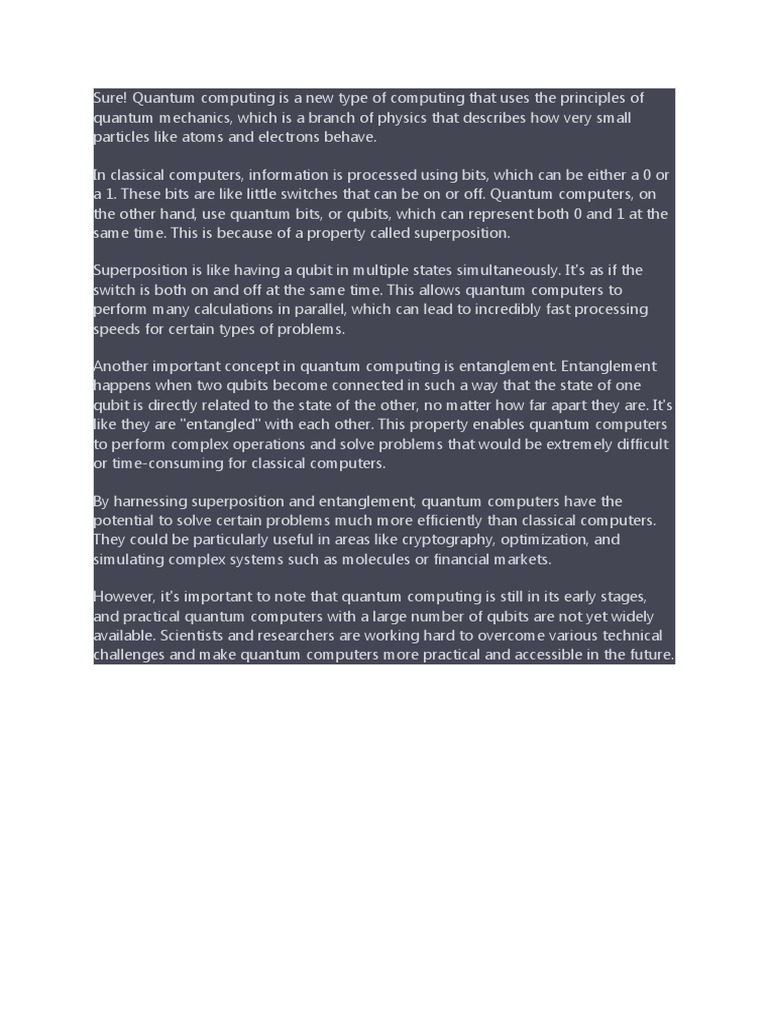
What is the scope of quantum computers in the future?

Understanding Quantum Computing Quantum computing represents a revolutionary shift from traditional computing paradigms by leveraging the principles of quantum mechanics. Unlike classical computers that use bits as the smallest unit of data, quantum computers utilize quantum bits, or qubits, which can exist simultaneously in multiple states thanks to superposition. This unique characteristic enables quantum systems […]

Read More →

What is quantum advantage and quantum supremacy?

Understanding Quantum Advantage and Quantum Supremacy In recent years, the terms quantum advantage and quantum supremacy have gained prominence in both scientific circles and popular discussions. Although these phrases are sometimes used interchangeably, they represent distinct milestones in the development of quantum computing technology. Both concepts carry significant implications not only for computational capabilities but […]

Read More →

How can a quantum computer be hacked?

Understanding Quantum Computing and Its Security Challenges Quantum computing represents a groundbreaking paradigm shift in information processing, captivating interest across fields such as computer science, cryptography, and physics. Unlike classical computers that rely on bits as the fundamental unit of data, quantum computers utilize quantum bits or qubits, which can exist in multiple states simultaneously […]
Read More →

What are the absolute basics of quantum computing?

Definition of Quantum Computing Quantum computing represents a cutting-edge technological domain that leverages the principles of quantum mechanics to revolutionize information processing. Unlike classical computing, which relies on binary bits, quantum computing employs quantum bits or qubits, enabling fundamentally different and more powerful computational capabilities. Fundamental Concepts of Quantum Computing At the heart of quantum […]

Read More →

Quantum Advantage: When Speed Becomes Supremacy

Definition of Quantum Advantage Quantum advantage describes the phenomenon where quantum computers outperform classical computers in solving specific computational problems. This concept represents a significant milestone in computational science, suggesting a future where quantum machines can tackle tasks that are currently impractical or impossible for traditional systems. At its essence, quantum advantage highlights the superior […]

Read More →

Who is doing research in quantum information science?

Definition of Quantum Information Science Quantum information science is a multidisciplinary field that explores how the principles of quantum mechanics can be applied to the processing, storage, and transmission of information. It investigates the unique properties of quantum systems-such as superposition and entanglement-to develop new computational and communication technologies that surpass classical limitations. Quantum bits […]

Read More →

Is it possible to buy quantum computers?

Understanding Quantum Computers Quantum computers represent a revolutionary advancement in computational technology, distinct from classical computers that rely on bits as the fundamental unit of information. Instead, quantum machines utilize quantum bits, or qubits, which can exist simultaneously in multiple states due to the principle of superposition. This capability allows quantum computers to tackle complex […]

Read More →

Are we reaching the limits of classical computing?

Understanding Classical Computing Classical computing forms the backbone of modern digital technology, operating on the principles of binary logic. At its core, classical computers use bits-units of information that exist in one of two states, 0 or 1-to perform calculations and process data. These systems rely on well-established algorithmic frameworks and hardware architectures, such as […]

Read More →

What are the biggest challenges in quantum computing?

Understanding Quantum Computing Quantum computing represents a groundbreaking shift in computational technology, promising capabilities far beyond those of traditional classical computers. This emerging discipline harnesses the principles of quantum mechanics to process information in fundamentally new ways. However, the path to fully operational quantum computers is riddled with complex obstacles that require careful and innovative […]

Read More →