
Short Answer
Definition of Dark Matter Density
Dark matter density refers to the amount of dark matter mass contained within a given volume of space. Unlike ordinary matter, which includes stars, planets, and gas, dark matter does not interact with electromagnetic radiation, making it invisible to conventional telescopes. Despite this invisibility, dark matter constitutes roughly 27% of the universe’s total mass-energy content, playing a crucial role in shaping cosmic structures.
- Dark Matter:
A form of matter that does not emit, absorb, or reflect light, detectable only through its gravitational effects. - Density:
The mass of dark matter per unit volume, typically measured in units such as grams per cubic centimeter or GeV/cm3.
Understanding the Concept of Density in the Context of Dark Matter
While density is generally defined as mass divided by volume, applying this concept to dark matter introduces complexities. Since dark matter cannot be observed directly, its density is inferred from gravitational influences on visible matter and light. For example, the way stars orbit within galaxies or how light bends around massive objects (gravitational lensing) provides clues to the distribution and concentration of dark matter.
Typical Values and Scale of Dark Matter Density
Within our own galaxy, the Milky Way, the local dark matter density is estimated to be about 0.3 GeV/cm3, equivalent to approximately 5 × 10-25 grams per cubic centimeter. Although this density is extraordinarily low compared to the density of air on Earth, it accumulates over vast cosmic distances to form the gravitational framework necessary for galaxy formation and stability.
Spatial Variations in Dark Matter Density
Dark matter density is not uniform throughout the universe. It varies significantly depending on the cosmic environment:
- Galactic Halos:
Dark matter is densest in the halos surrounding galaxies, where it acts as a gravitational glue holding the galaxy together. These halos extend well beyond the visible edges of galaxies. - Cosmic Voids:
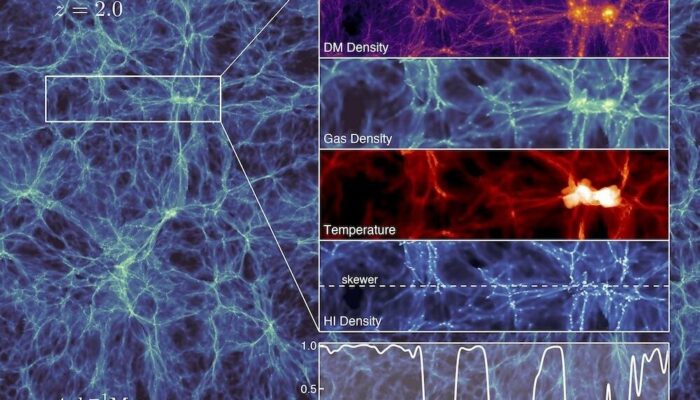
In the vast empty regions between galaxies, dark matter density drops sharply, highlighting the clumpy and filamentary nature of the cosmic web. - Galaxy Clusters:
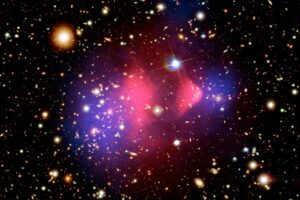
Clusters of galaxies contain massive, diffuse halos of dark matter. Observations of clusters like the Bullet Cluster have provided strong evidence for dark matter by showing a separation between dark matter and ordinary matter during collisions.
Mechanisms for Measuring Dark Matter Density
Scientists estimate dark matter density through indirect methods, primarily by analyzing gravitational effects:
- Galaxy Rotation Curves:
The speed at which stars orbit the center of galaxies reveals the presence of unseen mass. - Gravitational Lensing:
The bending of light from distant objects by massive foreground structures helps map dark matter distribution. - Cosmological Simulations:
Advanced computer models simulate the evolution of dark matter over billions of years, predicting density fluctuations and large-scale structure formation.
Mathematical Representation of Dark Matter Density
Dark matter density (ρ) can be expressed as:
ρ = M / V
- ρ (rho): Dark matter density
- M: Mass of dark matter within a volume
- V: Volume considered
In astrophysical contexts, density is often given in units such as GeV/cm3 or grams per cubic centimeter, depending on the scale and measurement method.
Challenges and Theoretical Perspectives
Determining the exact density of dark matter is complicated by the unknown nature of its constituent particles. Various candidates have been proposed, each implying different density distributions:
- Weakly Interacting Massive Particles (WIMPs):
Hypothetical particles that interact via gravity and weak nuclear force, expected to cluster in halos. - Axions:
Ultra-light particles that could form diffuse dark matter distributions. - Sterile Neutrinos:
Hypothetical neutrinos that do not interact via the standard weak force, potentially influencing density profiles.
Ongoing experiments aim to detect these particles directly, which would refine our understanding of dark matter density and its distribution.
Significance of Dark Matter Density in Cosmology
Dark matter density is fundamental to our comprehension of the universe’s structure and evolution. It acts as the invisible scaffold upon which galaxies and clusters form and evolve. Without dark matter’s gravitational influence, the universe would look drastically different, lacking the large-scale structures observed today.
Interrelation Between Dark Matter Density and Dark Energy
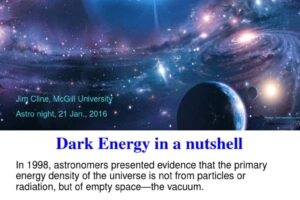
While dark matter exerts an attractive gravitational force, dark energy drives the accelerated expansion of the universe. Understanding the balance and distribution of these two components is essential for a complete cosmological model. Dark matter density informs the gravitational framework, whereas dark energy influences the universe’s expansion rate, together shaping cosmic history.
Real-World Examples Illustrating Dark Matter Density
Several astronomical observations highlight the role of dark matter density:
- The Milky Way Galaxy:
The rotation speeds of stars in the Milky Way’s outer regions indicate a dark matter halo with a specific density profile. - The Bullet Cluster:
A collision between two galaxy clusters where dark matter and ordinary matter separate, providing direct evidence of dark matter’s gravitational effects and density distribution. - Gravitational Lensing by Galaxy Clusters:
Mapping dark matter density through the distortion of background light reveals the mass distribution in clusters.
Common Misconceptions About Dark Matter Density
Dark matter is dense like ordinary matter.
Dark matter density is extremely low compared to everyday materials but is significant on cosmic scales due to its vast distribution.
Dark matter can be detected directly through light.
Dark matter does not interact with electromagnetic radiation, so its presence is inferred only through gravitational effects.
Dark matter density is uniform throughout the universe.
Dark matter density varies widely, being concentrated in halos around galaxies and clusters, and sparse in cosmic voids.
Future Directions and Technological Advances
Recent improvements in astronomical instruments, such as high-resolution spectral surveys and enhanced gravitational lensing techniques, have refined measurements of dark matter density. These advances allow scientists to map the intricate distribution of dark matter from dense galactic centers to the faint filaments connecting clusters, bridging theoretical models with observational data.
Conclusion: The Cosmic Importance of Dark Matter Density
Dark matter density is more than a mere numerical value; it represents the invisible framework that governs the universe’s structure and evolution. As research progresses, each new insight into dark matter density reshapes our understanding of the cosmos, revealing a universe dominated by unseen forces. This knowledge not only deepens scientific inquiry but also challenges our perception of reality, inviting us to explore the profound mysteries hidden within the fabric of space.
FAQ
What is dark matter density?
Dark matter density refers to the mass of dark matter per unit volume in space, which is crucial for understanding cosmic structures.
How is dark matter density measured?
It is measured indirectly through gravitational effects, galaxy rotation curves, and gravitational lensing.
Why is dark matter density important?
It plays a vital role in the formation of galaxies and the overall structure of the universe.

Leave a Reply