

Short Answer
Understanding Dark Matter and Black Holes
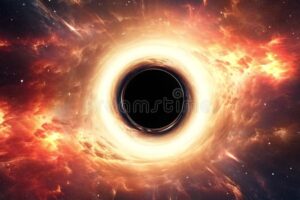
The fate of dark matter once it crosses a black hole’s event horizon remains one of the most intriguing puzzles in contemporary astrophysics. Dark matter, an elusive form of matter constituting approximately 27% of the universe’s total mass-energy, has never been directly observed but is inferred through its gravitational effects on visible matter and cosmic structures. Black holes, formed from the gravitational collapse of massive stars or other extreme cosmic events, create regions in spacetime where gravity is so intense that nothing, not even light, can escape. Investigating how dark matter behaves in the presence of black holes challenges our understanding of both phenomena and the fundamental laws governing the universe.
Definition and Characteristics of Dark Matter
Dark matter is a hypothetical form of matter that does not interact with electromagnetic radiation, making it invisible to telescopes and other detection methods relying on light. Its presence is inferred primarily through gravitational effects on galaxies and galaxy clusters.
- Non-baryonic nature:
Unlike ordinary matter composed of protons and neutrons, dark matter is believed to be non-baryonic, meaning it does not consist of the particles that make up atoms. - Weak interactions:
Dark matter interacts predominantly through gravity and possibly the weak nuclear force, but it does not emit, absorb, or reflect light. - Cosmic role:
It plays a crucial role in the formation and stability of large-scale cosmic structures, influencing galaxy rotation curves and gravitational lensing phenomena.
Black Holes: Structure and Properties
Black holes are regions in space where gravitational forces compress matter into an infinitely dense point known as a singularity, surrounded by an event horizon-the boundary beyond which escape is impossible.
- Event horizon:
The point of no return, marking the limit where the escape velocity exceeds the speed of light. - Singularity:
A theoretical point of infinite density where classical physics ceases to apply, necessitating quantum gravity theories. - Spacetime curvature:
Black holes dramatically warp spacetime, affecting the motion of nearby matter and light.
Interaction Between Dark Matter and Black Holes
Given that dark matter interacts gravitationally, it is expected to be influenced by black holes similarly to ordinary matter. However, its unique properties lead to distinct behaviors and raise several questions about its fate inside black holes.
Gravitational Capture and Accretion
Dark matter particles, like any mass, are drawn toward black holes by gravity. Some theories propose that dark matter contributes incrementally to black hole mass through a process called accretion. Unlike baryonic matter, dark matter does not emit radiation when falling into a black hole, making its accretion invisible to electromagnetic observations.
Dark Matter Density Near Black Holes
Because dark matter rarely interacts with normal matter except gravitationally, it may accumulate in denser concentrations near black holes, forming “spikes” or halos. These dense regions could influence the black hole’s gravitational field and potentially affect its growth and evolution.
Potential Quantum Effects Inside Black Holes
Some quantum gravity models suggest that information carried by dark matter particles might not be lost inside black holes but could be encoded in subtle ways, possibly affecting black hole entropy or contributing to phenomena like Hawking radiation. This hints at a profound connection between dark matter and quantum information theory.
Dark Matter Candidates and Their Behavior in Extreme Environments
Dark matter is hypothesized to consist of various exotic particles, such as Weakly Interacting Massive Particles (WIMPs) or axions, each with different interaction properties that could influence their behavior near or inside black holes.
- Self-interacting dark matter:
If dark matter particles interact weakly with each other, they might form dense cores near event horizons or even annihilate if particle-antiparticle pairs exist, potentially producing exotic byproducts. - Primordial black holes as dark matter:
Some theories propose that primordial black holes themselves could constitute a fraction of dark matter, blurring the distinction between black holes and dark matter and raising questions about their mutual influence.
Observational Challenges and Prospects
Studying dark matter within black holes is hindered by the invisibility of dark matter and the event horizon’s impenetrable nature. However, indirect methods offer promising avenues:
- Gravitational wave astronomy:
Observations of black hole mergers may reveal anomalies indicative of dark matter’s influence. - Gravitational lensing and black hole shadows:
Subtle distortions in light paths or changes in black hole silhouettes could hint at dark matter halos surrounding black holes.
Why Understanding Dark Matter in Black Holes Is Crucial
Exploring the interaction between dark matter and black holes is vital for advancing our comprehension of the universe’s fundamental components and the laws governing extreme environments. It challenges existing physics paradigms and may unlock new insights into the nature of dark matter, quantum gravity, and the evolution of cosmic structures.
Common Misconceptions
Dark matter is absorbed and destroyed inside black holes.
While dark matter is gravitationally captured, some theories suggest its information might be preserved in quantum states, challenging the notion of total destruction.
Dark matter forms luminous accretion disks around black holes.
Dark matter does not interact electromagnetically and thus does not emit radiation, making its accretion invisible in electromagnetic spectra.
Summary
The destiny of dark matter within black holes remains an open question at the frontier of astrophysics. Its unique properties and interactions with black holes offer a rich field for theoretical exploration and observational innovation. As technology advances and theoretical models refine, the veil obscuring dark matter’s role in these cosmic enigmas may gradually lift, deepening our understanding of the universe’s darkest mysteries.
FAQ
What is dark matter?
Dark matter is a hypothetical form of matter that does not interact with electromagnetic radiation, making it invisible and detectable only through its gravitational effects.
How do black holes interact with dark matter?
Black holes can capture dark matter gravitationally, potentially contributing to their mass and influencing their growth.




Leave a Reply