
Short Answer
Understanding Galactic Rotation Curves
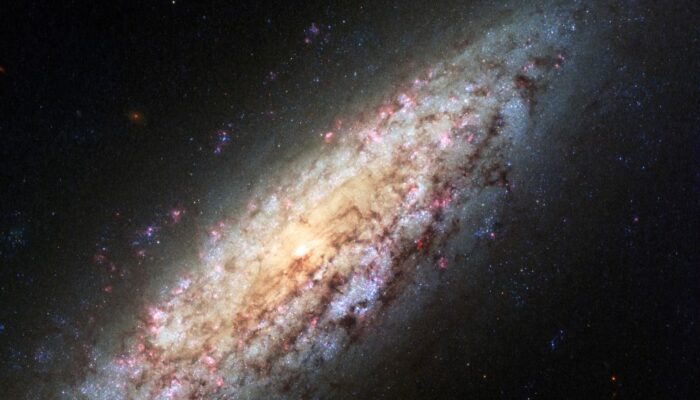
Galactic rotation curves are essential tools used by astronomers to analyze how mass is distributed within galaxies. These curves graph the orbital velocity of stars and interstellar gas relative to their distance from the galaxy’s center. Classical physics, based on Newtonian gravity and the visible matter observed, predicts that rotational speeds should decline with increasing distance from the core-similar to how planets in our solar system orbit more slowly the farther they are from the Sun. This expected decrease in velocity, known as the Keplerian decline, reflects the diminishing gravitational pull as mass becomes sparser toward the galaxy’s edges.
Unexpected Observations and the Dark Matter Puzzle
Contrary to these predictions, astronomical measurements reveal that stars located in the outer regions of galaxies maintain velocities that remain constant or even rise slightly, rather than slowing down. This surprising discovery, notably documented by Vera Rubin and her colleagues in the late 20th century, challenges the conventional understanding of galactic dynamics. The sustained high speeds imply the presence of a substantial amount of unseen mass that cannot be accounted for by stars, gas, or dust visible through telescopes. This invisible component, which exerts gravitational influence without emitting or absorbing light, is what scientists now refer to as dark matter.
Definition and Characteristics of Dark Matter
Dark matter is a hypothetical form of matter that does not interact with electromagnetic radiation, making it undetectable by conventional observational methods. Despite its invisibility, it exerts gravitational forces that significantly affect the motion of celestial bodies within galaxies and beyond.

- Non-luminous:
Dark matter neither emits nor reflects light, rendering it invisible across the electromagnetic spectrum. - Gravitationally influential:
It shapes the dynamics of galaxies by providing the additional mass necessary to explain observed rotation curves. - Widespread presence:
Dark matter forms extensive halos enveloping galaxies, extending far beyond the visible stellar components.
Mathematical Framework of Galactic Rotation
The relationship between rotational velocity and mass distribution in a galaxy can be expressed by the equation:
v² = (G × M) / r
- v: Orbital velocity of a star or gas cloud at radius r
- G: Gravitational constant
- M: Mass enclosed within radius r
- r: Distance from the galactic center
If the mass were concentrated near the center and decreased outward, the velocity v would diminish with increasing r. However, the observed flat or rising rotation curves indicate that the enclosed mass M must increase with radius, suggesting the presence of a massive, invisible halo surrounding the galaxy.
Role of Dark Matter in Galactic Stability
The unexpectedly high orbital speeds of stars at the periphery of galaxies raise a critical question: why don’t these stars escape into intergalactic space? Without an additional gravitational force, the centrifugal effect from their rapid motion would cause the galaxy to disperse. Dark matter provides this essential gravitational binding, acting as a cosmic scaffold that maintains the structural cohesion of galaxies over billions of years.
Cosmological Significance of Dark Matter
Beyond individual galaxies, dark matter plays a pivotal role in shaping the large-scale structure of the universe. It influences the formation and evolution of galaxy clusters and superclusters by guiding the aggregation of ordinary, baryonic matter. This invisible mass is fundamental to understanding how the universe evolved from initial density fluctuations in the early cosmos to the complex web of galaxies observed today.
Advancements in Dark Matter Research: Self-Interacting Dark Matter
Recent theoretical developments propose that dark matter may not be entirely inert but could interact with itself through forces other than gravity. This concept of self-interacting dark matter offers explanations for observed discrepancies in galactic rotation patterns and structural diversity. Such interactions might cause dark matter to redistribute or heat up, addressing the “diversity problem” where galaxies of similar size exhibit different rotation behaviors. These insights are prompting scientists to refine models of dark matter’s nature and properties.
Common Misconceptions About Galactic Rotation and Dark Matter
The rotation speeds of stars should always decrease with distance from the galactic center.
Observations show that rotation speeds often remain constant or increase, indicating additional unseen mass.
Dark matter emits light and can be detected with telescopes.
Dark matter does not interact with electromagnetic radiation, making it invisible to traditional detection methods.
Why Galactic Rotation Curves and Dark Matter Matter
The study of galactic rotation curves has revolutionized our understanding of the cosmos by revealing the presence of dark matter, a dominant yet invisible component of the universe. This discovery has profound implications for astrophysics, cosmology, and the fundamental laws governing matter and gravity. It challenges the notion that the universe is composed solely of visible matter and opens new avenues for exploring the unseen forces shaping cosmic evolution. Ultimately, the investigation of galactic rotation not only enriches scientific knowledge but also inspires a deeper appreciation of the universe’s complexity and mystery.
Real-World Examples of Galactic Rotation Curves
One of the most famous cases is the Andromeda Galaxy (M31), whose rotation curve remains flat well beyond its visible edge, strongly suggesting a massive dark matter halo. Similarly, the Milky Way exhibits rotation speeds that defy expectations based solely on luminous matter, reinforcing the dark matter paradigm. These examples underscore the universality of the phenomenon across different galaxy types and sizes.

Leave a Reply