
Short Answer
Definition of Dark Photons
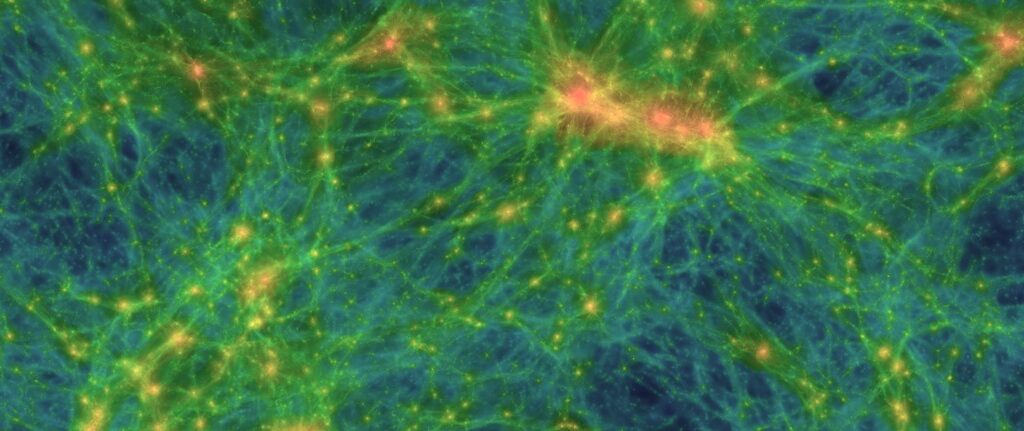
Dark photons are hypothetical particles proposed as mediators of a hidden force within the so-called “dark sector” of the universe. Analogous to ordinary photons, which are the carriers of the electromagnetic force and visible light, dark photons are theorized to interact very weakly with standard matter and radiation. They are considered potential constituents or facilitators of dark matter, the mysterious substance that makes up about 27% of the universe’s total mass-energy but remains invisible to conventional detection methods.
- Dark Matter:
A form of matter that does not emit, absorb, or reflect light, detectable only through its gravitational influence on visible matter and cosmic structures. - Dark Sector:
A hypothesized realm containing particles and forces that interact minimally with the known particles of the Standard Model, potentially including dark photons. - Dark Photons:
Proposed vector bosons similar to photons but associated with a new U(1) gauge symmetry, possibly possessing a small mass and mediating interactions within the dark sector.
Origins and Theoretical Framework
The concept of dark photons emerges from extensions to the Standard Model of particle physics, particularly those introducing an additional U(1) gauge symmetry. This mathematical framework allows for a new force carrier particle, the dark photon, which may have a nonzero mass, unlike the massless ordinary photon. The presence of dark photons could explain certain astrophysical and cosmological phenomena that remain puzzling under current models.
These theories suggest that dark photons might mix kinetically with ordinary photons, enabling extremely weak interactions between the dark sector and visible matter. This kinetic mixing could manifest as subtle effects detectable in high-precision experiments or astrophysical observations, providing a potential window into the dark sector.
Mechanism of Dark Photon Interaction
Dark photons are thought to mediate forces within the dark sector, analogous to how photons mediate electromagnetic interactions. Their interaction with ordinary matter is hypothesized to occur through kinetic mixing, a process where the dark photon and the ordinary photon slightly overlap, allowing for faint but measurable exchanges of energy or momentum.
This mechanism could lead to phenomena such as dark photon oscillations, where dark photons convert into ordinary photons and vice versa, or rare decay processes. The small mass attributed to dark photons would influence these dynamics, differentiating them from the behavior of massless photons.
Mathematical Description and Formulae
The theoretical description of dark photons involves an extension of the Standard Model Lagrangian to include an extra U(1) gauge field, often denoted as ( A’_mu ), representing the dark photon. The kinetic mixing term is typically expressed as:
( mathcal{L} supset -frac{1}{4} F_{munu} F^{munu} – frac{1}{4} F’_{munu} F’^{munu} + frac{epsilon}{2} F_{munu} F’^{munu} + frac{1}{2} m_{A’}^2 A’_mu A’^mu )
- ( F_{munu} ): Electromagnetic field strength tensor for ordinary photons.
- ( F’_{munu} ): Field strength tensor for dark photons.
- ( epsilon ): Kinetic mixing parameter quantifying the interaction strength between photons and dark photons.
- ( m_{A’} ): Mass of the dark photon, which may be small but nonzero.
This Lagrangian encapsulates the dynamics of both photon types and their interaction, providing a basis for predicting experimental signatures.
Astrophysical and Cosmological Significance
Dark photons could play a crucial role in explaining several cosmic mysteries. For instance, the unexpectedly high rotational speeds of stars in galaxies suggest the presence of unseen mass-dark matter-that exerts gravitational influence. Dark photons might be part of this unseen mass or mediate interactions within dark matter, affecting galaxy formation and evolution.
Additionally, dark photons may influence the early universe’s thermal history, impact the cosmic microwave background radiation, and contribute to phenomena such as dark radiation or self-interacting dark matter models. Observations of excess positrons in cosmic rays have also been speculated to involve dark photon-related processes.
Experimental Searches and Detection Efforts
Scientists employ a variety of experimental approaches to detect dark photons or constrain their properties. These include:
- Fixed-Target Experiments:
High-energy particle beams directed at stationary targets to produce and detect rare dark photon events. - Underground Detectors:
Sensitive instruments shielded from cosmic radiation, designed to observe faint signals from dark photon interactions. - Space-Based Observatories:
Telescopes monitoring cosmic phenomena for anomalies consistent with dark photon effects.
These experiments focus on identifying kinetic mixing signatures, such as unexpected electromagnetic signals or deviations in known particle behaviors. Although no conclusive evidence has yet been found, ongoing improvements in detector sensitivity continue to narrow the parameter space where dark photons might exist.
Common Misconceptions About Dark Photons
Dark photons are just another name for dark matter.
Dark photons are proposed force carriers within the dark sector, potentially mediating interactions between dark matter particles, but are not themselves synonymous with dark matter.
Dark photons interact strongly with ordinary matter.
Dark photons are expected to interact very weakly with standard particles, primarily through kinetic mixing, making their detection challenging.
Dark photons have the same properties as ordinary photons.
Unlike massless ordinary photons, dark photons may have a small mass, leading to different physical behaviors and experimental signatures.
Importance and Implications
Understanding dark photons is pivotal for advancing our knowledge of the universe’s fundamental composition. If confirmed, dark photons would not only illuminate the nature of dark matter but also expand the Standard Model, revealing new forces and particles. This breakthrough could transform astrophysics, cosmology, and particle physics by providing novel detection methods and explaining phenomena that currently elude scientific explanation.
Moreover, the pursuit of dark photons exemplifies the broader human endeavor to comprehend the unseen aspects of reality, pushing the boundaries of technology and theory. It underscores the interconnectedness of the cosmos, where hidden forces may shape the visible universe in profound ways.
Summary
Dark photons represent a promising theoretical candidate in the quest to decode dark matter and the dark sector. Emerging from extensions to the Standard Model, these particles could mediate new forces, possess a small mass, and interact faintly with ordinary matter through kinetic mixing. Their study bridges theoretical physics and experimental innovation, with ongoing research striving to detect their subtle signatures. As investigations continue, dark photons remain a captivating possibility that could redefine our understanding of the universe’s hidden fabric.





Leave a Reply