
Short Answer
Understanding Dark Matter
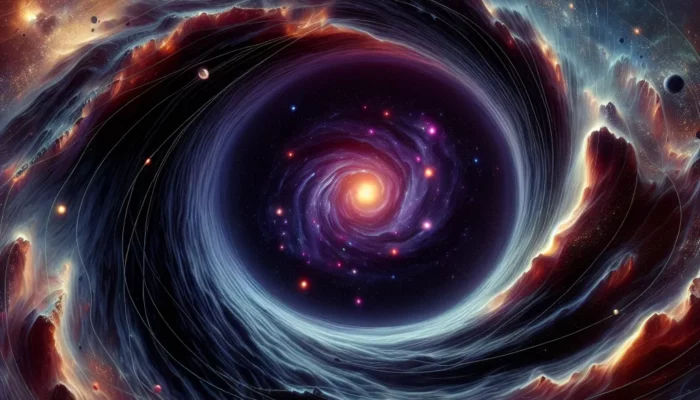
Dark matter is a mysterious and invisible form of matter that does not emit, absorb, or reflect light, making it undetectable through conventional electromagnetic observations. Despite its elusive nature, it is believed to constitute a significant fraction of the universe’s total mass, influencing the structure and evolution of cosmic systems through its gravitational effects.
- Nature:
Dark matter interacts primarily via gravity and possibly weakly through other forces, but it does not interact with electromagnetic radiation. - Cosmic Role:
It forms extensive halos around galaxies, affecting their rotation and the motion of galaxy clusters.
Historical Context and Galactic Evidence
The concept of dark matter originated from observations that challenged classical gravitational theories. When astronomers measured the rotational speeds of stars in galaxies, they found that stars far from galactic centers moved faster than expected based on visible matter alone. This discrepancy suggested the presence of an unseen mass component, leading to the hypothesis of a dark matter halo enveloping galaxies.
This evidence, however, primarily applies to large-scale cosmic structures, raising the question of whether dark matter can be detected within smaller, more localized environments such as our Solar System.

Dark Matter in the Solar System: Challenges and Considerations
Within the Solar System, gravitational interactions are dominated by the Sun, planets, moons, and smaller bodies like asteroids and comets. Observations and precise measurements of planetary orbits have consistently matched predictions from Newtonian mechanics and general relativity, without requiring additional gravitational sources.
This creates a paradox: if dark matter is abundant in the galaxy, why does it not produce noticeable effects on the scale of the Solar System?
- Low Local Density:
Dark matter density in the galactic halo is extremely low, approximately 0.3 GeV/cm³, which translates to a negligible gravitational influence within the Solar System’s volume. - Subtle Effects:
Any gravitational perturbations caused by dark matter are smaller than those induced by factors such as interplanetary dust or solar radiation pressure, making detection through orbital dynamics exceedingly difficult.
Methods for Detecting Dark Matter Locally
Given the difficulty of direct gravitational detection, researchers have developed alternative strategies to identify dark matter within or near the Solar System.
Particle Detection Experiments
Some theories propose that dark matter particles may interact weakly with ordinary matter beyond gravity. Experiments like the Cryogenic Dark Matter Search (CDMS) and XENON aim to detect rare interactions between dark matter particles and atomic nuclei by observing nuclear recoil events in highly sensitive detectors located underground or in space.
Orbital Anomalies and Spacecraft Tracking
Another approach involves scrutinizing minute deviations in the orbits of planets, especially the outer planets and trans-Neptunian objects. Unexplained perturbations could hint at localized concentrations of dark matter or exotic matter. Similarly, precise tracking of spacecraft trajectories using instruments such as accelerometers may reveal subtle gravitational influences indicative of dark matter clumps.
Dark Matter Substructures
Theoretical models suggest that dark matter may not be smoothly distributed but could form dense substructures or “clumps” due to early universe dynamics or galactic processes. If such clumps exist near the Solar System, they might leave detectable gravitational signatures on celestial bodies or spacecraft.
Scientific and Technological Challenges
Detecting dark matter within the Solar System is hindered by several factors:
- Signal Weakness:
Potential dark matter effects are extremely faint and easily masked by other astrophysical phenomena. - Measurement Precision:
Planetary ephemerides and spacecraft tracking data require continuous refinement to reduce uncertainties and isolate possible dark matter influences. - Complex Modeling:
Differentiating dark matter effects from known forces such as solar wind, gravitational perturbations from known bodies, and observational errors demands sophisticated analytical techniques.
Significance of Detecting Dark Matter in the Solar System
Confirming the presence of dark matter locally would represent a monumental breakthrough, linking cosmological theories with direct experimental evidence accessible within our cosmic neighborhood. It would deepen our understanding of the universe’s fundamental composition and the forces shaping it.
Moreover, the Solar System serves as a natural laboratory where the interplay between fundamental physics and observational astronomy can be explored with unprecedented precision. Success in this endeavor would not only validate dark matter models but also potentially reveal new physics beyond the current paradigms.
Common Misconceptions About Dark Matter Detection
Dark matter can be easily detected by its gravitational effects on planets.
The local density of dark matter is so low that its gravitational influence on planetary orbits is negligible compared to other forces.
Dark matter interacts strongly with ordinary matter.
Dark matter is believed to interact very weakly, if at all, with normal matter except through gravity, making direct detection extremely challenging.
Summary and Outlook
While the direct detection of dark matter within the Solar System remains elusive due to its sparse distribution and subtle effects, ongoing research employs innovative methods such as particle detection experiments and high-precision orbital analyses. These efforts continue to push the boundaries of current technology and scientific understanding.
The pursuit of dark matter detection close to home not only advances fundamental physics but also embodies humanity’s enduring quest to unravel the hidden fabric of the cosmos. As measurement techniques improve and theoretical models evolve, the Solar System may yet reveal the secrets of this enigmatic component of the universe.



Leave a Reply